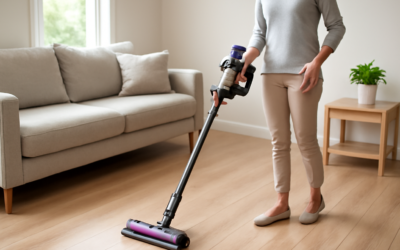
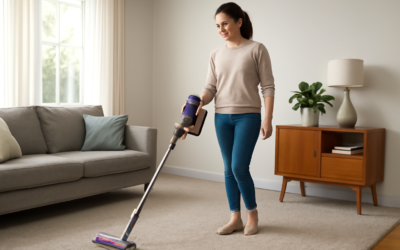
Upright vacuums have a steering problem: four fixed wheels force you to shove the machine back and forth in straight lanes. The Dyson Ball Multi Floor vacuum attacks that annoyance directly by mounting the motor inside a pivoting ball, letting the machine carve around chair legs with a twist of the wrist. It has been one of Dyson’s core corded uprights for years, sold in several trims (Multi Floor 2, Multi Floor Origin, and related variants). This guide covers what the machine actually does well, where it falls short, and how to keep one running for a decade.
What the Ball Multi Floor Is
At its core this is a bagless corded upright built around two signature Dyson technologies. Radial Root Cyclone separation spins incoming air through an array of small cyclones that fling dust out of the airstream before it reaches the filters — the reason Dyson bins can fill nearly to the line without the machine wheezing like a clogged bagged vacuum. Ball steering places the motor low inside the rolling sphere, dropping the center of gravity and letting the vacuum turn on a dime instead of pivoting on rear wheels.
Typical specs across recent Multi Floor trims: roughly 15 to 16 pounds, a bin capacity around 0.4 gallons, a cleaning path near 13 inches, a cord in the 30-foot range, and an instant-release wand and hose that stretch for stairs and cobwebs. Exact numbers vary slightly by version, so check the box for the trim you are buying.
Filtration and Air Quality
Dyson advertises whole-machine filtration on this line, meaning the machine is sealed so that air passes through the cyclone pack and filters rather than leaking around them — with the goal of trapping fine particles down to allergen size and expelling cleaner air. Two washable filters do the work: a pre-motor filter that lifts out of the ball area and a post-motor filter. Neither needs replacing on a schedule; you rinse them in cold water roughly once a month with regular use and let them air-dry for a full 24 hours before reinstalling. Running the vacuum with a damp filter is the most common way owners kill the motor, so dry them longer than feels necessary.
How It Performs on Different Floors
The “Multi Floor” name refers to the self-adjusting cleaner head, which raises and lowers the base plate automatically as you roll from carpet onto tile or hardwood. On medium-pile carpet the machine is a genuinely strong performer — the brush bar and high suction pull embedded grit that lighter cordless sticks leave behind. On hard floors, suction is excellent, though the brush bar on most Multi Floor trims cannot be switched off, so a few scattered large particles (cereal, cat litter) can get flicked forward before the head captures them.
- Low and medium carpet: excellent deep cleaning; visibly grooms the pile.
- High-pile or plush carpet: suction can be strong enough to make pushing difficult; crack the valve or expect a workout.
- Hardwood, tile, LVP: very good pickup of dust and fine debris.
- Area rugs: strong suction may lift lightweight rugs; stand on a corner or use slower strokes.
Honest Pros and Cons
After years on the market the Ball Multi Floor’s strengths and weaknesses are well established. In its favor: powerful, fade-free suction that does not drop as the bin fills; no bags or replacement filters to buy, which saves $20 to $60 per year versus bagged uprights; hygienic push-button bin emptying; agile steering; and Dyson’s 5-year parts-and-labor warranty on corded uprights, which is longer than most competitors offer.
Against it: at 15-plus pounds it is heavy to carry up stairs compared with an 8-pound cordless stick; the ball design gives it a tall head that will not slide under low furniture; it is loud, in the range typical of full-size uprights; the non-switchable brush bar is imperfect for delicate hard floors; and hose reach, while usable, is shorter and stiffer than a canister vacuum’s. None of these are dealbreakers, but they define who the machine suits: homes with substantial carpet that want maximum deep cleaning per dollar, not minimalist hard-floor apartments.
What It Costs
Street pricing moves around constantly with retailer promotions, but Multi Floor trims generally sell in the roughly $250 to $400 range new, with the Origin trim frequently discounted below $300 and refurbished units direct from Dyson often $100 or more under retail. That positions it against the Shark Navigator and Vertex uprights, which cost less, and Miele bagged canisters, which cost more. The value argument for the Dyson is the warranty length and zero consumables; the argument against is that budget uprights now clean carpet respectably for half the price.
Maintenance That Keeps It Alive
These machines routinely last 10 years, but only with basic upkeep. A simple routine:
- Empty the bin at or before the MAX line — overfilling chokes the cyclones.
- Wash both filters monthly in cold water only, no detergent; dry 24 hours.
- Cut hair and thread off the brush bar monthly with scissors or a seam ripper.
- Check the base plate and hose for clogs whenever suction drops; a flashlight and a broom handle clear most blockages.
- Wipe cyclone shroud mesh with a dry cloth — never submerge the cyclone pack or bin assembly with electronics.
If the machine pulses or the brush bar stops, it is almost always a blockage or a wrapped brush bar rather than a failure; the brush bar on most trims has a reset procedure in the manual.
Storage and handling habits matter too. Wrap the cord loosely rather than yanking it tight around the hooks, since cord strain at the base is a common long-term failure point on all corded uprights. Store the machine upright with the wand locked, and keep it out of damp garages where the electronics and filters absorb moisture. When something does break out of warranty, Dyson sells most parts individually — bins, hoses, cleaner heads, and filters are all user-replaceable with no tools beyond a coin, which is a genuine repairability advantage over glued-shut budget vacuums.
Who Should Buy One
Choose the Dyson Ball Multi Floor vacuum if your home is mostly carpet, you prefer one powerful corded machine over charging batteries, and you value a long warranty with no recurring costs. Skip it if you live in a small hard-floor space where a lightweight cordless stick handles daily cleanup, or if under-furniture reach is a priority. It is not the newest machine in Dyson’s lineup, and that is exactly why it is often the best value in it — proven engineering at a discounted price.
Prefer to explore on your own?
See how new flooring looks in your actual room in seconds — free, no signup.
Try the free Floor Studio →