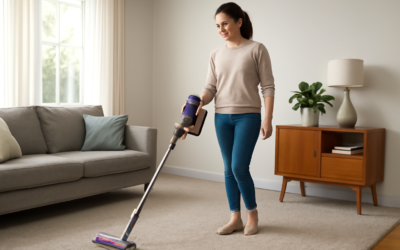
Hardwood floors look stunning until they get scratched by the wrong vacuum. Choosing the right Dyson hardwood floor vacuum prevents damage while picking up fine dust, pet hair, and debris that a broom pushes around. Dyson makes over a dozen cordless and corded models, and not all of them are safe for sealed wood surfaces. This guide breaks down the best options, the attachments that matter, and the settings you should actually use.
Why Dyson Works Well on Hardwood
Dyson vacuums use cyclonic suction technology that maintains consistent airflow without relying on aggressive bristle rollers. Many models ship with soft roller heads specifically designed for hard surfaces. These soft woven nylon and anti-static carbon fiber filaments pick up fine particles without scratching polyurethane, oil-finished, or waxed hardwood.
The key advantage over traditional uprights is adjustable suction. Running a Dyson V15 Detect on eco mode delivers around 30 minutes of runtime and gentle cleaning power that is perfect for daily maintenance on oak, maple, or walnut floors. Boost mode is reserved for carpets or deeply embedded grit in textured wood grain.
Best Dyson Models for Hardwood Floors
Not every Dyson is ideal for wood. Here are the top picks based on attachment options, weight, and suction control.
- Dyson V15 Detect — The flagship cordless model at around $750. Its laser slim fluffy cleaner head illuminates dust on hard floors so you can see exactly what you are picking up. A piezo sensor automatically adjusts suction based on particle count.
- Dyson V12 Detect Slim — Lighter at 5.2 lbs and priced near $650. Same laser detection as the V15 but in a more compact body, making it easier to maneuver under furniture.
- Dyson V8 Absolute — A budget-friendly option around $350 to $400. Includes the soft roller cleaner head and provides up to 40 minutes of fade-free suction on the lowest setting.
- Dyson Omni-glide — Designed exclusively for hard floors at roughly $300. Its omnidirectional fluffy cleaner head pivots flat and moves in every direction, reaching tight spots between furniture legs.
Essential Attachments for Wood Surfaces
The vacuum body is only half the equation. Attachments determine whether your Dyson hardwood floor routine protects or harms the finish.
- Soft roller cleaner head — Wrapped in soft woven nylon, this head is the non-negotiable for hardwood. It picks up large debris and fine dust simultaneously without stiff bristles.
- Articulating hard floor tool — A low-profile head that pivots to clean under beds and sofas where dust accumulates fastest.
- Crevice tool — Reaches between baseboards and floor edges where grit builds up and eventually gets kicked onto your wood surface.
- Mini soft dusting brush — Useful for spot-cleaning high-traffic areas and transitions between hardwood and area rugs.
Settings and Modes That Protect Hardwood
Running a Dyson on max power across hardwood is unnecessary and can wear down finish over time by driving abrasive particles into the surface before they get suctioned up. Start with eco or low mode for daily cleaning. This setting generates enough airflow to lift pet hair and fine dust without creating excessive friction.
If your model has auto mode, the vacuum adjusts suction in real time. On the V15 Detect, auto mode typically stays at low power on sealed hardwood and only ramps up when it encounters a rug or high-debris zone. For homes with engineered hardwood or thinner wear layers, sticking with eco mode provides the safest approach.
Common Mistakes to Avoid
Even a premium vacuum causes problems when used incorrectly on wood floors. Avoid these pitfalls.
- Using the motorized direct-drive head on hardwood — This attachment has stiff nylon bristles designed for carpet. It can leave micro-scratches on softer species like pine or fir.
- Skipping the filter maintenance — A clogged HEPA filter reduces suction, forcing you to increase power and make more passes. Wash Dyson filters monthly under cold water and let them air dry for 24 hours.
- Vacuuming over grit without pre-sweeping — Sand or small stones dragged by the roller head act like sandpaper. A quick dry dust mop pass before vacuuming prevents the most common scratch damage.
- Running boost mode on thin engineered hardwood — Excessive suction can lift edges on floating engineered floors, especially at seams that have started to separate.
Dyson vs Other Brands for Hardwood
Shark and Bissell both offer hardwood-friendly vacuums at lower price points, often $150 to $250. Where Dyson pulls ahead is build quality, sustained suction over the battery life, and the soft roller engineering. Shark’s DuoClean heads combine soft and bristle rollers, which works but still carries slightly more scratch risk than a dedicated fluffy head.
Roborock and iRobot Roomba models are popular for automated daily hardwood cleaning, but they lack the manual precision of a Dyson stick vacuum around furniture legs and corners. Many homeowners use a robot vacuum for daily upkeep and a Dyson for weekly deeper cleaning, covering both convenience and thoroughness.
Maintenance Tips for Long-Term Performance
A well-maintained Dyson lasts five to eight years with consistent suction. Empty the dustbin after every session rather than waiting for it to fill. Compressed dust reduces airflow efficiency and puts more strain on the motor. Check the soft roller head weekly for tangled hair, which wraps around the end caps and creates drag across your floor.
Replace the HEPA filter once a year even if you wash it monthly, since filtration efficiency degrades over time. Genuine Dyson replacement filters cost $30 to $40 and are worth the investment to maintain air quality and suction. Store the vacuum on a wall-mounted dock to keep it charged and ready, which also prevents the soft roller from developing flat spots on one side.
Which Dyson Should You Buy?
For homes that are mostly hardwood with a few area rugs, the Dyson V12 Detect Slim offers the best balance of weight, runtime, and floor protection. Its laser head reveals dust you would otherwise miss, and the slim form factor makes daily use less of a chore. If budget is a concern, the V8 Absolute with the soft roller head delivers reliable dyson hardwood floor cleaning at nearly half the cost of the V15.
Households with pets should lean toward the V15 Detect for its automatic suction adjustment and larger dustbin. Regardless of the model you choose, the soft roller cleaner head is the single most important factor for protecting your hardwood investment.
Prefer to explore on your own?
See how new flooring looks in your actual room in seconds — free, no signup.
Try the free Floor Studio →