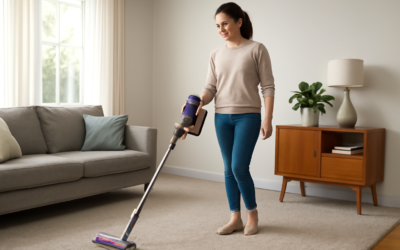
If you own hardwood floors and a Dyson vacuum, the dyson hardwood floor head is the single accessory that protects your investment the most. Hardwood refinishing can cost anywhere from 3 to 8 dollars per square foot, so a cleaning tool that lifts grit without scratching the finish pays for itself quickly. This guide explains exactly what the attachment is, how it works, which models include it, and how to get years of streak-free results.
What the Dyson Hardwood Floor Head Actually Is
Dyson sells several floor-cleaning heads, and the names can be confusing. The attachment most people mean when they say “hardwood floor head” is the soft roller cleaner head, sometimes branded as the Fluffy or Soft Roller. Instead of the stiff nylon bristles found on carpet-focused heads, it uses a single large roller wrapped in soft woven nylon and anti-static carbon fiber filaments.
That soft surface does two jobs at once. The woven nylon scoops up larger debris like cereal, pet kibble, and crumbs, while the carbon fiber strands capture fine dust and remove the static charge that makes dust cling to smooth surfaces. The result is a head designed specifically for hard, flat floors such as sealed hardwood, engineered wood, laminate, tile, and vinyl.
Why It Matters for Wood Floors
Standard vacuum beater bars and stiff-bristle heads are built to dig into carpet pile. On a wood surface, those same bristles drag trapped grit across the finish, leaving micro-scratches that dull the floor over time. The soft roller avoids this in two ways. First, the gentle material will not gouge the topcoat. Second, the roller actually makes contact with the floor and rolls debris forward into the suction path rather than flicking it sideways.
There is one more practical benefit. Because the roller is soft and continuous, the head can pick up both large and fine debris in a single pass. With a traditional head you often chase a piece of cereal around the room. The soft roller pulls it straight in.
Which Dyson Models Include It
The soft roller head has shipped with many Dyson cordless vacuums over the years, though exact inclusion varies by package and region. As a general rule:
- Dyson V7, V8, V10, V11, and V15 cordless vacuums have been offered in versions that include the soft roller head, especially “Absolute” trims.
- The newer Dyson Gen5detect and V15 Detect models include a soft roller head with a built-in laser that illuminates fine dust on the floor, making it easy to see what you have missed.
- Some “Animal” or “Motorhead” trims ship only with the carpet-oriented torque drive head, so the soft roller may need to be purchased separately.
Before buying, check the in-box accessory list for your specific model rather than assuming. If your vacuum did not include one, Dyson and third parties sell compatible soft roller heads, but confirm the connector matches your machine’s wand.
How to Use It Correctly
Getting the best results is mostly about technique. Follow these steps:
- Attach the head to the wand or directly to the machine until it clicks. Give it a gentle tug to confirm it is locked.
- On models with adjustable power, start in the lower or “eco” mode for sealed wood. Hardwood does not need maximum suction, and lower power extends runtime.
- Move slowly and let the roller do the work. A measured back-and-forth pass collects more than a fast sweep.
- If your head has a laser, dim the room slightly or close blinds so the illuminated dust is easier to see.
- Work toward your exit so you are not walking back across freshly cleaned floor.
Avoid running the soft roller over standing liquid or sticky spills. The woven material absorbs moisture and can streak, and a Dyson cordless is not a wet vacuum. Wipe wet messes by hand first.
Maintenance and Cleaning
The soft roller is the part of the head that needs the most attention, because hair and long fibers wrap around it. To keep performance high:
- Pop the roller out using the end-cap release, usually a coin-turn or lever, and pull off wrapped hair.
- Rinse the roller under cold water only. Never use detergent, and never put it in a dishwasher or washing machine.
- Squeeze gently, then stand it upright to air dry for at least 24 hours before reinstalling. Installing a damp roller can cause odor and streaking.
- Wipe the head housing and check the small wheels for trapped debris.
- Empty the vacuum bin frequently and wash the main filter on the schedule Dyson recommends, typically about once a month, since a clogged filter reduces suction at the head.
Common Problems and Fixes
If the head leaves debris behind, the roller may be saturated with dust or wrapped in hair, or the bin may be full. Clean the roller and empty the bin first. If the roller stops spinning, check for a hair jam at the end caps and make sure nothing is blocking the brush motor. Streaking on the floor almost always means the roller is dirty or was reinstalled while still damp.
A sudden drop in suction usually points to a clog in the wand or a filter that needs washing, not a fault in the head itself. Disconnect the head, look through the wand toward a light, and clear any blockage.
Is the Dyson Hardwood Floor Head Worth It?
For anyone with a meaningful amount of hard flooring, yes. The soft roller is gentler on finishes than a bristle head, picks up both fine and large debris in one pass, and is simple to maintain. If your model did not include one, adding it is one of the most worthwhile upgrades you can make for a home with wood, tile, or vinyl. Pair it with regular roller cleaning and timely filter washes, and it will keep your floors looking sharp for years.
The bottom line is straightforward. The right head turns a general-purpose vacuum into a tool that genuinely protects hard floors, and the soft roller is that head. Match it to your model, use a lower power setting on wood, keep the roller clean and dry, and you will get consistent, scratch-free results every time.
Prefer to explore on your own?
See how new flooring looks in your actual room in seconds — free, no signup.
Try the free Floor Studio →