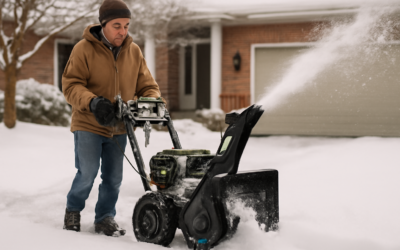
The old knock on electric snow blowers was that they were toys — fine for a dusting, useless in a real storm. An EGO electric snow blower put that idea to rest. Running on the same 56-volt battery platform that powers EGO’s mowers and chainsaws, these machines throw snow 35 to 50 feet, clear a foot of accumulation, and start instantly with a button in sub-zero cold — no gas, no oil, no yanking a frozen pull cord. For most driveways they now rival gas without the fumes or maintenance. This guide breaks down the lineup, the battery reality, and whether cordless is right for your winters.
- Why Cordless Changed the Game
- Single-Stage vs Two-Stage EGO Models
- The Battery Question
- Features Worth Having
- Electric vs Gas: The Honest Comparison
- Maintenance and Storage
- Understanding Throw Distance and Clearing Speed
- Cold-Weather Battery Tips
- Matching Runtime to Your Driveway Size
- Is It Right for Your Winter
Why Cordless Changed the Game
Gas snow blowers are powerful but miserable to own: they demand fuel stabilizer, oil changes, spark-plug swaps, and they often refuse to start on the coldest morning you actually need them. EGO’s battery system flips all of that. Push the button and it runs, every time, even at -20°F. There’s nothing to winterize, no fumes in the garage, and the noise drops from a roar to a manageable hum. For a suburban driveway, that convenience is the whole selling point.
The engineering that makes it possible is EGO’s high-output 56V ARC Lithium batteries and brushless motors, which deliver torque comparable to a mid-size gas engine as long as you feed them enough amp-hours.
Single-Stage vs Two-Stage EGO Models
EGO makes both, and the choice depends on your snow load and driveway:
- Single-stage (Power+ 21-inch): A 21-inch clearing width, throws snow up to 35 feet, and handles up to about 8 inches of accumulation. Ideal for flat paved driveways and lighter snowfall regions. Runs roughly $500 to $600 with batteries.
- Two-stage (Power+ 24-inch): A 24-inch width with an auger plus impeller design that chews through deep, heavy, and packed snow, throwing it up to 50 feet. Handles end-of-driveway plow piles and 12-plus inches. Runs $1,100 to $1,400 with batteries.
- Peak Power two-stage (28-inch): The heavy hitter, dual batteries and self-propelled drive for large driveways and serious snow country.
If you get occasional light snow, the 21-inch single-stage is plenty and far cheaper. If you’re in a snowbelt with regular deep storms and a long driveway, spend up for a two-stage.
The Battery Question
Runtime is the spec that makes or breaks an electric snow blower, and it depends on battery amp-hours and snow conditions. EGO batteries come in 5.0Ah, 7.5Ah, 10Ah, and 12Ah sizes. Deep wet snow drains them faster than dry powder.
- A single 7.5Ah battery clears a typical two-car driveway of moderate snow on one charge.
- Two batteries (many two-stage models run dual packs) roughly double runtime and can push through 20+ minutes of heavy clearing.
- Rapid chargers refill a battery in 40 to 60 minutes, so a spare pack means you never wait mid-storm.
The smart move: buy the machine with the largest included battery you can afford, and keep a charged spare in the garage. Cold weather also temporarily reduces capacity, so size up if you live somewhere brutal.
Features Worth Having
Beyond raw clearing power, a few features make the job easier:
- LED headlights — essential for early-morning or after-dark clearing.
- Chute control — a joystick or crank to aim the discharge quickly; the better models let you redirect on the fly.
- Steel auger on two-stage units for durability against gravel and ice.
- Self-propelled drive on larger models so you’re not muscling the machine through drifts.
- Foldable handle for compact off-season storage.
Electric vs Gas: The Honest Comparison
Cordless has clearly won for most homeowners, but gas still has a niche. Here’s the straight trade-off:
- Electric wins on: instant starting, zero maintenance, no fumes, quiet operation, and lighter weight.
- Gas wins on: unlimited runtime (just refuel), and slightly more brute force for extreme, sustained heavy snow over very large areas.
Unless you’re clearing a quarter-mile rural driveway after every storm, an EGO two-stage matches gas performance for the vast majority of residential jobs — and you’ll never fight a dead engine in January again.
Maintenance and Storage
The best part of electric is how little upkeep it needs. There’s no oil, fuel, or spark plug. Your whole maintenance list is short:
- Wipe the machine dry after each use so ice doesn’t build up and rust the auger.
- Check the scraper bar and skid shoes each season and replace when worn.
- Store batteries indoors between uses; don’t leave them in a freezing garage long-term.
- Keep the chute clear — always use the clearing tool, never your hand, to unclog it.
Understanding Throw Distance and Clearing Speed
Two performance numbers separate a good snow session from a frustrating one: throw distance and clearing rate. Throw distance — how far the machine flings snow — matters more than people expect, because a short throw means you’re constantly re-clearing snow that landed back on the driveway. EGO’s single-stage units throw roughly 35 feet, while the two-stage models reach up to 50 feet, letting you pile snow well clear of a wide driveway in one pass.
Clearing rate depends on width and intake height. A 21-inch single-stage clears a narrower path but moves quickly on lighter snow; a 24- or 28-inch two-stage takes bigger bites and handles the tall, dense piles a plow leaves at the end of your driveway. Match the width to your driveway size — an oversized machine on a small path just wastes battery and storage space, while an undersized one turns a 15-minute job into 45 minutes of overlapping passes.
Cold-Weather Battery Tips
Lithium batteries lose some capacity in the cold, which is the one quirk to manage with any electric snow blower. A little planning keeps runtime strong all winter:
- Store batteries indoors at room temperature and only bring them out to the machine when you’re ready to clear.
- Keep a fully charged spare or two on hand so you can swap and keep working through a big storm.
- Charge batteries indoors after use, not in a freezing garage — charging a cold pack is slower and harder on the cells.
- Clear snow promptly after it falls; fresh, fluffy snow is far easier on the battery than the wet, packed, or icy stuff that sits for a day.
Follow those habits and the cold-weather capacity dip becomes a minor footnote rather than a real limitation.
The shared-battery platform is the quiet financial argument for going with EGO. If you already own EGO’s mower, string trimmer, leaf blower, or chainsaw, the same 56V packs drop straight into the snow blower — meaning you may be able to buy the “bare tool” version without batteries and save $200 or more. That cross-tool compatibility spreads the cost of the expensive batteries across your whole yard-care lineup and is a big reason homeowners standardize on one cordless ecosystem rather than mixing brands.
Matching Runtime to Your Driveway Size
The most useful question before buying is how much clearing you can finish on one set of batteries, because that dictates how many amp-hours you need. As a working estimate, a single 7.5Ah pack clears roughly 15 to 20 car-lengths of moderate 6-inch snow before it needs a swap, while deep, wet 12-inch piles can cut that in half. Translate that to your own driveway and buy accordingly:
- Short two-car driveway (under 600 square feet): a 21-inch single-stage with one 7.5Ah or 10Ah battery finishes in a single charge.
- Standard suburban driveway (600 to 1,200 square feet): a 24-inch two-stage on dual 5.0Ah or 7.5Ah packs handles it, with a spare pack for the heaviest storms.
- Long or sloped driveway (over 1,200 square feet): the 28-inch Peak Power self-propelled model on dual 10Ah or 12Ah batteries, plus a charged backup set on the shelf.
Because a rapid charger refills a pack in 40 to 60 minutes, a single spare battery effectively doubles your working window — start on one set, swap to the charged spare, and the first set is ready again before the second runs down on all but the longest driveways.
Is It Right for Your Winter
For a suburban driveway in a moderate-to-heavy snow region, an EGO electric snow blower delivers gas-class clearing with none of the gas-class headaches — it starts every time, needs almost no maintenance, and runs clean and quiet. Match the model to your snow load, buy the biggest battery you can and a charged spare, and you’ll clear your driveway faster and with far less hassle than the smoking, stubborn gas machine it replaces.