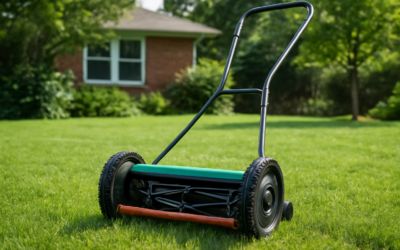
Golf course greens look the way they do because they are cut with reels, not spinning blades. An electric reel mower brings that scissor-style cut to a home lawn, using a battery to spin the reel instead of relying on your pushing speed. It shines on small, flat, well-kept lawns with fine-bladed grasses, and it struggles with tall, weedy or bumpy yards.
Here is the short answer. If your lawn is under roughly a quarter acre, fairly level, and planted with grasses that like a low cut (such as Bermuda, zoysia or bentgrass), a powered reel mower can deliver a cleaner, healthier-looking cut than a rotary mower. If you have thick tall fescue kept at 3 to 4 inches, rough ground, sticks and pine cones, or you often let the grass get long between mowings, a rotary mower is usually the better fit.
- How an Electric Reel Mower Works
- Powered Reel vs Manual Reel vs Rotary
- Grass Types and Lawn Sizes That Suit Reel Mowing
- Cut-Height Limits
- Step-by-Step: Mowing With a Powered Reel
- Sharpening and Backlapping the Reel
- Battery Storage and Care
- Troubleshooting
- General Cost Ranges
- When to Call a Pro
- Frequently Asked Questions
The rest comes down to cut height, lawn size, blade care and battery storage. Each of those gets a closer look here so you can decide whether a cordless reel mower belongs in your garage.
How an Electric Reel Mower Works
A reel mower uses a spinning cylinder of curved blades that pulls grass against a fixed bedknife, snipping it cleanly like scissors. On a manual reel mower, the wheels drive the reel, so the cut quality depends on how fast and steadily you push. An electric reel mower adds a battery-powered motor that spins the reel at a constant speed, and some models also power the wheels.
That constant reel speed is the main advantage. You get a consistent cut even when you slow down at corners, and the motor helps the reel chew through slightly thicker patches that would stall a push reel. A rotary mower, by comparison, uses a single blade spinning horizontally at high speed to tear grass off, which works on almost any lawn but leaves more ragged tips.
Powered Reel vs Manual Reel vs Rotary
| Feature | Powered reel | Manual reel | Rotary |
|---|---|---|---|
| Cut quality | Very clean, even | Clean if pushed steadily | Good, rougher tips |
| Best lawn size | Small to medium, flat | Very small, flat | Any |
| Tall or rough grass | Limited | Poor | Strong |
| Noise | Quiet | Very quiet | Louder |
| Upkeep | Reel sharpening, battery care | Reel sharpening | Blade sharpening, battery or engine care |
Buyers searching for the best powered reel mower usually want something between a quiet manual push reel and a full rotary. Think of the powered reel as a specialist tool: excellent on the right lawn, frustrating on the wrong one.
Grass Types and Lawn Sizes That Suit Reel Mowing
Reel mowers do their best work on grasses that are healthiest when cut low and often.
- Great fits: Bermuda, zoysia, bentgrass, and fine fescues kept short.
- Workable: Kentucky bluegrass and perennial ryegrass at moderate heights, if the mower adjusts high enough.
- Poor fits: tall fescue kept at 3.5 to 4 inches, St. Augustine with thick stolons, and lawns with lots of tall weeds or seed heads.
Lawn size matters because of battery run time and the narrower cut width of most reel mowers. Many models cut a swath of about 14 to 20 inches. For lawns up to about a quarter acre, one or two batteries usually cover the job. Beyond that, mowing time adds up and a wider rotary is more practical.
Terrain matters too. Reels ride close to the ground, so bumps, holes and slopes cause scalping. Flat, smooth, well-leveled yards give the best results.
Cut-Height Limits
Every reel mower has a height range, and many top out lower than rotary mowers. Typical ranges run from well under an inch to around 2.5 or 3 inches, depending on the model. Check the maximum height before you buy if your grass type prefers a taller cut.
Reel mowers also struggle when grass is more than about a third taller than the cut height. Plan to mow frequently, often twice a week during peak growth for warm-season grasses cut short. If you fall behind, raise the height for one pass, then lower it on the next mowing. Following the one-third rule keeps the lawn healthy and the reel happy.
Step-by-Step: Mowing With a Powered Reel
- Clear the lawn. Pick up sticks, pine cones, nuts, toys and stones. Reels jam or nick on debris a rotary would throw.
- Charge the battery fully and check the cut height on both sides.
- Mow when the grass is dry. Wet grass clumps and smears across the bedknife.
- Walk at a steady pace in straight lines, overlapping each pass by a few inches.
- Alternate directions each time you mow to prevent ruts and grain.
- Empty the catcher when used, or leave fine clippings on the lawn if the model mulches.
- Clean the reel with a brush after mowing, with the battery removed.
Always remove the battery or safety key before clearing a jam or touching the reel. The blades are sharp, and a powered reel can move unexpectedly if the motor engages.
Sharpening and Backlapping the Reel
Reel mowers depend on a precise edge between the reel blades and the bedknife. When the cut gets ragged or grass folds instead of snipping, it is time for maintenance.
Adjusting Reel-to-Bedknife Contact
Start by checking the contact. Many mowers let you adjust the bedknife with screws on each side. The goal is light, even contact across the full width: the reel should cut a strip of paper cleanly along the whole blade without heavy dragging. Adjust in small increments and test often.
Backlapping
Backlapping is the standard way to restore a reel’s edge at home. With the battery removed, you apply a lapping compound to the reel blades and spin the reel backward against the bedknife (by hand crank or a drill adapter, depending on the model and kit). The compound hones both edges so they meet cleanly again. Wear gloves and eye protection, follow the mower maker’s instructions, and wipe off all compound when finished.
Most owners backlap once or twice a season. A reel with deep nicks, a bent blade or a badly worn bedknife needs professional grinding, which a mower shop can handle.
Battery Storage and Care
Lithium-ion batteries last longest with a little attention:
- Store batteries indoors in a cool, dry spot, not in a hot shed or a freezing garage.
- For winter storage, leave the battery partly charged (many makers suggest around 40 to 60 percent) rather than full or empty.
- Use only the charger made for that battery, and charge on a hard, non-flammable surface away from clutter.
- Stop using any battery that is swollen, cracked, leaking or overheating, and recycle it through a battery drop-off program.
- Keep contacts clean and dry.
Troubleshooting
Grass is folded, not cut. The reel is dull or not touching the bedknife. Adjust contact, then backlap if needed.
Streaks or uncut strips. Contact is uneven from side to side, or you are not overlapping passes. Readjust and overlap more.
Scalped spots. The lawn is uneven or the height is too low. Raise the cut and consider topdressing low spots.
Motor stalls. Grass is too tall or wet, or debris is jammed in the reel. Remove the battery, clear the reel, and mow at a higher setting.
Short run time. The battery is aging or cold. Store it warmer and consider a second battery.
General Cost Ranges
Manual reel mowers are the least expensive option. Powered reel mowers typically cost more than basic cordless rotary mowers because of their precision reels, and extra batteries add to the total. Backlapping kits are inexpensive, and professional reel grinding is a modest periodic service cost. Over time, a powered reel mower has low running costs: no fuel, no oil changes and minimal noise.
When to Call a Pro
Take the mower to a small-engine or mower shop if the reel has deep nicks, a bent blade, a damaged bedknife, or a motor fault. For large, sloped or rough lawns, a lawn care pro can advise whether leveling, topdressing or a different mower makes more sense. Chosen for the right lawn, an electric reel mower rewards you with a quiet, clean, carpet-like finish.
Frequently Asked Questions
Is an electric reel mower better than a rotary mower?
On small, flat lawns with fine grasses cut short, it gives a cleaner cut. On tall, rough or large lawns, a rotary mower handles conditions better.
What grass types work best with reel mowers?
Bermuda, zoysia, bentgrass and fine fescues kept low are ideal. Tall fescue kept at 3.5 inches or more is usually a poor match.
How often should I backlap a reel mower?
Once or twice per mowing season for most homeowners, or whenever the cut turns ragged and adjustment alone does not fix it.
Can a powered reel mower cut tall grass?
Only in a limited way. Keep to the one-third rule, mow often, and raise the height for one pass if the grass has grown long.
How should I store the mower battery in winter?
Store it indoors in a cool, dry place, partly charged, and away from heat sources. Check the charge once or twice over the off-season.