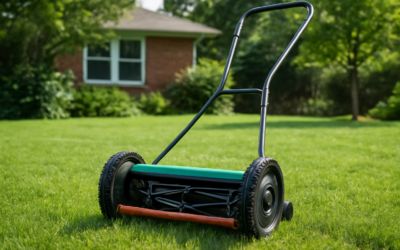
There is a quiet revolution happening in small-yard maintenance, and it runs on nothing but your own two feet. The Scotts 14 in. manual lawn mower is a reel-type push mower that cuts grass with a scissor action instead of a spinning engine blade, and for the right yard it is genuinely better than a gas machine. No fuel, no oil changes, no pull cord, no noise, and it starts every single time. This guide covers exactly how it works, what size lawn it suits, how to keep the blades cutting cleanly, and whether the trade-offs make sense for you.
We will look at the cutting mechanism, height settings, real-world performance on different grass types, and honest limitations so you buy with clear expectations.
How a Reel Mower Cuts
Unlike a rotary mower that tears grass with a fast-spinning horizontal blade, a reel mower works like a pair of scissors. Five curved blades on a rotating cylinder sweep past a fixed cutting bar, called the bed knife, slicing each blade of grass cleanly. That clean cut is the reel mower’s biggest agronomic advantage.
A rotary blade actually tears the grass tip, leaving a ragged edge that browns and invites disease. The scissor action of the Scotts 14 in. manual lawn mower leaves a clean, healthy cut that heals faster and looks crisper. Golf courses use reel mowers for exactly this reason. On a healthy, regularly mowed lawn, the quality of cut rivals machines costing ten times as much.
Key Specifications
The Scotts 14-inch model is a compact, lightweight machine built for maneuverability. Here are the specs that matter.
- Cutting width: 14 inches per pass
- Blades: 5 heat-treated alloy steel blades on the reel
- Cutting height: adjustable roughly 1 to 2.5 inches
- Wheels: 8.5-inch diameter for easier pushing
- Weight: around 20 to 27 pounds, easy to carry and store
- Power source: human-powered, zero emissions
The 14-inch width is narrower than a typical 20- or 21-inch gas mower, which means more passes on a given area but easier steering around obstacles and tight spaces. That trade defines who this mower is for.
Who It’s Right For
The reel mower is not for everyone, and being honest about that saves buyers from disappointment. It excels on small, flat lawns under 4,000 square feet with grass that gets mowed regularly. City lots, townhome yards, and small suburban front lawns are its sweet spot.
If you have a quarter-acre or larger, thick tall fescue, or a lawn you let grow long between cuts, a reel mower will frustrate you. It struggles to cut grass over about 3 inches tall and cannot handle woody weeds or heavy growth. The ideal owner mows once or twice a week during peak season, keeping the grass at a manageable height where the reel glides through effortlessly. Consistency is the whole game with a reel mower.
Setting the Cutting Height
Cutting height is controlled by adjusting the wheels or a height lever, and getting it right matters more on a reel mower than a rotary. Most cool-season grasses do best cut at 2 to 2.5 inches, while Bermuda and other warm-season grasses tolerate a lower 1 to 1.5 inches.
Set the height on the higher end if your lawn has any unevenness, since a reel mower cuts what the bed knife reaches and can scalp high spots. Adjust both sides evenly so the reel sits level. A quick way to check is to measure from the flat ground to the bed knife on each side with a tape measure before you start.
Blade Maintenance and Sharpening
A reel mower cuts beautifully when sharp and simply pushes grass over when dull. Fortunately, maintenance is minimal and infrequent compared to a gas engine.
- The reel-to-bed-knife contact should be light, with just a whisper of drag
- Test the cut by slipping a strip of newspaper between reel and bed knife; it should slice cleanly
- Backlapping with a lapping compound restores the edge once a season
- Keep the reel free of grass buildup and lightly oil the axle bearings
Backlapping is the reel-mower equivalent of sharpening, and it is a simple 20-minute job. You apply a gritty compound to the blades and turn the reel backward with a crank or drill until the edges are honed. Do this once each spring and the mower cuts like new all season.
Real-World Performance
On a well-kept lawn cut regularly, the Scotts 14-inch delivers a clean, quiet cut with a satisfying whir. The lack of noise means you can mow early Sunday morning without a neighbor complaint, and the lack of exhaust means no fumes in your face. It weighs little enough to hang on a garage wall hook.
The honest limits show up with tall grass, dandelion stems, and any twig or debris that jams between the blades. Reel mowers do not mulch leaves well and will not cut wet, matted grass cleanly. Rake up sticks and pinecones before mowing, and mow before the grass gets ahead of you. Manage those conditions and it performs admirably. Ignore them and it will feel like hard work.
Cost and Value
Priced around $80 to $120, the Scotts 14 in. manual lawn mower costs a fraction of a gas or battery mower and eliminates fuel, oil, tune-ups, and battery replacement entirely. Over five years, the savings on gas and maintenance alone can exceed the purchase price.
For a small-yard homeowner who values quiet, clean air, light exercise, and near-zero maintenance, it is an easy recommendation. It is also a smart secondary mower for trimming tight areas even if you own a larger machine. Just match it to the right lawn, keep the grass at a steady height, and backlap the blades each spring. Do that, and this simple, elegant tool will outlast several gas mowers.
Health and Environmental Benefits
Beyond the crisp cut, a reel mower delivers benefits that gas and even electric mowers cannot. Pushing it is genuine low-impact exercise, burning around 200 to 300 calories in a half hour of mowing, roughly the same as a brisk walk. You get your yard work and a workout in one.
The environmental case is equally strong. A reel mower produces zero emissions, uses no gasoline or electricity, and makes almost no noise beyond a soft whir. Gas mowers are surprisingly heavy polluters for their size, lacking the emission controls cars have, so replacing one with a reel mower on a small lawn eliminates a real source of air pollution. There is no fuel to buy, store, or spill, no oil to change and dispose of, and nothing to plug in or charge. For anyone trying to shrink their carbon footprint, the reel mower is about as green as lawn care gets.
Tips for the Best Results
A reel mower rewards good technique and consistent habits. Follow these practices and you will get golf-course-quality results from a simple tool.
- Mow frequently, ideally twice a week during peak growth, so grass never gets ahead of the reel
- Mow when the grass is dry; wet grass mats down and slips past the blades
- Walk at a steady, brisk pace, since the reel spins faster and cuts cleaner with momentum
- Overlap your passes slightly to avoid leaving uncut strips
- Clear sticks, stones, and pinecones before you start to prevent jams
- Backlap the blades each spring and keep the axle bearings lightly oiled
The single biggest factor in reel-mower satisfaction is mowing frequency. Owners who cut on a regular schedule love their machines, while those who let the lawn grow tall between cuts find it frustrating. Keep the grass short and the reel does the rest with ease.