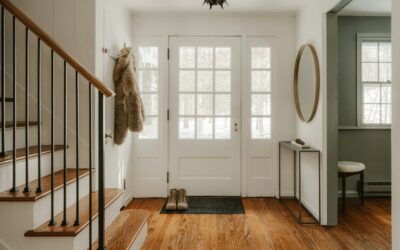
Your entryway is the handshake of your home. It’s the first thing guests see and the last thing you pass on the way out, yet it’s often the most neglected wall in the house. The right entryway paint colors set the mood for everything beyond, make a cramped foyer feel welcoming, and tie your interior to your front door in a way that reads as intentional rather than accidental. Whether you have a grand two-story foyer or a slim strip of wall by the front door, this guide walks through the colors that work, why they work, and how to choose the right one for your light and layout.
Part of our Paint & Walls guide — explore the full guide →
- Why the Entryway Deserves Special Attention
- Warm Neutrals: The Safe, Welcoming Choice
- Bold and Dark Colors for Drama
- Cheerful Colors to Brighten the Welcome
- Matching Color to Your Light and Space
- Coordinating With Trim, Door, and Adjoining Rooms
- Sheen and Durability for a High-Traffic Zone
- Small vs Large Entryways
- Finishing Touches That Complete the Look
- Putting It All Together
Why the Entryway Deserves Special Attention
Entryways carry a heavy design load for their size. They transition guests from outside to inside, preview your home’s style, and often connect to multiple other rooms, which means the color has to play well with everything it touches. A foyer painted a flat builder white feels like an afterthought; the same space in a warm greige or a moody navy feels considered and inviting.
Because entries are usually small and see hard use, from bumped walls to scuffs near the door, color and finish choices matter more here than in a large open room. The upside is that a small square footage means premium paint and even bold color cost very little to try.
Warm Neutrals: The Safe, Welcoming Choice
If your entry connects to several rooms or you want a timeless backdrop, warm neutrals are the reliable path. They feel inviting rather than sterile and flatter both natural and artificial light.
- Greige: The gray-beige hybrid is the modern default. Sherwin-Williams Accessible Beige and Agreeable Gray give entries a soft, adaptable warmth that pairs with nearly any adjoining room.
- Warm white: Benjamin Moore White Dove and Swiss Coffee bring a creamy, airy feel that brightens dark foyers without going cold.
- Soft taupe: A step warmer than greige, taupe adds a cozy, grounded feeling that suits traditional and transitional homes.
Warm neutrals photograph beautifully, hide minor scuffs, and rarely clash with flooring or furnishings you already own. They’re the “can’t go wrong” answer when the entry opens onto many other colors.
Bold and Dark Colors for Drama
Small entries are the perfect place to be brave. A saturated or dark color that might overwhelm a large living room turns a compact foyer into a jewel-box moment guests remember. Deep colors also cleverly disguise scuffs and fingerprints in a high-traffic zone.
Navy is a perennial favorite. Benjamin Moore Hale Navy and Sherwin-Williams Naval wrap an entry in confident, classic depth that pairs stunningly with white trim and warm wood floors. Deep greens like Sherwin-Williams Pewter Green and Benjamin Moore Essex Green bring an organic, sophisticated calm. For maximum drama, charcoal and near-black shades such as Benjamin Moore Wrought Iron or Sherwin-Williams Iron Ore turn a foyer into a striking, gallery-like space, especially with good lighting and a statement mirror.
Cheerful Colors to Brighten the Welcome
Not every entry wants to be moody. If your goal is a bright, happy hello, lean into softer color with personality. A pale, sunny yellow like Benjamin Moore Hawthorne Yellow gives a traditional foyer a warm glow that’s especially welcoming in homes with limited natural light. Soft blues and blue-greens, such as Sherwin-Williams Sea Salt, read fresh and coastal without shouting.
Muted terracotta, blush, and warm clay tones have surged in popularity for entries because they feel both current and comforting. These earthier warm colors flatter skin tones (handy for the mirror-check on your way out) and pair naturally with woven rugs, wood consoles, and greenery.
Matching Color to Your Light and Space
The single most common paint mistake is ignoring the room’s light, and entries are notorious for having little of it. Before you commit, account for these factors. A dark, north-facing, or windowless foyer benefits from warm, light colors that bounce what light there is, or from a deliberately dark color that embraces the coziness rather than fighting it. A bright entry with a glass door or sidelights can carry cooler and bolder shades without feeling gloomy.
Always test before you buy gallons. Paint a two-foot square on the main wall, or use a large sample board, and observe it in morning, afternoon, and evening light and under your entry’s actual light fixtures. Colors shift dramatically between daylight and warm bulbs, and a shade that looks perfect at the store can turn muddy or garish on your wall.
Coordinating With Trim, Door, and Adjoining Rooms
An entry never stands alone, so plan its color in context. Think of three connected surfaces: the walls, the trim and doors, and whatever rooms are visible from the foyer. A crisp white trim (Benjamin Moore Chantilly Lace is a go-to) sharpens any wall color and keeps the space feeling clean. Painting the interior of the front door a contrasting color, like a deep green or black against pale walls, adds an unexpected designer touch.
Make sure the entry color transitions gracefully into adjacent rooms. If your living room is a soft greige, an entry in a complementary navy or a deeper tone of the same neutral family creates flow rather than a jarring cutoff. When rooms are open to each other, pick colors that share an undertone (all warm or all cool) so the eye moves smoothly from one to the next.
Sheen and Durability for a High-Traffic Zone
Entries take a beating from hands, shoes, bags, and weather tracked in from outside, so finish matters. Flat paint shows every scuff and can’t be scrubbed, making it a poor pick here. Reach for eggshell or satin on the walls, which wipe clean and hide minor imperfections while keeping a soft look. Use semi-gloss on trim, doors, and any wainscoting, since it’s the most washable and stands up to constant contact.
Choose a quality washable paint (many premium lines are formulated for scrubbing) so you can wipe away the inevitable marks without burnishing the finish. A durable sheen keeps your carefully chosen color looking fresh for years instead of dingy within months.
Small vs Large Entryways
The size and shape of your entry should steer the color as much as your style does. A small foyer or a narrow strip of wall by the front door actually benefits from a bold or dark color, since the compact space makes drama feel like a jewel box rather than an overwhelming commitment. Deep navy, charcoal, or forest green in a tiny entry reads as intentional and rich, and the small square footage keeps the paint cost trivial.
A large, two-story foyer plays by different rules. Big walls of a very dark color can feel heavy and cavernous, so consider a warm mid-tone or a light neutral to keep the space airy, reserving deeper color for an accent like the stair wall or the front-door interior. In grand entries, you can also use color to define scale, painting the lower level a warm neutral and adding architectural interest with wainscoting or a two-tone treatment. Match the intensity of the color to the intimacy of the space, and both small and large entries land beautifully.
Finishing Touches That Complete the Look
Paint sets the stage, but a few finishing details turn an entry from painted to polished. Good lighting is essential, since even the perfect color falls flat in a dim foyer; a statement pendant, a pair of wall sconces, or a well-placed lamp makes the color glow and the space feel welcoming. A large mirror amplifies both light and the sense of space while giving you a spot for the final glance on your way out.
Layer in warmth with a runner or entry rug, a console table, and a piece of art or a gallery wall that plays off your paint color. If you painted the walls a bold shade, keep the trim crisp white to frame it, and consider echoing the wall color on the front-door interior for a cohesive, designed feel. These touches don’t cost much, but together with the right paint they transform the entryway into a space that genuinely says welcome the moment the door swings open.
Putting It All Together
The best entryway paint colors balance welcome, style, and durability for the space that greets everyone who walks in. Play it safe and versatile with a warm greige or creamy white, make a statement with navy, deep green, or charcoal in a small foyer, or brighten a dark entry with soft yellow or an earthy terracotta. Test your top picks in real light, coordinate with your trim, door, and neighboring rooms, and choose a washable eggshell or satin finish. Get those elements right and your entryway will make a confident first impression every single time the door opens.