
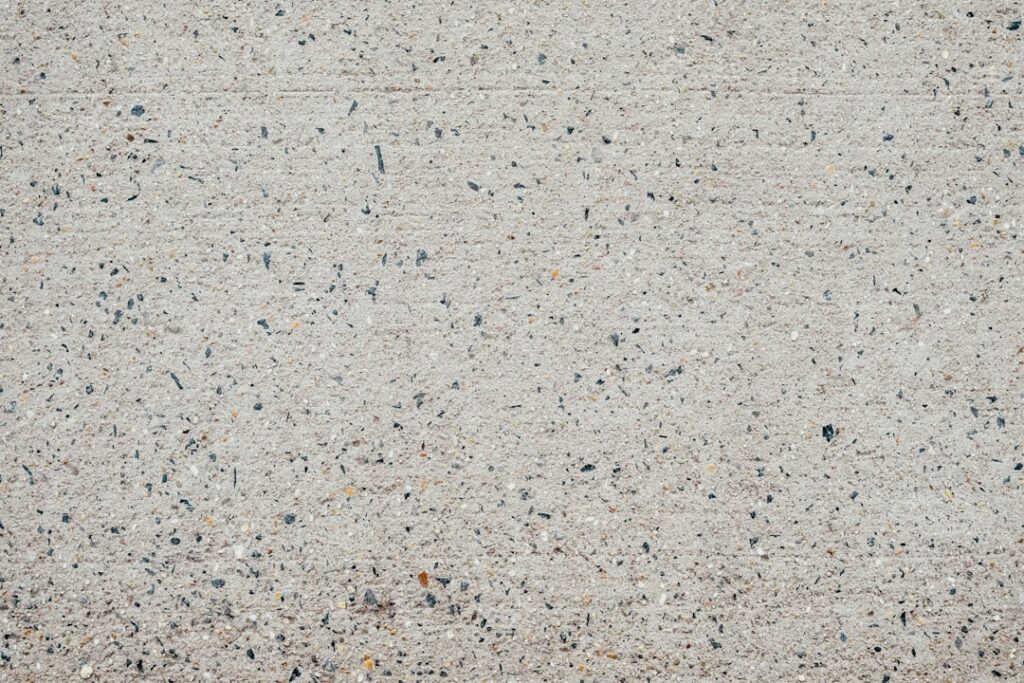
The most durable decorative finish in concrete isn’t something added to the surface — it’s something revealed from inside it. Exposed aggregate concrete strips away the top skin of cement paste to expose the stones within, turning a plain gray slab into a textured surface of river pebbles, granite chips, or crushed quartz. It’s been paving driveways and pool decks since the 1910s for a simple reason: the finish is the structure, so it can’t peel, chip off, or wear through like a coating. Here’s how the finish is created, what it costs, and how to keep it looking sharp for decades.
- What Exposed Aggregate Actually Is
- Method 1: Integral Exposure
- Method 2: Seeding
- The Wash: How the Stone Gets Revealed
- What Exposed Aggregate Costs
- Choosing the Stone: Color, Size, and Source
- Sealing: Not Optional
- DIY or Hire It Out?
- Maintenance and Long-Term Durability
- What Drives the Cost for Exposed Aggregate Concrete
What Exposed Aggregate Actually Is
Every slab is full of stone — normally hidden under a quarter inch of troweled cement cream. An exposed aggregate finish removes that cream at the surface, leaving the tops of the stones standing slightly proud in a matrix of hardened paste. The look depends entirely on the rock: warm brown river gravel reads traditional, black basalt and gray granite read modern, and crushed glass or white quartzite reads high-end architectural. Stone size matters too — 3/8-inch pea gravel gives a fine, foot-friendly texture for pool decks, while 3/4-inch cobble reads bolder from the curb.
Beyond looks, the texture solves a real problem: traction. Exposed aggregate is one of the most slip-resistant finishes you can put around a pool or on a sloped driveway, wet or dry, without the harshness of heavy brooming.
Method 1: Integral Exposure
The classic approach uses decorative stone batched through the entire mix. The plant substitutes your chosen aggregate for standard gravel, the crew pours and floats the slab normally (no hard troweling), and the surface is then treated so the top layer of paste can be removed. It’s the simplest method and the stone runs full-depth — chips and wear never expose anything different underneath. The trade-off is cost: you’re paying decorative-stone prices for the whole slab, including the 90 percent nobody sees, which adds $20 to $40 per yard to the mix.
Method 2: Seeding
Seeding puts premium stone only where it shows. The crew pours a standard slab, screeds it slightly low, then broadcasts decorative aggregate evenly across the fresh surface by shovel or hand — about 50 pounds per 25 sq ft. The stones get pressed in with a bull float or roller until a thin film of paste closes over them, then the surface is exposed like any other method. Seeding unlocks exotic stone (polished black pebbles, glass, shells) at reasonable cost, since a $30 bag of specialty aggregate covers what would cost hundreds batched integrally. The skill requirement is real, though: uneven broadcasting shows forever, and stones seeded too late sit proud and pop out within a year.
The Wash: How the Stone Gets Revealed
Timing the exposure is the make-or-break step. Most crews spray a surface retarder (such as Top-Cast or Rugasol, $30 to $50 per gallon) onto the fresh slab right after finishing. The retarder stalls the cure of the top 1/16 to 3/8 inch of paste while the slab below hardens normally. The next morning — typically 12 to 24 hours later — the crew washes and soft-brushes the surface, and the un-set cream rinses away to reveal the stone. Depth of exposure is controlled by which retarder grade was sprayed, which is why modern jobs look so consistent.
The old-school alternative skips the chemical: watch the slab, and scrub-wash at the exact window when the paste is firm but removable — usually 4 to 8 hours in, shifting with temperature. It works, and plenty of veteran finishers still do it, but the window is unforgiving. Wash early and stones dislodge; wash late and you’re renting a pressure washer or acid-etching to fix it. A third route, abrasive blasting after full cure, produces a flatter, matte exposure used more in commercial work.
What Exposed Aggregate Costs
Expect to pay a meaningful but not extravagant premium over plain gray:
- Standard broom-finish concrete: $6 – $10 per sq ft installed
- Exposed aggregate, integral with local stone: $9 – $13 per sq ft
- Seeded with premium or imported stone: $12 – $18 per sq ft
- Multiple stone colors, borders, or combined decorative finishes: $15 – $22 per sq ft
A typical 600 sq ft exposed aggregate driveway lands between $5,500 and $8,500. That sits below stamped work on average — and if you’re weighing the two looks side by side, our guide to stamped concrete patterns covers what patterned finishes offer where exposed aggregate can’t go.
Choosing the Stone: Color, Size, and Source
The aggregate decision deserves more attention than most homeowners give it, because it’s permanent in a way paint and stain never are. Start local: your ready-mix plant’s native decorative stone — often a tan-and-brown river gravel — is the cheapest option and weathers naturally into the landscape. Stepping up, suppliers stock regional specialties like Northwest black basalt, Midwest rose quartz blends, and imported polished pebbles sold by the 50-pound bag for seeding. Ask to see a cured sample panel, not a handful of dry stone; aggregate reads dramatically darker and richer under sealer than in the bag.
Size drives both look and comfort. For barefoot zones — pool decks, patios — stay at 3/8 inch or smaller and specify rounded (not crushed) stone; angular crushed rock at larger sizes is genuinely unpleasant underfoot. Driveways and walkways can carry 1/2- to 3/4-inch stone for a bolder read from the street. Many contractors will pour a 2×2-foot mockup for $100 to $200 before the main pour, and on a $7,000 driveway that’s the best-spent money on the job.
Sealing: Not Optional
Exposure leaves millions of tiny paste edges gripping each stone, and sealer is what keeps them gripping. Within a few weeks of the wash (after the slab dries), apply a solvent-based acrylic sealer — two thin coats, about $40 to $60 per 5-gallon pail covering 700 to 1,000 sq ft. The sealer locks stones in place, blocks water and deicing salt from attacking the matrix, and wet-looks the color of the rock, which is half the reason people choose this finish. Plan on resealing every 2 to 3 years for driveways, 3 to 5 for patios. A gloss additive with anti-slip grit (like SharkGrip) keeps pool decks from turning slick under sealer.
Skip sealing and the failure pattern is predictable: stones start popping loose along wheel paths within a few winters, and freeze-thaw plus salt slowly erodes the paste until the surface sheds gravel like a country road.
DIY or Hire It Out?
Exposed aggregate sits near the top of the concrete-finish difficulty ladder, and the failure mode is permanent. A homeowner with solid flatwork experience can manage a small seeded stepping-stone project or a garden pad using retarder and careful timing. A driveway or patio is a different animal: the crew is placing, seeding, floating, and spraying retarder across hundreds of square feet inside a shrinking weather window, and a blown exposure — washed too deep, too shallow, or unevenly — can’t be re-troweled away. Professional exposed-aggregate crews carry the retarder experience, the washing equipment, and crucially the judgment about timing that only comes from dozens of pours. Pay the $3 to $6 per square foot premium on any surface you’ll look at from the kitchen window for the next thirty years.
Maintenance and Long-Term Durability
Day to day, the finish asks little — hose it down, sweep it, and avoid deicing salts the first two winters. Individual popped stones can be re-glued with exterior epoxy, and a faded surface revives dramatically with a pressure wash and fresh sealer. Done right, an exposed aggregate slab is a 30- to 40-year surface that hides stains and hairline cracks far better than smooth gray ever will. It’s the rare decorative upgrade that’s also the practical one: more traction, less visible wear, and a finish that can’t delaminate because it was never applied in the first place.
What Drives the Cost for Exposed Aggregate Concrete
The cost for exposed aggregate concrete on any single project depends less on the finish itself than on the job around it. Two driveways of the same size can land far apart once tear out, access, slab design, and local labor rates are added in. Knowing which line items move the total makes quotes easier to compare and shows where there is room to save.
Site Work and Removal
Replacing an old slab adds demolition, hauling, and disposal to the bill, and that can be a large share of the total on a driveway. Poor soil, low spots that need fill, or drainage corrections add excavation and base gravel before any concrete is placed. Tight access matters too: if a ready mix truck cannot reach the forms, the crew has to pump concrete or move it by wheelbarrow, which raises labor and equipment charges. Grade changes, curves, and many small sections take more forming time than one simple rectangle.
Slab Design Choices
Thickness and reinforcement follow how the slab will be used. A driveway that carries trucks or a camper usually calls for a thicker slab and more reinforcement than a garden path, and both raise material cost. Control joints, sawcut patterns, and decorative borders in a contrasting finish add labor. Upgrading from local stone to a premium or imported aggregate raises the price more on integral mixes than on seeded work, since the stone runs through the full depth of the slab rather than just the top.
Region, Season, and Crew
Labor rates and ready mix prices vary widely from one area to another, so national averages are only a starting point. Busy spring and summer months can bring higher bids and longer waits, while some crews offer better pricing in shoulder seasons when the weather still allows proper curing. Experienced exposed aggregate crews may charge more per square foot than general flatwork contractors, but a reliable exposure on the first pour avoids the expense of grinding or replacing a failed surface.
Lifetime Cost and Comparing Bids
The installed price is only part of the picture. Exposed aggregate needs periodic resealing, and that recurring cost is modest compared with the repairs an unsealed slab invites. Over decades, a well sealed surface often costs less to keep up than finishes that need recoating or patching more often. When comparing bids, ask each contractor to spell out demolition, base preparation, slab thickness, reinforcement, the stone type and method, the exposure approach, and whether the first sealer coat is included. A bid that looks low frequently leaves out removal or sealing, and those items surface later as change orders. Getting at least three detailed written quotes is the most reliable way to see what a fair price looks like where you live.


