Exterior drain tile is the perimeter drainage system buried alongside your foundation footing that collects groundwater and carries it safely away from your home. Despite the name, it is not tile at all in the modern sense; it is a perforated pipe set in gravel, a descendant of the old clay drainpipe sections that gave the system its lasting name.
Part of our Tile & Grout guide — explore the full guide →
This guide explains how exterior drain tile works, why it matters for a dry basement, what installation involves, and roughly what it costs. Because the work usually means excavating to the footing, it is one of the most important and most professionally driven waterproofing projects a home can have.
What Exterior Drain Tile Actually Is
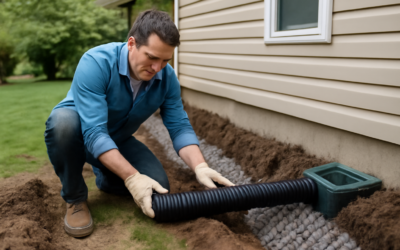
An exterior drain tile system is a length of perforated drainpipe installed at the base of the foundation footing, surrounded by washed gravel and wrapped in filter fabric. Water that collects in the soil around the foundation seeps into the gravel, enters the perforated pipe through its holes, and flows downhill to a discharge point.
The term “drain tile” survives from an era when these systems were built from short sections of clay or concrete tile laid end to end. Today the pipe is usually corrugated or rigid PVC, but the principle is identical: give subsurface water an easy path to follow so it does not build up against your foundation walls and force its way inside.
Why Foundation Drainage Matters
Water is the foundation’s greatest enemy. When soil around the foundation becomes saturated, it exerts hydrostatic pressure against the walls, which can drive moisture through tiny cracks, cause leaks, and over time contribute to cracking and structural movement. A wet basement also invites mold and ruins finished space.
A working exterior drain tile system relieves that pressure by intercepting water before it reaches the wall. It is generally considered the most effective form of foundation drainage because it stops water on the outside, rather than managing it after it has already entered, the way an interior system does.
How the System Works
The system relies on gravity and proper slope to move water continuously toward an outlet. Several components work together to keep it functioning.
- Perforated pipe: Laid at the footing level to collect water through its holes.
- Washed gravel: Surrounds the pipe to create voids that let water flow freely toward it.
- Filter fabric: Wraps the gravel and pipe to keep soil and silt from clogging the system.
- Slope to daylight or a sump: The pipe must pitch consistently downhill, either to a point that exits on a lower part of the property (daylight) or into a sump pit where a pump lifts the water out.
Without correct slope and a clear discharge, even a well-built system will fail to move water, so these details are critical.
Installation Basics
Installing exterior drain tile on an existing home is major work because it requires excavating down to the footing all the way around the affected area. The general sequence helps you understand the scope even if a contractor does the work.
- Excavate carefully along the foundation down to the footing, following safe trenching and shoring practices.
- Clean and, where appropriate, inspect or waterproof the exposed foundation wall.
- Lay filter fabric and a gravel bed sloped toward the discharge.
- Set the perforated pipe with consistent pitch, holes oriented per the installer’s method.
- Cover with more gravel, fold the filter fabric over, and backfill in layers, grading the soil to slope away from the house.
Because excavation near a foundation carries real safety and structural risks, deep trenches and foundation waterproofing should be handled by qualified professionals.
Cost of Exterior Drain Tile
Exterior drain tile is one of the pricier drainage solutions because of the excavation involved. Costs vary widely with depth, soil, landscaping, and access, so treat these as general estimates.
- Exterior drain tile installation often runs from the low thousands to well over ten thousand dollars depending on the linear footage and depth.
- Adding a sump pump and pit, exterior waterproofing membrane, or restoring landscaping increases the total.
- Interior drain tile systems are sometimes chosen as a less disruptive, often lower-cost alternative, though they manage water differently.
Get multiple detailed bids from reputable foundation or waterproofing contractors, and ask exactly what is and is not included.
Maintenance and Common Problems
A properly installed system needs little routine attention, but a few things keep it working. Make sure the discharge point stays clear and that the ground continues to slope away from the foundation, since settled soil can redirect water back toward the house. If your system uses a sump pump, test it periodically and consider a battery backup for power outages.
The most common failure is clogging from silt and roots when filter fabric was omitted or the wrong gravel was used. Recurring basement moisture despite a system usually means the slope, discharge, or fabric was not done correctly, and the area may need inspection. Keep gutters and downspouts working too, because surface water management reduces the load on the drain tile.
Pay attention to the discharge end specifically, since it is the part you can actually see and maintain. A daylight outlet should stay free of leaves, mulch, mud, and snow, and a rodent guard on the pipe end keeps animals from nesting inside and blocking flow. If your system runs to a sump, listen for the pump cycling normally during wet weather; a pump that runs constantly or not at all signals a problem worth investigating before the next heavy rain tests the system.
When to Call a Professional
For most homeowners, exterior drain tile is not a DIY project. The combination of deep excavation near a load-bearing foundation, precise slope requirements, and the consequences of getting waterproofing wrong make professional installation the right call. A qualified foundation or waterproofing contractor can assess your specific water problem, recommend whether an exterior or interior approach fits, and execute the work safely. If you are seeing chronic dampness, pooling near the foundation, or basement leaks, start with a professional evaluation before committing to any single solution.
Prefer to explore on your own?
See how new flooring looks in your actual room in seconds — free, no signup.
Try the free Floor Studio →