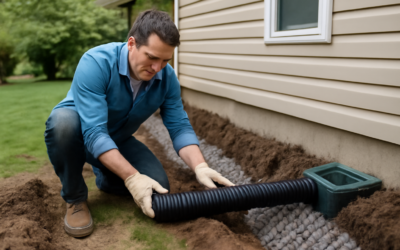
The phrase confuses almost everyone the first time they hear it, because it has nothing to do with the ceramic tiles on your floor. What is drain tile, in plain terms, is a buried pipe-and-gravel system that collects groundwater and carries it away from your foundation before it can seep into your basement. The name is a holdover from a century ago, when these systems were built from short sections of clay or concrete “tile.” Today they use perforated plastic pipe, but the job is identical: keep water out of the place you do not want it.
Part of our Tile & Grout guide — explore the full guide →
Why It Is Called Drain Tile
Generations ago, farmers and builders laid lengths of fired clay pipe end to end to drain soggy fields and wet foundations. Each segment was called a tile, and water seeped in through the gaps between them. The term stuck even after the technology changed completely. Modern drain tile is a continuous corrugated or PVC pipe with rows of small holes or slots, surrounded by washed gravel and often wrapped in filter fabric.
So when a contractor tells you that your home needs drain tile, picture a perforated pipe ringing your foundation footing, not anything resembling a bathroom tile. The mismatch in the name causes a lot of unnecessary confusion.
How a Drain Tile System Works
The principle is simple gravity and collection. Water in the soil follows the path of least resistance, and a properly installed drain tile system gives it an easier path than your basement wall. Here is the basic flow:
- Perforated pipe is buried alongside the foundation, either on the outside footing or under the interior slab.
- Groundwater seeps through the gravel and enters the pipe through its holes.
- The pipe slopes toward a low point, usually a sump pit.
- A sump pump lifts the collected water and discharges it well away from the house, or the system drains to daylight on a sloped lot.
Without this path, water builds up against the foundation as hydrostatic pressure, the silent force that pushes moisture through cracks, cold joints, and porous concrete.
Interior vs Exterior Drain Tile
There are two main approaches, and each has its place. Exterior drain tile is installed during construction or by excavating around the existing foundation. The pipe sits at the footing on the outside, intercepting water before it ever reaches the wall. It is the most thorough solution, but retrofitting it means digging out the entire perimeter, which is expensive and disruptive.
Interior drain tile is installed inside the basement by cutting a channel in the perimeter of the concrete slab, laying pipe in gravel, and routing it to a sump pit. It does not stop water from reaching the wall, but it captures water that gets in and removes it before it floods the floor. For an existing home with a wet basement, interior drain tile is usually the more practical and affordable retrofit.
Signs Your Home Needs Drain Tile
Water problems announce themselves if you know what to watch for. Consider a drainage system if you notice any of these:
- Water seeping in where the basement wall meets the floor after heavy rain.
- Persistent dampness, musty odors, or visible mold on lower walls.
- Efflorescence, the white chalky mineral residue, on concrete walls.
- Cracks that weep water or a floor that is damp in spots.
- A sump pit that runs constantly or overflows during storms.
One wet event after an unusual storm may not warrant a full system. A pattern of moisture, especially seasonal flooding, almost always does.
What Drain Tile Costs
Pricing depends heavily on the approach and the size of your foundation. Interior systems are generally less expensive because they avoid excavation, while exterior retrofits carry the cost of digging out the perimeter. As a broad range, interior drain tile often falls between $50 and $100 per linear foot installed, and a full basement perimeter can run several thousand dollars. Exterior excavation-based systems usually cost considerably more.
A sump pump adds to the total, and a battery backup pump is worth strongly considering, because the heaviest rains that overwhelm a basement often coincide with the power outages that kill an unprotected pump. These are general figures; a local foundation contractor should assess your specific lot, soil, and water table.
Drain Tile and the Bigger Drainage Picture
A drain tile system is one piece of keeping water away from your foundation, not the whole strategy. Before you spend on a system, make sure the easy fixes are handled. Gutters should be clean and discharge at least several feet from the house. The grade around the foundation should slope away from the walls, not toward them. Window wells should drain, and downspout extensions should carry roof water well clear of the basement.
Fixing surface drainage sometimes solves a minor moisture problem on its own and always makes a drain tile system work better. Think of drain tile as the last line of defense for water that surface measures cannot stop.
How Long Drain Tile Lasts
A properly installed modern drain tile system can last for decades, often the life of the home, because the perforated PVC or corrugated pipe does not corrode the way old clay tile eventually did. The weak points are not usually the pipe but the things around it. Filter fabric can clog over many years, gravel can silt up, and the sump pump, a mechanical device, will wear out long before the pipe does.
That is why the sump pump deserves attention even when everything seems fine. A typical pump lasts roughly 7 to 10 years, and it tends to fail exactly when it is needed most, during a heavy storm. Testing the pump a couple of times a year by pouring water into the pit and confirming it cycles on is a five-minute habit that prevents a flooded basement.
Maintaining a Drain Tile System
Hidden systems are easy to forget, but a little upkeep keeps them working. Make these checks part of your routine:
- Test the sump pump regularly and keep the pit free of debris that could jam the float switch.
- Confirm the discharge line is clear and routes water well away from the foundation, not back toward it.
- Watch for a pump that runs constantly or never runs, both of which can signal a problem.
- Consider a battery backup or water-powered backup pump for storm-related power outages.
- Keep gutters and surface drainage in good shape so the system is not overwhelmed.
None of this is demanding, but it is the kind of maintenance that pays for itself the first time a major storm rolls through and your basement stays dry.
The Bottom Line
Drain tile is the unglamorous, hidden system that decides whether your basement stays dry. Despite the misleading name, it is a buried perforated pipe that collects groundwater and routes it to a sump pump or daylight, relieving the pressure that drives water through foundation walls. If your basement shows the warning signs, a properly designed interior or exterior system, paired with good surface drainage, is one of the most worthwhile investments you can make in your home.
Prefer to explore on your own?
See how new flooring looks in your actual room in seconds — free, no signup.
Try the free Floor Studio →