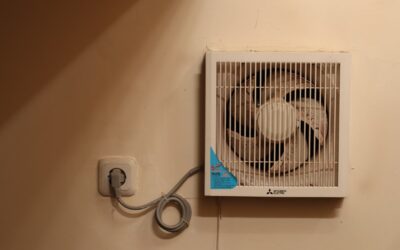
A quiet, high-flow remote fan changes how a bathroom or laundry room feels. A Fantech exhaust fan is one of the go-to upgrades contractors install when a homeowner is tired of noisy builder-grade ceiling fans that still leave mirrors fogged. Fantech has built its reputation on inline and remote-mount blowers that move air quietly from outside the occupied space, typically in the attic. Knowing which model fits your room, how to size it, and how the install compares to a standard ceiling fan will help you decide if it is worth the premium over big-box alternatives.
Why Inline Fans Outperform Ceiling-Mount Fans
A typical builder-grade bathroom fan is a squirrel-cage motor bolted directly into the ceiling housing above the grille. The motor sits six inches from your ear, which is why most of them sound like a vacuum cleaner. Inline and remote fans move the motor 10 to 25 feet away — usually in the attic or a mechanical chase — and connect through flexible or rigid duct to a quiet intake grille in the ceiling.
The result: noise drops from 2.5 to 4.5 sones on a standard fan to under 1.0 sone with a properly installed inline unit. Airflow also stays closer to spec because larger inline fans fight static pressure losses better than small ceiling-mounted motors.
Popular Fantech Models and What They Fit
Fantech’s lineup covers everything from a single bathroom to whole-house ventilation. The models most homeowners encounter:
- Fantech PB110: Premium bath fan kit with a 110 CFM inline blower. Fits a single 60 to 80 square foot bathroom. Roughly $320 to $380 for the kit.
- Fantech PB190: 190 CFM inline blower, suitable for a single large bath or two small baths sharing one duct. $420 to $480.
- Fantech PB270: 270 CFM, for master bathrooms with steam showers or multiple fixtures. $540 to $620.
- Fantech FG Series: Inline duct fans in 4, 6, 8, 10, and 12-inch diameters. Used for custom dual-bath setups, whole-home fresh air, or grow rooms. $180 to $650 depending on size.
- Fantech SHR Series: Heat recovery ventilators (HRVs) for whole-house ventilation. Not a single-room exhaust but worth mentioning if you are building tight.
Kits typically include the blower, a mounting bracket, a wall or ceiling grille, and a roof or wall cap. Duct and wiring are sold separately.
Size the Fan Correctly for Your Room
Undersized fans leave moisture on mirrors and walls. Oversized fans pull conditioned air out of the house and waste energy. The Home Ventilating Institute recommends 1 CFM per square foot of bathroom floor area, with a minimum of 50 CFM for half baths and 80 CFM for full baths. Add 50 CFM per fixture if you have multiple showers, tubs, or water closets.
A master bathroom with a 4×6 shower stall, a soaking tub, and a toilet totaling 120 square feet needs roughly 200 to 220 CFM. That lines up with the Fantech PB190 or a 6-inch FG6XL inline fan with a custom grille. Use an HVI-certified online calculator to double-check numbers before buying.
Plan the Duct Run Before You Buy
Static pressure eats airflow. Every 10 feet of smooth rigid duct drops output about 5 percent. Every 90-degree elbow drops it another 10 to 15 percent. Flexible insulated duct roughly doubles those losses. Keep duct runs as short and straight as possible.
Best practice: use 6-inch galvanized rigid duct for runs over 10 feet, with long-sweep elbows and sealed joints using UL-listed foil tape or mastic. Insulate any duct running through an unheated attic with R-6 or R-8 duct wrap to prevent condensation from forming inside the pipe. Condensation inside a bath exhaust duct is the number one cause of ceiling drip stains six months after install.
Install Considerations and Pitfalls
Fantech fans hang from the attic structure using the included suspension straps — never directly to the duct or drywall. Route 120V power to the fan through a dedicated switched circuit, ideally a humidity-sensing timer switch like a Leviton IPVD1 or Broan HS5. These run the fan automatically when moisture rises above a preset level, then shut off when the room dries out.
Vent to the outside, never into the attic or soffit overhang. Soffit venting looks easy but pulls the moist air right back into the attic through nearby intake vents, causing mold and frost damage. A roof cap with a backdraft damper is the standard solution. Wall caps work for first-floor bathrooms. Always caulk the flashing and use self-sealing underlayment around roof penetrations.
Noise Levels You Can Actually Expect
Fantech rates their premium bath fans at 0.3 to 0.9 sones at the grille when installed to spec. A sone is roughly the sound of a quiet refrigerator hum. For reference, a typical Broan L100 inline at $180 reads around 1.1 sones, and a builder-grade NuTone 688 ceiling fan reads 4.0 sones — loud enough that conversations pause.
Real-world installs usually measure a bit higher than spec because of duct length, elbows, and grille restrictions. Plan on 1.0 to 1.5 sones for a well-installed Fantech kit. The room will sound like hushed white noise rather than a running motor.
Cost Comparison and When It Pays Off
A Fantech PB190 kit installed by a contractor runs about $850 to $1,300 depending on duct complexity, compared to $275 to $450 for a Panasonic WhisperCeiling FV-0511VQ1, which is itself a step up from builder-grade. The premium buys you 2x to 4x quieter operation and a motor replaceable from the attic without tearing apart the ceiling when it eventually fails.
The upgrade makes sense for master suites, bedrooms adjacent to bathrooms, and any space where a loud fan discourages use. A fan that nobody turns on is worse than no fan at all because moisture stays trapped in the space.
Maintenance and Lifespan
Vacuum the intake grille every six months. Once a year, climb into the attic, unplug the fan, and blow dust off the blower wheel with compressed air. A Fantech inline fan properly installed should last 15 to 20 years with a single bearing service around year 10 — triple the lifespan of typical ceiling-mounted bath fans that usually fail at five to seven years.