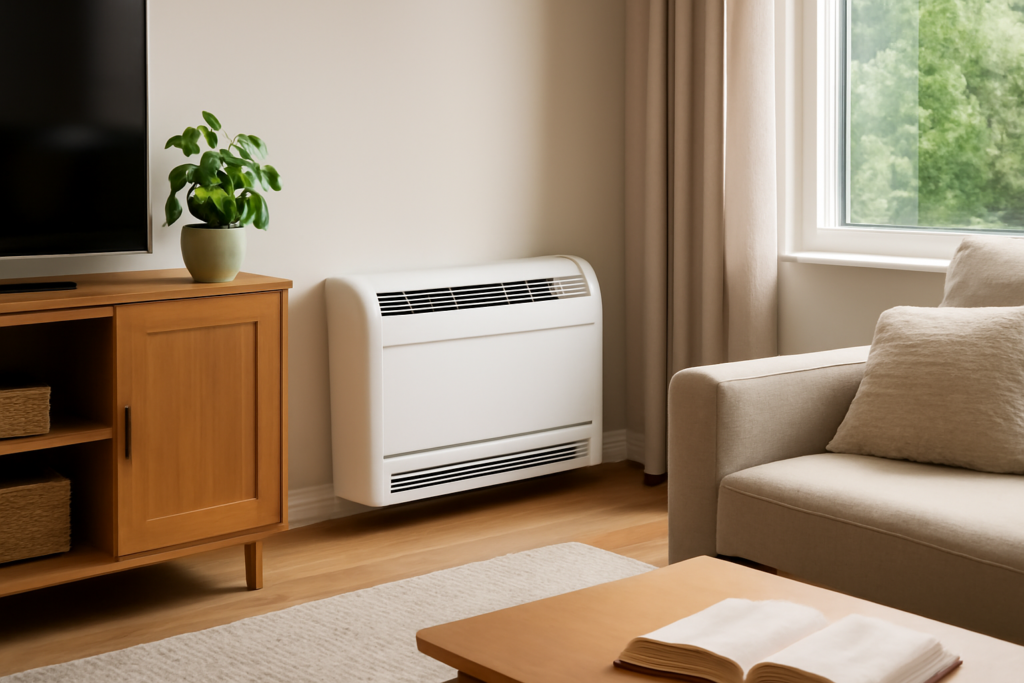
A floor mounted mini split puts the indoor head down low, sitting on the floor or mounted a few inches up the wall like a radiator, instead of high near the ceiling. That single change in position solves a surprising number of problems. Warm air rises, so a low unit delivers heat at foot level where you actually feel it, and it fits under windows, in rooms with sloped ceilings, and on walls where a high-mounted head would look wrong or block a window. The floor console is a strong fit for bedrooms, cabins, and older homes with knee walls.
The console does have trade-offs, mostly around floor space and furniture placement. This guide walks through how the floor unit works, its real pros and cons versus a wall head, how to size it, the clearances it needs, and what it costs in 2026.
How a Floor Console Differs From a Wall Head
Mechanically, a floor-mounted mini-split is the same system as any ductless setup: an outdoor condenser tied to an indoor head by a line set carrying refrigerant, a control wire, and a condensate drain. What changes is the indoor unit. Instead of a slim cassette mounted 7 feet up the wall, the floor console is a taller, boxier unit that sits at floor level or on a low bracket, typically 6 to 8 inches off the floor, with the air discharge near the top and often a second lower vent.
That low position changes the airflow. A ceiling-height wall head throws conditioned air across the top of the room and relies on it mixing down. A floor console pushes heat out at the level where your feet are and lets it rise naturally, which many people find more comfortable in heating mode. Some models discharge from both top and bottom to spread the air more evenly.
The Real Advantages
The floor console earns its place in specific situations, and when it fits, it fits well:
- Better heating comfort: delivering warm air low means you feel it at floor level, and it rises to fill the room instead of stratifying at the ceiling.
- Rooms with sloped or low ceilings: attics, bonus rooms, cabins, and dormers where a high wall head has nowhere to go, the floor unit sits neatly against a knee wall.
- Under-window placement: the console fits below a window like a traditional radiator or baseboard, an ideal spot for even distribution.
- Easier service access: filters and the unit itself are at a reachable height, no ladder required for routine cleaning.
- A cleaner look for some rooms: low-profile consoles read more like furniture than a wall cassette in a traditional interior.
The Downsides to Weigh
The floor position that helps in some ways hurts in others. The console occupies wall space at floor level, which competes with furniture, so you cannot place a sofa, bed, or dresser in front of it or you will block the airflow and choke the return. In a small room with limited walls, that constraint is real.
A floor unit is also more exposed to being bumped, blocked by drapes, or obstructed by anything set on top of or in front of it. In cooling mode, some people find a low unit less effective at spreading cold air across a large open space than a ceiling-height head, because cold air wants to sink and pool near the floor. And because the drain line exits low, the condensate often needs a condensate pump if there is no easy gravity drain path, which adds a part that can fail.
Sizing a Floor-Mounted Unit
Sizing follows the same BTU math as any mini-split. Floor consoles come in 9,000, 12,000, 18,000, and sometimes 24,000 BTU, where 12,000 BTU equals one ton. Use roughly 20 to 30 BTU per square foot for a reasonably insulated room with standard ceilings.
- A 300 sq ft bedroom typically wants a 9,000 BTU console.
- A 500 to 600 sq ft living space lands around 12,000 BTU.
- An 800 sq ft open area needs 18,000 BTU or more.
Because floor consoles are so often chosen for their heating comfort, pay close attention to the heating output and the HSPF2 rating, and to the unit’s rated capacity at low outdoor temperatures if you are in a cold climate. As always, resist oversizing, an inverter unit that is too large short-cycles and leaves the room humid.
Installation and Clearances
The install mirrors a wall-head mini-split with a few floor-specific details. The line set still routes through a cored hole to the outdoor condenser, and the console mounts to the wall through a bracket even though it sits low, so the wall carries the weight rather than the unit resting purely on the floor. Keep these clearances in mind:
- Leave the top discharge unobstructed, at least 6 to 12 inches of open space above the unit, so nothing set on top blocks the airflow.
- Keep furniture back from the front and sides so the intake and discharge breathe.
- Plan the condensate route early, a low exit often needs a small condensate pump unless you can drain by gravity to the outside.
The outdoor side is unchanged: set the condenser on a pad or wall bracket with the clearances the manufacturer specifies, and wire it to a dedicated circuit, usually 208/230 volts for 12,000 BTU and larger. As with any conventional mini-split, the refrigerant connection and charge require a licensed tech unless you buy a DIY pre-charged system.
What a Floor-Mounted Mini-Split Costs in 2026
Floor consoles cost roughly the same as wall heads, sometimes slightly more for the same capacity. Expect equipment prices of $1,000 to $2,200 for a single-zone floor-mount system, and a professionally installed single-zone floor console typically runs $3,800 to $6,000 all in. A condensate pump, if needed, adds $60 to $150 in parts plus a little labor.
Multi-zone setups that mix floor consoles and wall heads off one condenser scale up the way any multi-zone does, landing $6,000 to $12,000 or more depending on the number of heads. The floor unit itself rarely adds a big premium, the cost is driven by capacity, zone count, and install complexity, same as any ductless system.
Who Should Choose the Floor Console
Pick a floor-mounted mini-split when heating comfort is your priority, when the room has sloped or low ceilings that rule out a high wall head, or when you want the unit under a window like a radiator. It is a natural fit for bedrooms, cabins, sunrooms, and finished attics. Choose a wall or ceiling head instead when floor and wall space is tight, when cooling a large open room is the main job, or when furniture placement leaves no clear low wall to give up. Match the unit type to how you use the room, and the floor console will reward you with even, comfortable heat right where you feel it.
Maintenance and Filter Access
One quiet advantage of the floor console that deserves more attention is maintenance. Because the unit sits at floor level rather than seven feet up the wall, cleaning the filters is a task you can do without dragging out a ladder, which means you are far more likely to actually do it. Most floor consoles use washable mesh filters that slide out from the front or top, and they should be rinsed every three to four weeks during heavy use. A clean filter keeps airflow up, efficiency high, and the coil from icing. This accessibility is a real, if unglamorous, reason people who have owned both prefer the floor unit.
Deeper maintenance follows the same rhythm as any mini-split. Once or twice a year, clean the indoor coil and check the blower wheel, which can accumulate a film of dust and kitchen grease that dampens output and can grow mildew. Keep an eye on the condensate path, especially if you installed a pump, because a stuck float switch or a clogged line is the most common nuisance failure on any ductless unit.
On the outdoor side, the condenser needs the same care it would with a wall head: keep the coil clear of leaves and grass, maintain the clearances, and watch for winter frost that the defrost cycle should handle automatically. Because floor consoles are so often the primary heater in the rooms they serve, staying on top of this maintenance directly protects your comfort through the coldest months. A floor-mounted mini-split that is cleaned on schedule holds its rated output and quiet operation for its full 12- to 15-year service life, delivering that low, even heat exactly where a ceiling head never could.