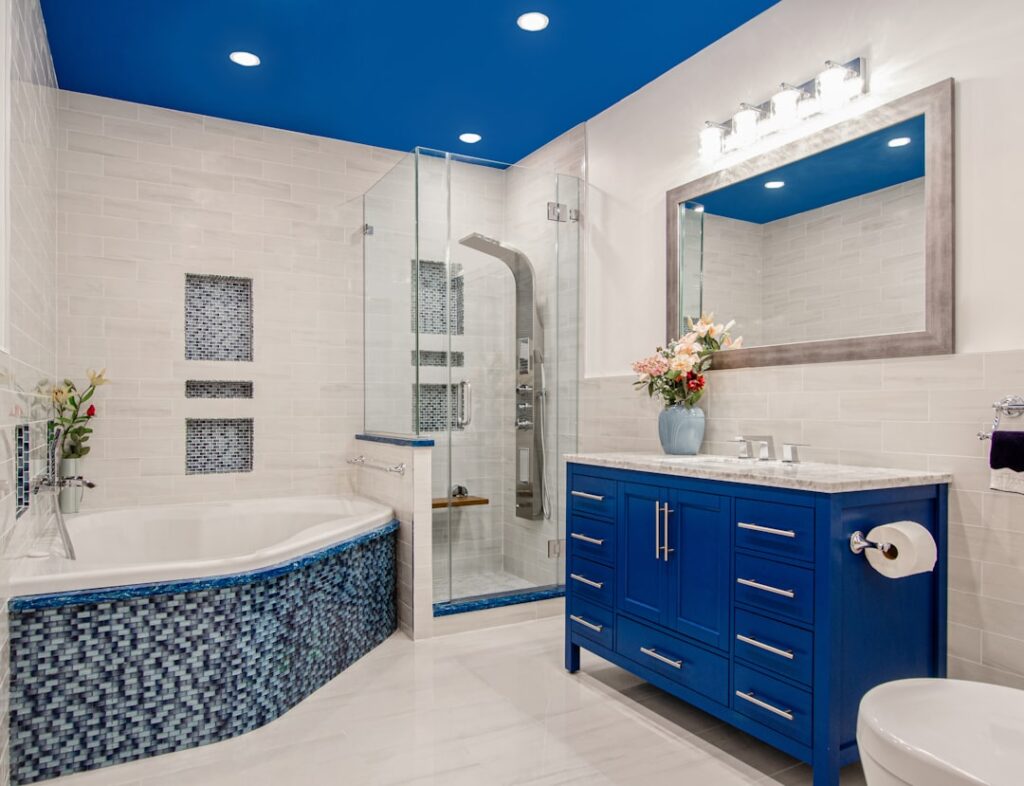
Somewhere in the last decade, the fully tiled bathroom went from a European hotel signature to the default request on high-end remodels. And I get the appeal — a floor to ceiling tile bathroom reads seamless, architectural, and unapologetically finished, like the room was carved from one material. But full-height tile roughly doubles to triples your wall tile area compared to a traditional wainscot, and that multiplies material, labor, and prep costs on the biggest surface in the room. Whether that’s money well spent depends on the room, the tile, and your goals. Having built both versions many times over, here’s my honest cost-benefit teardown.
Part of our Bathroom Remodeling & Flooring guide — explore the full guide →
The Real Math: How Much More Tile Are We Talking?
Take a standard 5×8 bathroom with 8-foot ceilings. Perimeter is 26 feet, minus the door. Wall areas by approach:
| Approach | Wall Tile Area | Tile + Labor @ $18–28/sq ft |
|---|---|---|
| Shower surround only (to ceiling) | ~90 sq ft | $1,600–$2,500 |
| Shower + 42″ wainscot elsewhere | ~150 sq ft | $2,700–$4,200 |
| Full floor-to-ceiling, every wall | ~215–230 sq ft | $3,900–$6,400 |
So in a modest bathroom, going full-height on every wall adds roughly $1,200 to $2,500 over a generous wainscot, and $2,300 to $4,000 over a standard shower-only tile job — before you’ve touched a premium tile. In a large primary bath with 9 or 10-foot ceilings, the delta can easily hit $6,000 to $12,000. The $18 to $28 per square foot installed figure assumes mid-range porcelain; handmade zellige or natural stone pushes installed costs to $35 to $60 per square foot, at which point full-height becomes a five-figure decision on walls alone.
What You Get for the Money
The case for full-height tile is stronger than pure aesthetics, and I make it honestly:
- Visual height and scale. Uninterrupted vertical surfaces pull the eye up. Small bathrooms genuinely feel taller and larger fully tiled — the effect is strongest with large-format tile and matched grout, which minimize gridlines.
- No transition management. Wainscots create a horizontal seam that needs trim, a cap, and a paint decision above. Full-height deletes that whole design problem, along with the perpetual scuff-and-splash zone of painted drywall above a backsplash.
- Durability where bathrooms actually get damaged. Steam, splash, kids, cleaning sprays — painted bathroom drywall needs repainting every 4 to 7 years and grows peeling problems around showers with weak ventilation. Tile shrugs all of it off. Over a 25-year horizon, full tile is arguably the cheaper wall finish.
- Steam-shower and wet-room readiness. If the room is a true wet room or you ever want a steam shower, full-height (and ceiling) tile over proper membranes isn’t a style choice — it’s the required assembly.
- Resale signal. Full tile reads “expensive hotel” to buyers instantly. Agents tell me it photographs better than any paint color.
What It Costs You Beyond Money
The trade-offs nobody posts about:
- Commitment. Paint above a wainscot lets you re-theme a bathroom in a weekend for $60. A fully tiled room is locked into its palette for decades. This is exactly why I steer full-height clients toward quiet, timeless tile and push the personality into towels, vanities, and lighting.
- Acoustics. All-hard-surface rooms are echo chambers. Noticeable in big primary baths; barely relevant in powder rooms. Rugs and wood vanities dampen it some.
- Coldness — visual and literal. A fully tiled room in cool tones can feel institutional. Warm neutrals, texture variation, and wood elements are the antidote.
- Repair stakes. Plumbing access or a cracked tile in year twelve means matching discontinued tile across a whole wall. Buy 10 to 15 percent overage and store it in the attic; future-you will be grateful.
- Prep sensitivity. Full-height large-format tile telegraphs every wave in the framing. Walls need flattening to tight tolerances, which is real labor money ($500 to $1,500 in many remodels) hiding inside those installed prices.
Where Full-Height Is Worth It — My Field Rules
After a lot of these jobs, my recommendations sort cleanly:
- Small bathrooms and powder rooms: yes, best value. The area delta is small — often only $800 to $1,500 more than wainscot — and the space-enlarging effect is maximal. This is the biggest bang-for-buck full-tile scenario.
- Wet rooms, curbless showers, steam showers: yes, functionally required in the wet zones and usually worth carrying through the whole room for coherence.
- Kids’ and high-traffic family baths: yes on durability grounds, using affordable porcelain ($4 to $7 per square foot) — the maintenance savings are real.
- Large primary baths: selectively. Full-height in the shower and behind the tub and vanity (the “wet wall” and focal walls), painted or limewashed finish on the remaining walls. You capture 80 percent of the look for 60 percent of the cost and keep some acoustic and visual softness.
- Rental units and flips: usually no. The ROI math favors shower-surround tile plus durable paint; buyers and renters don’t repay the delta reliably outside luxury markets.
Design Moves That Make Full-Height Sing
If you’re spending the money, execution decisions multiply the payoff:
- Go large-format (12×24 or 24×48) with rectified edges and tight matched-grout joints for the monolithic look, or small handmade-look tile for the artisan version — the awkward middle (standard 8x10s with contrasting grout) delivers neither.
- Stack vertically in low-ceilinged rooms; the upward lines add perceived height on top of the full-tile effect.
- Tile the ceiling in the shower zone if you’re going full-height there anyway — the return edge where wall tile meets painted shower ceiling is the one seam that still reads unfinished. Adds $300 to $700.
- Plan your edges. Full-height tile ends at doorways, windows, and outside corners everywhere. Budget for metal edge profiles or bullnose on all of it — trim is the hidden line item, often $300 to $800 in profiles alone.
- One tile, or two max. The power of the look is continuity. A field tile plus one accent zone. Three-tile-plus schemes fragment exactly the seamlessness you’re paying for.
The Verdict Numbers
Summarizing the value equation from real projects: in a small bathroom, full-height tile costs 15 to 30 percent more than a conventional tile job and delivers the single biggest visual upgrade available in that room — worth it, almost always. In a large bathroom, it costs 40 to 80 percent more on walls and competes with alternatives like better fixtures, heated floors, or a nicer vanity that may serve you more — worth it selectively, on the walls that matter. And in any bathroom with moisture problems, marginal ventilation, or hard family use, tile’s near-zero wall maintenance quietly repays the premium over a decade regardless of aesthetics.
Ventilation: The Detail Full-Tile Rooms Forgive (and Expose)
A side effect worth planning for: fully tiled rooms change how moisture behaves. Painted drywall absorbs and slowly releases a little humidity; tile absorbs nothing, so every bit of shower steam condenses on the coolest surfaces and runs. That’s actually an argument for full tile — condensation on tile is harmless, while the same moisture cycling degrades paint and feeds mold on drywall — but it makes a properly sized exhaust fan non-negotiable. Spec at least 1 CFM per square foot of floor area (a 5×8 bath wants a 50 CFM minimum; I install 80 to 110 CFM with a humidity-sensing switch, about $120 to $250 in hardware), vent it outdoors rather than into the attic, and run it 20 minutes past shower’s end. Fully tiled rooms with good fans stay pristine for decades; the rare moldy full-tile bathroom I’ve seen always traces back to a dead or undersized fan, never to the tile. While you’re at it, heated floors deserve a mention here too: an all-tile room in a cold climate benefits enormously from electric radiant underfoot ($10 to $20 per square foot installed), which converts tile’s thermal mass from a winter liability into the most luxurious feature in the house.
My honest closer: I’ve never had a client regret a floor to ceiling tile bathroom done in calm, quality tile with clean edges — the regrets I’ve witnessed were all about bold tile choices locked in at full-room scale, not about the coverage itself. So if you go full-height, pair maximal coverage with minimal drama: neutral field tile, matched grout, personality in the changeable layers. Spend the premium in small rooms where it transforms the space, deploy it strategically in big ones, and always — always — buy the extra boxes. Tiled walls are forever; discontinued tile is faster than you think.
Prefer to explore on your own?
See how new flooring looks in your actual room in seconds — free, no signup.
Try the free Floor Studio →