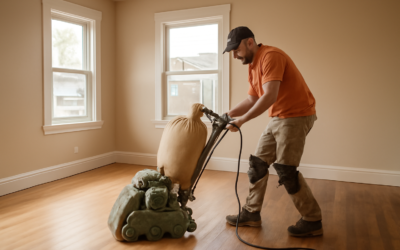
Buffalo winters punish flooring in ways most installers from milder climates don’t account for. Road salt tracked in for 5 months a year, sub-zero polar vortex events, and the basement humidity that comes with century-old Western New York housing stock all reshape what “best flooring” means here. Flooring Buffalo NY projects need salt-resistant finishes, dimensionally stable engineered cores, and basement-specific moisture mitigation — three factors that don’t matter as much in Florida or Texas installs.
2026 Buffalo Pricing
Local pricing observed across the WNY market in early 2026:
- Mid-grade LVP (12-mil wear layer) — $3 to $5 per sq ft material, $1.50 to $3 install. Total $4.50 to $8.
- Engineered hardwood — $5 to $11 per sq ft material, $3 to $5 install. Total $8 to $16.
- Solid red oak 3/4 inch — $5 to $8 per sq ft material, $4 to $6 install. Total $9 to $14.
- Porcelain tile — $2.50 to $7 per sq ft material, $5 to $9 install. Heavy labor add for winter installs.
- Carpet (broadloom) — $2 to $5 per sq ft installed including pad.
Buffalo install labor sits 5 to 10 percent below Albany, 15 percent below NYC metro. Winter installs (December through March) often carry a 5 percent premium for crew comfort costs and HVAC management on site.
Best Showrooms in Buffalo
Where local homeowners and contractors actually shop:
- Carpet Outlet Plus (Tonawanda) — strong residential carpet selection, in-stock LVP
- Carpetland (Amherst, Cheektowaga) — Shaw, Mohawk, and Stainmaster dealers, 7-day install turnaround
- Floor & Decor (Williamsville) — best porcelain tile inventory in WNY, clearance pricing on overruns
- Hadley Exteriors and Floors (Lancaster) — full custom hardwood install crew, NWFA-certified
- Empire Today and 50 Floor — strong in-home estimate networks, but expect 10 to 20 percent markup over local independents
Lowes Hamburg and Home Depot Cheektowaga carry mid-grade LVP, vinyl plank, and laminate at the budget tier. Skip them for hardwood — better selection at Carpetland or Hadley.
Winter-Specific Considerations
Buffalo’s flooring enemies, ranked:
Calcium chloride and rock salt — Magic Salt, Mag-9, and rock salt tracked in from November through April. Soft wood finishes (water-based poly, oil) etch within one season. Polyurethane oil-modified (Bona Traffic HD, Pallmann Magic Oil) handles salt; aluminum oxide factory finishes on engineered hardwood handle it best.
Temperature shock — slab temps in unheated garages and mudrooms swing from 70°F to 15°F across a season. Adhesives crack, click-lock joints separate. Always install over heated, conditioned slabs. Unconditioned spaces need LVP with click-lock systems rated for ambient temperature swings (Karndean Korlok, COREtec Pro Plus).
Acclimation requirements — solid hardwood needs 14 to 21 days at 65-75°F and 30-50% RH before install. In Buffalo’s January conditions, that means heating the install site and running a humidifier (or dehumidifier in spring/fall) to hit spec. Skipping this guarantees gapping by April.
Basement Moisture in Buffalo Homes
About 65 percent of Buffalo single-family homes are pre-1950 stock with stone or block foundations. These leak moisture even when dry to the touch. Before any flooring install in a basement:
- Run ASTM F1869 calcium chloride test for 60 to 72 hours. Target below 5 lbs/1000 sq ft/24 hr.
- Or ASTM F2170 in-situ RH probe. Target below 75% RH.
- If above thresholds, install a vapor barrier (DRIcore, Barricade, or sheet poly under sleeper subfloor) before any wood-based flooring.
- For high-moisture basements (above 85% RH), only sheet vinyl, LVP, or porcelain tile work long-term.
Best Material Picks for Buffalo Climate
By room and use case:
- Main living and bedrooms — engineered hardwood (Mohawk RevWood Plus, Shaw Repel, Mannington Restoration). Survives radiant heat, holds up to salt residue with proper mats.
- Kitchens and entryways — porcelain tile (MSI, Daltile) with DCOF ≥0.42 for wet/salty conditions, OR 20-mil+ LVP for budget-conscious installs.
- Bathrooms — porcelain tile with anti-microbial grout sealer (Aqua Mix Sealer’s Choice Gold).
- Basements — LVP over moisture barrier or polished concrete with epoxy topcoat.
- Mudrooms and laundry — sheet vinyl or porcelain tile. Skip wood entirely.
How to Vet a Buffalo Contractor
Three checks before signing:
- NYS Home Improvement Contractor license — required for jobs over $200. Check at dos.ny.gov.
- NWFA or CTEF certification — for hardwood and tile respectively. Both maintain online directories.
- Verify they handle moisture testing in-house — not subcontracted. A good Buffalo crew has at least one Tramex CME or Wagner Rapid RH meter.
Buffalo’s BBB lists active complaints against several discount installers focused on rip-and-replace; check the BBB rating and Google reviews before committing to anyone under $4 per sq ft labor. Cheap installs that cup or buckle in March cost more to redo than doing it right the first time.
Best Time of Year to Install
Spring (April through early June) and early fall (mid-September through October) hit the sweet spot for Buffalo flooring installs. Indoor humidity matches typical year-round levels, slab temps stay between 55 and 70°F, and contractor crews aren’t overbooked. Avoid mid-summer humidity peaks (July through mid-August) for solid hardwood — boards installed at 65% RH cup when winter heating drops the indoor RH below 30%.
If you must install in deep winter, plan to run the HVAC and a humidifier for 14 days before delivery to reach 35-45% RH. Many failed Buffalo installs trace back to January installs in dry, heated houses where the wood expanded too much when spring humidity returned.
Resale Value in Buffalo Market
WNY’s median home price sits around $215K in 2026 with strong demand in the $300-500K bracket in Amherst, Williamsville, and Orchard Park. Mid-grade engineered hardwood in main living areas returns 70-90 percent of installation cost at resale. Avoid trendy gray finishes if you might sell within 5 years — Buffalo buyers consistently prefer warm and natural tones over the cooler designs popular on the coasts. Replace worn carpet with hardwood or LVP before listing — flooring upgrades are among the top 3 ROI improvements in this market.
Prefer to explore on your own?
See how new flooring looks in your actual room in seconds — free, no signup.
Try the free Floor Studio →