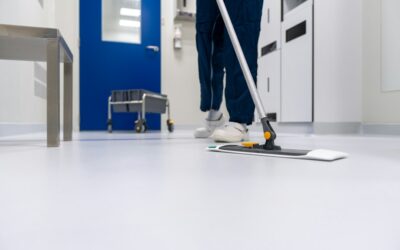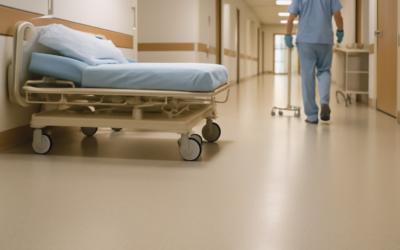
The wrong floor in a medical clinic costs more than the right floor ever could. Hospital-acquired infections in outpatient settings have been linked to floor-source contamination in studies from the CDC and Joint Commission, which makes the choice of flooring for medical clinics a clinical decision, not a design one. Add in OSHA slip-resistance requirements, ADA wheelchair traction standards, and the brutal chemical exposure from daily disinfection, and the product list narrows fast. Three materials genuinely belong in healthcare: heat-welded sheet vinyl, commercial LVT, and rubber. Everything else is a compromise.
- What Healthcare Floors Actually Have to Do
- Heat-Welded Sheet Vinyl: The Gold Standard
- Commercial LVT: Style Meets Performance
- Rubber Flooring for High-Traffic Wings
- Brand Spotlight: Tarkett iQ Granit
- What to Avoid in Medical Settings
- Slip Ratings and ADA Compliance
- Total Cost of Ownership Beats Sticker Price
- Zone-by-Zone Specification
What Healthcare Floors Actually Have to Do
A medical clinic floor handles six daily abuses that residential floors never face. Bleach and quaternary disinfectants at 1:10 dilution touch the surface 4 to 8 times per day. Wheeled equipment up to 600 pounds rolls over it. Blood, urine, and chemotherapy spills land on it without warning. Slip falls are the leading injury claim in outpatient settings, so the floor must hit DCOF 0.42 minimum wet. Cove bases must seal to walls to eliminate the joint where bacteria colonize. And every seam is a potential infection vector.
The three materials that handle all six demands are commercial heat-welded sheet vinyl, vinyl tile with chemically welded seams, and rubber sheet flooring. Each has a specific role.
Heat-Welded Sheet Vinyl: The Gold Standard
Armstrong Medintech, Mannington BioSpec, and Tarkett iQ Granit are the names that dominate clinic specifications. These 2-meter rolls install with a continuous coved base that runs 6 inches up the wall, sealed with heat-welded thermoplastic rod that fuses seams into one monolithic surface. No grout, no glue lines, no joints for bacteria to hide.
Pricing runs $5 to $9 per square foot installed, including coving and welding labor. The product carries 15-to-20-year commercial warranties, FloorScore certification, and slip ratings well above DCOF 0.42. The catch is that the install requires a certified technician. Most general contractors cannot weld it correctly, so demand a healthcare-credentialed installer.
Commercial LVT: Style Meets Performance
When the clinic owner wants a wood-look or stone-look surface without the institutional feel of sheet vinyl, commercial luxury vinyl tile is the answer. Look for 20-mil to 28-mil wear layers, urethane topcoats, and welded seams. Mannington Spacia, Karndean Da Vinci, Amtico Spacia, and Shaw Contract Hard Surface all build to clinic standards.
- Wear layer: 20-mil minimum for clinics, 28-mil for surgery centers
- Seam treatment: Chemical or heat weld, not butt joints
- Topcoat: Aluminum-oxide or polyurethane for chemical resistance
- Slip rating: DCOF 0.42 wet minimum per ANSI A326.3
- Indoor air: FloorScore or Greenguard Gold certified
Rubber Flooring for High-Traffic Wings
Nora Systems and Mondo dominate the healthcare rubber category. Nora Norament 926 and Mondo Sport M are spec’d in hospital corridors, ICUs, and operating room corridors where comfort underfoot matters as much as durability. Rubber absorbs sound (15 to 20 decibels less than vinyl), eases standing fatigue for nurses across 12-hour shifts, and tolerates more chemical abuse than any other resilient floor.
Pricing is high. Expect $9 to $15 per square foot installed. Maintenance is also different. Rubber does not accept floor finish like vinyl does. It is sealed at the factory and only needs neutral-pH cleaning. For the right wing of the right clinic, the comfort and acoustic benefits pay back the premium across a 25-year life cycle.
Brand Spotlight: Tarkett iQ Granit
Tarkett’s iQ Granit is arguably the most-specified clinic floor in North America. The 2mm homogeneous vinyl wears uniformly through its full thickness, which means surface scratches dry-buff out and the floor can be restored to factory finish using a high-speed burnisher and a chemical reactivation pad. No stripping, no waxing, no recoating. Tarkett’s lifetime cost analysis shows the iQ system saves roughly $0.50 per square foot per year in maintenance versus standard VCT.
What to Avoid in Medical Settings
Carpet has no place in patient-contact zones, full stop. Even antimicrobial-backed broadloom holds 8 to 10 times the bacterial load of hard surface and cannot be properly disinfected after blood or fluid exposure. Ceramic tile with grout joints is another problem. Grout absorbs disinfectants and harbors bacteria in microscopic porosity. If tile must be used for design reasons, specify epoxy grout and a porcelain body with COF above 0.42 wet.
Hardwood, laminate, and residential-grade LVP also fail under clinic conditions. Their wear layers are not designed for hourly quaternary disinfection, and they will discolor and chalk within 18 to 24 months.
Slip Ratings and ADA Compliance
Healthcare floors must meet ANSI A326.3 DCOF wet 0.42 or higher for level surfaces, and 0.50 for ramps. Verify the test report comes from the actual specified product, not a similar SKU. Wheelchair-friendly transitions cannot exceed 1/4 inch vertical change without a beveled edge, and 1/2 inch with a 1:2 bevel. Cove bases, welded seams, and integral wall-floor joints are also part of ADA-compliant infection-control design.
- Confirm the product holds an FDA Class I device clearance or healthcare-specific data sheet
- Verify DCOF and ASTM E84 Class A fire ratings in writing
- Specify a heat-welded or chemically welded seam treatment
- Require 6-inch cove base integral to the field flooring
- Confirm the installer is manufacturer-certified for healthcare
Total Cost of Ownership Beats Sticker Price
A budget VCT floor costs $2 to $3 per square foot installed but requires stripping, waxing, and burnishing on a 6-to-8-week cycle. Over 20 years, the maintenance labor alone exceeds $15 per square foot. A premium iQ vinyl or rubber floor at $9 per square foot installed needs only neutral cleaning and occasional burnishing, dropping lifetime cost to roughly $11 per square foot. The premium product is the cheap option once you do the math.
Zone-by-Zone Specification
Different clinic zones demand different floors. Exam rooms benefit from heat-welded sheet vinyl with integral cove base for full disinfection. Waiting areas and front-desk zones tolerate commercial LVT for the warmer wood-look appearance patients respond to. Corridors and nurse stations earn rubber for standing-fatigue relief and acoustic absorption. Restrooms require slip-rated DCOF 0.50 wet surfaces with seamless cove. Lab and procedure rooms need chemical-resistant homogeneous vinyl that survives reagent spills. Mismatch a zone and you either overspend or under-perform for the actual use case.
Prefer to explore on your own?
See how new flooring looks in your actual room in seconds — free, no signup.
Try the free Floor Studio →