Most garages were wired as an afterthought, with one lonely receptacle by the door and a ceiling outlet for the opener. Garage outlet installation is different from adding a receptacle in a bedroom because a garage is treated as a damp, unfinished space where people run high-draw tools, park vehicles, and stand on concrete. That combination drives three rules you cannot skip: ground-fault protection on every general-use receptacle, circuits sized for real tool loads, and placement that keeps cords off the floor.
If you want to add outlets to a garage, start by planning the loads rather than the boxes. A miter saw, shop vacuum, and space heater can easily trip a single shared 15-amp circuit. A well-planned garage usually has at least one dedicated 20-amp circuit for the walls, a separate outlet for the door opener, and possibly a 240-volt circuit for a compressor, welder, or electric vehicle charger.
- Garage Outlet Installation Basics: What Makes a Garage Different
- Planning Placement: Walls, Workbench, and Ceiling
- Circuits and Load Planning
- GFCI Protection Options
- 240-Volt Outlets for Tools and EV Charging
- What the Installation Process Looks Like
- Troubleshooting Common Garage Outlet Problems
- Cost Ranges
- When to Call a Licensed Professional
- Frequently Asked Questions
This guide covers what the rules generally require, where outlets should go, what the work involves, and which parts are best handed to a licensed electrician. Rules vary by jurisdiction and code edition, so confirm details with your local building department before any work begins.
Garage Outlet Installation Basics: What Makes a Garage Different
A garage sits in a gray zone between indoors and outdoors. Concrete floors wick moisture, doors stay open in the rain, and people often work there barefoot in summer or with wet boots in winter. Because of that, current national model codes generally require ground-fault circuit interrupter (GFCI) protection for all 125-volt, 15- and 20-amp receptacles in garages, and newer editions extend GFCI requirements to many 240-volt receptacles as well. Older homes may have a single non-GFCI outlet that was allowed when the house was built, but any new or replaced receptacle should meet today’s rules.
Garages also see heavier loads than most rooms. Many electricians recommend at least one 20-amp, 120-volt branch circuit dedicated to garage receptacles, and newer code editions call for one where the garage has electric power. That circuit should not also feed bedrooms or kitchen outlets. Keeping the garage separate means a table saw startup will not blink the lights in the house or trip a breaker shared with a freezer inside.
Finally, garages attached to the house share a fire-separation wall with living space. Any box cut into that wall must maintain the fire rating, which is one reason cutting holes in drywall on the house side is not a casual job.
Planning Placement: Walls, Workbench, and Ceiling
Good placement saves you from snaking extension cords across the floor, which is both a trip hazard and a common cause of cord damage from car tires. Think about how you actually use the space before marking boxes.
- Workbench outlets: Mount receptacles 42 to 48 inches off the floor so they sit above the bench top and above a typical backsplash or pegboard. A run of two or three duplex outlets, or a surface-mounted strip wired to a dedicated circuit, lets you run a charger, radio, and tool without juggling plugs.
- General wall outlets: Spacing them every 6 to 8 feet along walls where you park or store equipment keeps cords short. Many owners set them 18 to 24 inches high so bins and shelving do not block them.
- Ceiling outlets: The garage door opener needs a receptacle within reach of its cord, usually near the motor unit. Extra ceiling outlets are handy for retractable cord reels and hanging shop lights.
- Freezer or refrigerator: A dedicated circuit is smart so a tripped tool circuit does not spoil food. Some owners prefer a GFCI breaker for this so a nuisance trip is visible at the panel rather than hidden behind the appliance.
- Exterior-facing outlet: An outlet near the overhead door is useful for pressure washers and holiday lights, but anything outdoors needs a weather-resistant GFCI receptacle and an in-use (bubble) cover.
Keep outlets away from spots where a car bumper, lawnmower handle, or storage rack could strike them. In areas where vehicles pull in close to the wall, a higher mounting height is usually the better call.
Circuits and Load Planning
Before choosing outlets, add up what will run at the same time. A 15-amp circuit at 120 volts supplies about 1,800 watts total, and continuous loads should stay around 80 percent of that. A 20-amp circuit supplies about 2,400 watts. A portable space heater alone can draw 1,500 watts, and a contractor table saw can pull 13 to 15 amps at startup. Put those two on one circuit and the breaker will trip.
A practical layout for a two-car garage might look like this:
- One 20-amp circuit for the general wall receptacles, all GFCI-protected.
- One 20-amp circuit for the workbench area, so shop tools do not share with everything else.
- A separate receptacle or circuit for the door opener, often on the ceiling.
- A dedicated circuit for a freezer or second refrigerator if you have one.
- A 240-volt circuit, sized to the equipment nameplate, for a compressor, welder, or EV charging.
Your panel needs room for these breakers and enough capacity for the added load. A licensed electrician can run a load calculation to confirm the service can handle, for example, a 40- or 50-amp EV charging circuit on top of an electric range, dryer, and heat pump.
GFCI Protection Options
You can provide ground-fault protection in three common ways, and each has trade-offs.
GFCI receptacle at the first outlet
Installing a GFCI outlet at the first box on the circuit and wiring the rest from its LOAD terminals protects every downstream receptacle. It is inexpensive and lets you reset the circuit right in the garage. The downside is that a trip anywhere shuts down the whole run, and people sometimes do not realize which receptacle holds the reset button. Label the downstream outlets “GFCI Protected” so nobody assumes a dead outlet is broken.
GFCI receptacle at every location
Putting a GFCI device at each box costs more but localizes trips. If the freezer outlet trips, the workbench keeps running. This approach is common in garages with only a few outlets.
GFCI breaker at the panel
A GFCI breaker protects the entire circuit from the panel. It is tidy and allows standard receptacles in the garage, but you must walk to the panel to reset it. For 240-volt tool and EV circuits, a two-pole GFCI breaker is often the simplest way to meet newer requirements.
Whichever option you choose, use weather-resistant (WR) rated receptacles in damp locations and tamper-resistant (TR) receptacles where required. Test every GFCI monthly with its TEST button.
240-Volt Outlets for Tools and EV Charging
Large compressors, welders, some table saws, and Level 2 EV chargers need 240 volts. These circuits use a two-pole breaker, heavier conductors, and a receptacle whose shape matches the amperage, such as a 30-amp or 50-amp configuration. EV chargers are treated as continuous loads, so the circuit must be sized at 125 percent of the charger’s rated current. A 40-amp charger, for instance, needs a 50-amp circuit.
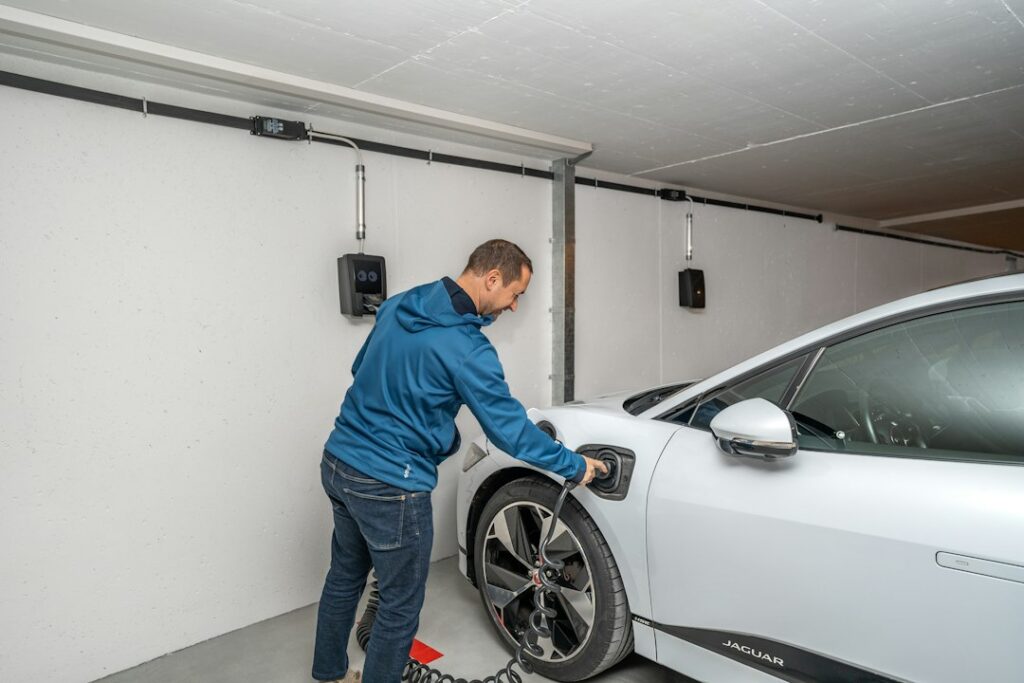
For EV charging, many electricians now favor a hardwired charger instead of a plug-in unit, because hardwiring avoids receptacle wear and some chargers require it at higher amperages. If you do use a receptacle, choose an industrial-grade device and make sure the circuit has the ground-fault protection your local code requires. This is not a DIY project for most homeowners; the wire gauge, breaker size, and panel capacity have to be right, and a permit and inspection are typically required.
What the Installation Process Looks Like
Even if you plan to hire the work out, understanding the steps helps you judge bids and spot shortcuts. A typical job for adding 120-volt outlets goes like this:
- Pull a permit. Most jurisdictions require one for new circuits or receptacles. The inspector will check box fill, wire gauge, GFCI protection, and fire-wall integrity.
- Shut off power. Turn off the breaker for any circuit being extended and confirm power is off with a non-contact voltage tester at every conductor in the box. Never work on or test a live circuit.
- Route the cable. In an open-stud garage, cable runs through bored holes in the framing and must be protected where exposed to damage. In a finished garage, it is fished behind drywall. Exposed cable at low heights often needs conduit or other physical protection.
- Set boxes. Use boxes rated for the wall type. Surface-mounted metal boxes with conduit are common on block walls and in shops because they hold up to bumps.
- Connect devices. Match conductors to the correct LINE and LOAD terminals on GFCI outlets, torque screws to the device’s specification, and ground every box and receptacle.
- Terminate at the panel. Adding a new breaker means working inside the panel, where the service conductors remain energized even with the main off. That is a licensed electrician’s job.
- Test and inspect. With power restored, press TEST and RESET on each GFCI and use a plug-in outlet tester to check polarity and grounding. Then schedule the inspection before covering any walls.
Low-voltage wiring, such as garage door sensor wires or a doorbell transformer’s secondary side, runs at a safe low voltage but still should not share a box with line-voltage outlet wiring. Keep the two systems separate.
Troubleshooting Common Garage Outlet Problems
Outlets dead with no tripped breaker. Look for a GFCI somewhere upstream: in the garage, a bathroom, the basement, or even an exterior wall. Older homes often chained garage outlets off a GFCI in an unexpected room.
GFCI trips repeatedly. Moisture in an outdoor box, a damaged tool cord, or an older freezer with leaky insulation can cause nuisance trips. Unplug everything, reset, and add loads back one at a time. If it trips with nothing plugged in, the wiring itself may have a fault, which calls for an electrician.
Breaker trips when tools start. The circuit is overloaded. Move the tool to a dedicated 20-amp circuit or stagger what runs at once.
Warm outlet or scorch marks. Turn off the breaker immediately and leave it off. Loose connections, backstabbed wires, or an undersized receptacle for the load are common causes. Have a licensed electrician inspect it.
Cost Ranges
Costs vary widely by region, wall type, and distance to the panel. As a general guide, replacing an existing garage receptacle with a GFCI outlet is a small job, often in the low hundreds of dollars when done by a pro. Adding new 120-volt outlets on an existing circuit usually runs a few hundred dollars per outlet. A new dedicated 20-amp circuit with several receptacles may land in the several-hundred to low-thousands range. A 240-volt circuit for a tool or EV charger commonly costs several hundred to a couple thousand dollars, and more if the panel needs an upgrade or the run is long. Permit fees are extra.
When to Call a Licensed Professional
Adding a new circuit, installing a new outlet location, or working inside the service panel should be done by a licensed electrician. Most jurisdictions require a permit and inspection for garage outlet installation, and unpermitted electrical work can complicate insurance claims and home sales. Call a pro any time you need a 240-volt circuit, an EV charger, a panel upgrade, work on a fire-rated wall between the garage and living space, or when you find aluminum branch wiring, cloth-insulated cable, or signs of overheating. A homeowner with basic skills may be able to swap a standard receptacle for a GFCI outlet on an existing circuit where local rules allow, but only after turning off the breaker and confirming power is off with a non-contact voltage tester.
Frequently Asked Questions
Do all garage outlets need to be GFCI protected?
Under current national model codes, general-use 125-volt, 15- and 20-amp receptacles in garages need GFCI protection, and newer editions extend that to many 240-volt outlets. Older homes may have grandfathered outlets, but new or replaced receptacles should meet today’s requirements. Check with your local building department for the edition in force.
Can I add outlets to a garage on an existing circuit?
Sometimes, if the circuit has spare capacity and is not already shared with rooms that have their own requirements. Many garages, though, need a dedicated 20-amp circuit to handle tools. A licensed electrician can check the existing load and advise whether extending it is safe.
How high should garage outlets be mounted?
There is no single required height for most garage receptacles. Workbench outlets are usually 42 to 48 inches off the floor, and general wall outlets are often 18 to 24 inches up so storage does not block them. Mount them higher where cars or equipment might strike them.
Do I need a 240-volt outlet for an EV charger?
Level 2 charging requires a 240-volt circuit, either hardwired or through a matching receptacle. The circuit must be sized at 125 percent of the charger’s rated current, so the panel must have capacity. This work generally needs a permit and a licensed electrician.
Why does my garage GFCI keep tripping?
Common causes include moisture in an outdoor or low box, a damaged tool cord, or an older appliance with ground leakage. Unplug everything, reset, and reconnect items one at a time. If it trips with nothing plugged in, have an electrician look for a wiring fault.