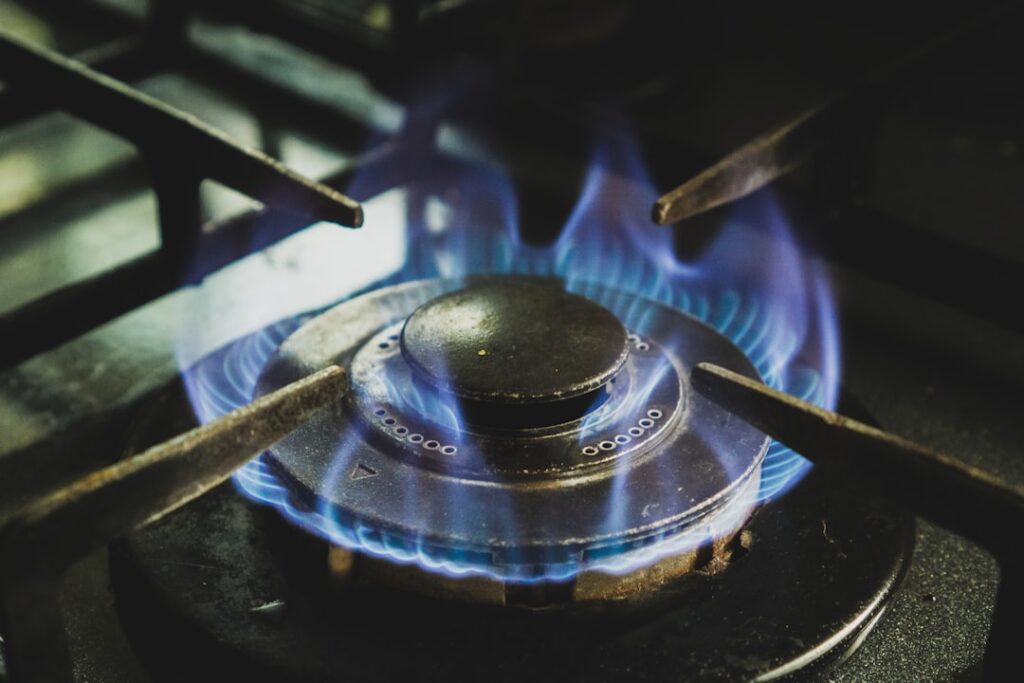
When the burners on top light fine but the oven below stays cold, the odds overwhelmingly point to one small part. A gas oven not heating up is caused by a weak or failed igniter in the majority of cases — a $20 to $60 component that glows white-hot to open the gas safety valve and light the burner. Before diagnosing anything, though, one rule stands above every other step in this guide: if you ever smell gas, do not troubleshoot. Leave the house, and call your gas utility’s emergency line from outside. Appliance repair is optional; gas safety is not.
Gas Safety Rules Before You Open Anything
These are non-negotiable, and they frame everything that follows. If you smell rotten eggs (the mercaptan odorant added to natural gas), stop immediately: do not flip switches, light flames, or unplug anything — sparks can ignite accumulated gas. Get everyone out, leave the door open behind you, and call the gas utility or 911 from a neighbor’s house or the street. Utilities respond to leak calls free of charge, at any hour.
Second rule: any work involving the gas line itself — the shutoff valve, the flex connector, the pressure regulator, or converting between natural gas and propane — belongs to a licensed technician or plumber, full stop. The DIY-appropriate territory in this article is limited to observation, cleaning, and swapping the igniter or thermostat-adjacent electrical parts with the gas valve closed and the appliance unplugged.
Third: before any inspection, unplug the range (or kill its breaker) and close the gas shutoff valve behind it — the handle is perpendicular to the pipe when closed.
How a Gas Oven Lights: 30 Seconds of Theory
Understanding the sequence makes diagnosis obvious. When you set a temperature on most modern ovens (anything with a glow-bar hot surface igniter, which is nearly everything sold since the 1990s), the control sends power through the igniter. As the igniter heats, it draws current; when it draws enough — meaning it is hot enough to reliably light gas — the safety valve in series with it opens, gas flows across the glowing bar, and the burner lights. The system is designed so gas cannot flow unless the igniter proves it is hot.
The failure mode follows directly: igniters weaken with age. A tired igniter still glows orange but never draws enough current to open the valve, so the burner gets no gas at all — or lights minutes late, or drops out mid-bake. That is why “it glows but doesn’t light” is the classic symptom, and why glowing does not mean the igniter is good.
Diagnosing the Igniter
With the racks out and the oven bottom panel removed (usually two screws), restore power and gas, set the oven to bake, and watch from a safe distance:
- Igniter glows but no flame within about 90 seconds: weak igniter. This is the textbook failure. Turn the oven off, and plan the replacement.
- No glow at all: failed igniter, blown thermal fuse, broken wire, or control board fault — igniter is still the most likely.
- Burner lights, then oven undershoots badly or shuts down: could still be a marginal igniter cycling out, or a temperature sensor problem.
Multimeter users can confirm: disconnect power, unplug the igniter connector, and measure resistance. Most healthy glow-bar igniters read roughly 40 to 400 ohms depending on type; an open circuit means dead. Handle any igniter by its base — the carbide element shatters at a touch and even skin oils shorten its life.
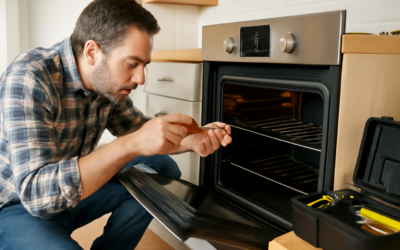
Replacement is one of the most DIY-friendly appliance repairs: unplug and shut off gas, remove two mounting screws and one wiring connector, and reverse with the new part. Parts run $20 to $60; the job takes 30 to 45 minutes. An appliance tech charges $150 to $300 for the same swap, which is reasonable if you prefer not to work near a gas burner assembly at all — a legitimate choice.
Other Culprits Worth Checking
When the igniter tests fine, work down this list. The temperature sensor (a thin probe in the upper back corner of the cavity) drifts with age; most read about 1,080 to 1,100 ohms at room temperature, and a bad one causes wild temperature errors or error codes — a $15 to $40 part. The bake element spark system on older pilot-style ovens is different: a standing pilot that has gone out can often be relit following the instructions on the appliance label, but if the pilot will not stay lit, the thermocouple or safety valve needs professional attention. A tripped thermal fuse after a self-clean cycle is a classic cause of a completely dead oven on some models. Clock and control lockouts embarrass everyone eventually — a delayed-start setting, Sabbath mode, or a control lockout will silently prevent heating, so check the manual before checking the wiring. Finally, a failed safety valve or control board is possible but statistically far behind the igniter; let a tech condemn those parts, since misdiagnosing them wastes $100-plus in parts.
What Not to Do
A few practices show up in online advice and belong nowhere near a gas appliance. Do not bypass or jumper the safety valve or igniter circuit “to test” — that circuit is the only thing preventing unburned gas from filling the oven. Do not repeatedly cycle an oven that is not lighting; each attempt can release small amounts of gas, and you should air out the kitchen between tests. Do not use flame to test for leaks (soapy water on fittings is the correct method, and it is a technician’s job on oven internals). And do not run an oven that lights with a boom, a persistent gas smell, or sooty yellow flames — those are combustion problems that need professional service and can produce carbon monoxide. Every kitchen with gas appliances should have a working CO alarm on the same floor.
Repair Costs and the Replace Decision
Typical numbers for a gas oven not heating up: DIY igniter swap $20 to $60; professional igniter replacement $150 to $300; temperature sensor $100 to $200 installed; safety valve $150 to $350; control board $200 to $500. Against a new gas range at $600 to $1,500 for mid-market models, the math is friendly to repair for igniters and sensors at any appliance age, and hostile to board and valve repairs on ranges past 12 to 15 years.
The encouraging truth is that this failure is usually the cheap one. An oven that clicks or glows but never lights is asking for a $40 part and half an hour of careful work — with the gas off, the plug pulled, and a firm commitment to walk outside and call the utility the moment anything smells wrong.