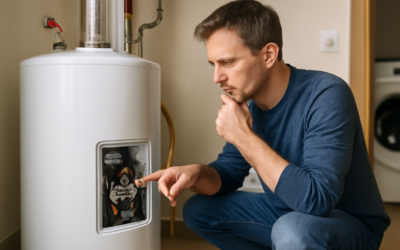
Standing in front of your water heater trying to figure out whether the gas valve for water heater on or off is set correctly is a surprisingly common moment of doubt, and getting it right matters for both hot water and safety. The good news is that reading these valves is straightforward once you know what the markings mean. The important news is that shutting the gas fully off is not something to do casually — relighting a system incorrectly, or ignoring a gas smell, is genuinely dangerous.
Safety first, before anything else: if you smell gas — a rotten-egg, sulfur odor — do not touch any valve, switch, or flame. Leave the home immediately, get everyone out, and from a safe distance call your gas utility’s emergency line or 911. Do not go back in until they clear it. For any valve that’s stuck, leaking, or behaving strangely, call a licensed plumber or gas technician rather than forcing it.
The Two Valves You’re Actually Looking At
Most gas water heaters have two separate gas controls, and people mix them up constantly:
- The manual shutoff valve — a lever or handle on the gas supply pipe a foot or two above the heater, before the gas enters the unit. This is the whole-heater on/off.
- The gas control valve (the thermostat) — the box mounted on the front of the tank where the gas line connects, usually with a red or black dial reading OFF, PILOT, and ON, plus a temperature setting.
Understanding which one you’re looking at is half the battle. The pipe lever controls gas flow to the unit; the front dial controls what the unit does with that gas.
How to Read the Manual Shutoff Lever
The lever on the supply pipe follows a simple, universal rule that applies to nearly all gas shutoff valves in a home:
- Handle parallel (in line) with the pipe = ON. Gas flows through.
- Handle perpendicular (crosswise, 90 degrees) to the pipe = OFF. Gas is blocked.
So if that lever runs the same direction as the pipe, gas is on. If it sits sideways across the pipe like a “T,” it’s off. For normal operation, this valve stays fully ON. You’d only turn it perpendicular for a repair, an emergency, or extended vacancy.
How to Read the Front Gas Control Dial
The gas control valve on the front of the tank is what most people mean when they ask about the water heater’s gas setting. It has three positions:
- ON — Normal running position. The pilot stays lit and the main burner fires whenever the water cools below your set temperature. This is where the dial lives day to day.
- PILOT — Used only during the lighting procedure. In this position gas flows only to the pilot so you can light it, but the main burner won’t fire.
- OFF — Cuts gas to both the pilot and the burner. The pilot goes out. This is used for servicing, draining the tank, or a safe shutdown.
For everyday use, this dial should be set to ON with the temperature at a safe, efficient level — around 120°F is the standard recommendation to prevent scalding and slow mineral buildup, though many run it at 125°F for a bit more hot-water reserve.
So Should It Be On or Off?
Under normal circumstances, both valves stay ON: the pipe lever open (parallel), and the front dial set to ON. That’s the running state that gives you hot water and keeps the pilot lit. You leave it that way for years at a time.
You would turn the gas OFF only in specific situations:
- You smell gas (leave first, then call the utility — don’t linger to shut valves unless it’s safe and instructed).
- You’re draining or replacing the tank.
- A plumber or technician is servicing the unit.
- The tank is leaking water and you need to shut it down safely.
- You’re leaving the home vacant for an extended period, though many people simply turn the dial to a “vacation” setting instead.
The Critical Warning About Shutting It Off
Here’s the part that deserves real attention. Turning the gas fully off means the pilot light goes out. To get hot water back, someone has to safely relight the pilot — and that involves purging air from the gas line, waiting for gas to clear, and following the exact lighting sequence printed on the tank. Do it wrong and you can create a dangerous flash of accumulated gas.
Never fully close the gas supply valve unless you’re confident you can safely relight and purge the system. If you’re not sure, don’t shut it off — and if you’ve already shut it off and aren’t comfortable relighting, call a licensed plumber or gas technician. This isn’t a place to guess.
If You Do Need to Relight the Pilot
Only attempt this if you’re confident and there’s no gas odor. Follow the label on your specific unit; the general modern (piezo-ignitor) sequence is:
- Turn the front control dial to OFF and wait a full 5 to 10 minutes for any lingering gas to clear. Do not rush this step.
- Confirm the supply lever on the pipe is ON (parallel).
- Set the dial to PILOT and press it down to start gas flowing to the pilot.
- While holding it down, click the red igniter button repeatedly until the pilot lights (view it through the sight glass).
- Keep holding the dial down for 30 to 60 seconds to let the thermocouple heat up, then release. The pilot should stay lit.
- Turn the dial to ON. The main burner should fire when there’s a hot-water demand.
If the pilot won’t stay lit, stop. A failing thermocouple or a gas supply problem needs a professional. Don’t keep cycling gas into the burner chamber.
Signs Something Is Wrong
Call a pro if you notice any of these:
- A persistent gas smell near the unit (leave first, then call from outside).
- A pilot that keeps going out on its own.
- Soot, scorching, or a yellow, lazy burner flame instead of crisp blue.
- A shutoff valve that’s seized, hard to turn, or hissing.
- Water pooling around the base combined with any gas concern.
Frequently Asked Questions
Which way is the gas valve on for a water heater?
On the supply pipe, the handle is ON when it’s parallel (in line) with the pipe and OFF when it’s perpendicular. The front control dial is on when set to the ON position.
Should I turn off the water heater gas when I go on vacation?
For short trips, use the “vacation” or “low” setting on the dial rather than shutting gas off, so you don’t have to relight the pilot. For long absences, some people shut it off — but only if they can safely relight it on return, or plan to call a pro.
Is it safe to turn the gas valve off myself?
Turning the pipe lever to off is simple, but the consequence — a dead pilot needing a proper relight and purge — is where risk lives. If you’re not confident relighting, don’t shut it off, or have a licensed technician handle it.
What do I do if I smell gas near the water heater?
Leave the home immediately without touching switches, flames, or valves, get everyone out, and call your gas utility’s emergency line or 911 from a safe distance. Do not return until it’s cleared.
Why does my pilot light keep going out?
The most common cause is a worn thermocouple that no longer keeps the gas valve open, but it can also be drafts, a dirty pilot orifice, or a venting problem. This is a job for a licensed plumber or gas technician.
For day-to-day life, leave both valves on and the temperature around 120°F, and you’ll never think about it. Just respect what “off” really involves — and when in doubt about gas, err toward calling a professional. It’s the cheapest insurance in the house.