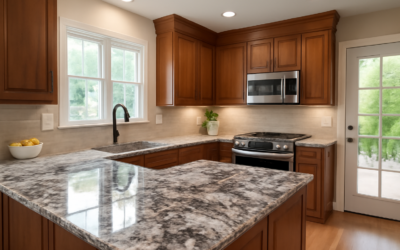
Great Falls sits in one of the most sought-after corners of Northern Virginia, where large traditional homes and high expectations for finish quality go hand in hand. If you’re weighing a granite countertop in Great Falls VA for a kitchen remodel or a bath refresh, you’re making a choice that fits the area’s luxury housing stock and holds its value well at resale. Granite remains a favorite here because it delivers natural stone character, real durability, and a look that suits the classic architecture common throughout Fairfax County. Here’s how to plan the project for this specific market.
Part of our Countertops guide — explore the full guide →
Why Granite Fits Great Falls Homes
Homes in Great Falls tend toward traditional and transitional styles, with formal kitchens, generous islands, and an emphasis on materials that read as substantial. Granite answers all of that. Its natural veining and depth suit the wood cabinetry and rich color palettes you see throughout the neighborhood, and its hardness stands up to the daily use of a busy family kitchen.
Resale is worth keeping in mind in this market. Buyers in the DC metro area expect natural stone in an upper-tier home, and a well-chosen granite counter signals quality without locking you into a trend that will date the kitchen. That combination of beauty and market appeal is why granite continues to hold its ground even as quartz has gained popularity.
Local Price Ranges to Expect
Pricing in the Northern Virginia and greater DC market tends to run a bit above the national average, reflecting higher labor and demand. For installed granite, homeowners in this area commonly see ranges of roughly $50 to $120 per square foot, including fabrication and installation. Entry-level granite in common colors sits at the lower end, while exotic slabs with dramatic movement or rare coloring push toward the top and sometimes beyond.
Several factors move you within that band. Edge profiles beyond a standard eased edge, cutouts for undermount sinks and cooktops, backsplash work, and the number of seams all add labor. A large island cut from a single slab to avoid a seam costs more but looks far cleaner. As a rough planning figure, a mid-size kitchen with 40 to 50 square feet of counter can land anywhere from several thousand dollars to well into five figures depending on the stone you fall in love with.
Popular Styles for the Area
Certain looks pair especially well with the traditional and luxury homes typical of Great Falls. A few directions consistently work:
- Classic whites and creams: Stones with soft neutral backgrounds and subtle veining brighten large kitchens and complement both white and stained cabinetry.
- Warm browns and golds: Movement-rich browns flatter the wood tones and warm palettes common in traditional NoVA homes.
- Deep blacks and charcoals: A darker granite makes a striking island or a dramatic perimeter against light cabinets.
- Gray and white blends: For transitional kitchens, cooler grays bridge classic and contemporary tastes.
Whatever direction you choose, always view the actual slab in person rather than committing off a small sample. Granite varies dramatically from one slab to the next, and the piece that ends up in your kitchen should be the one you personally approved on the fabricator’s floor.
Climate and Humidity Considerations
Northern Virginia summers bring real heat and humidity, and winters swing cold, so your kitchen sees a wide range of indoor conditions. Granite handles this well; it’s dimensionally stable and won’t warp or swell with humidity the way some materials might. That stability is one more reason it suits the local climate.
The one area to stay on top of is sealing, which matters more in a humid environment where moisture is always present. A properly sealed granite surface resists staining from water, wine, and cooking oils. In kitchens near the region’s many wooded lots, where windows stay open in the shoulder seasons, keeping the seal fresh keeps the stone looking its best.
Sealing and Everyday Care
Granite is porous, so sealing is the key maintenance task. Most installers seal the stone before they leave, and you’ll typically want to reseal every year or two depending on the stone’s density and how hard the kitchen works. A simple test tells you when: drop a small puddle of water on the counter and watch it. If it beads up, the seal is holding; if it soaks in and darkens the stone within a few minutes, it’s time to reseal.
Day to day, clean with warm water and a mild dish soap or a cleaner formulated for stone. Skip harsh acidic products like vinegar and lemon-based cleaners, which can dull the finish and break down the sealer over time. Wipe spills promptly, use cutting boards to protect both the stone and your knives, and set trivets under very hot pans as a matter of habit even though granite tolerates heat well.
Working With Local Fabricators
The DC metro area has a deep bench of stone fabricators and importers, which works in your favor. Rather than picking the first shop you find, gather a few detailed written estimates that spell out the stone, thickness (3-centimeter slabs are standard for kitchens), edge profile, sink and cooktop cutouts, seam locations, and the sealing included. Comparing itemized quotes side by side tells you far more than a single bottom-line number.
Ask to see and tag your specific slab, confirm who handles templating and installation, and verify their timeline; a typical project runs a couple of weeks from template to install once you’ve selected material. Confirm licensing and insurance, and read recent independent reviews to gauge workmanship. A reputable local fabricator will template with a digital measuring tool for a precise fit against your cabinets and walls.
Granite Versus Other Materials
It’s worth knowing where granite stands against the alternatives buyers in this market also consider. Quartz, an engineered stone, has surged in popularity because it never needs sealing and offers consistent, predictable patterns. Marble delivers a softer, more luxurious look but is more prone to etching and staining, which makes it a higher-maintenance choice for a working kitchen.
Granite occupies a sweet spot for many Great Falls homeowners: it’s fully natural, extremely heat and scratch resistant, and available in a range that spans budget-friendly to genuinely exotic. If you love the idea of a one-of-a-kind natural slab and don’t mind resealing periodically, granite is hard to beat. If zero maintenance is your priority, quartz may edge it out, but you sacrifice the natural depth that makes granite special.
Planning Your Timeline and Budget
Give the project room to breathe. Between choosing a slab, templating after cabinets are set, fabrication, and installation, plan for two to four weeks. Build a small contingency into your budget for edge upgrades or a pricier slab that catches your eye, since the stone selection is where most people happily spend a little more than they planned.
Approached carefully, a granite countertop in Great Falls VA is an investment that elevates the kitchen, suits the area’s homes, and rewards you with a durable surface for decades. Do the homework on stone selection, pricing, and your fabricator, and you’ll end up with a counter that looks right at home in this corner of Northern Virginia.