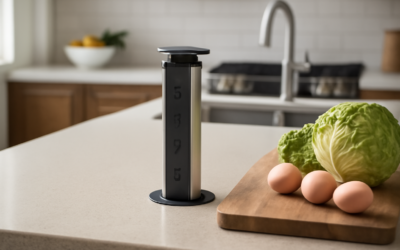
The cleanest way to add power to a kitchen island without cluttering the backsplash is a granite countertop pop up outlet, a receptacle that stays flush and hidden until you press it and it rises out of the stone. A well-installed granite countertop pop up outlet preserves the uninterrupted look of a granite slab while giving you code-compliant power exactly where you prep, charge, and plug in small appliances.
Part of our Countertops guide — explore the full guide →
This guide covers how these units work, the exact hole size you need, the electrical code rules that apply, realistic costs, and how the installation goes in real granite.
How a Pop-Up Outlet Works
A pop-up outlet is a spring-loaded or motorized power tower that mounts through a hole cut in the countertop and sits in a canister below the stone. When retracted, only a low-profile chrome, black, or brushed-nickel cap shows, sitting nearly flush with the surface. Press the cap and the receptacle assembly rises 3 to 5 inches, exposing two or three outlets and often USB-A and USB-C ports.
Two mechanisms exist. Manual push-push units pop up when you press them and push back down by hand; they are simpler and have nothing to burn out. Motorized units rise and lower at the touch of a button and look sleeker, but they add cost and a small motor that can eventually fail. For a granite island that gets daily use, most homeowners are happiest with a quality manual unit.
Choosing the Right Unit for Granite
Granite is thicker and harder than laminate, so pick a pop-up rated for stone with an adjustable collar that accommodates a 1-1/4-inch to 1-1/2-inch slab plus any plywood substrate. Key features to compare:
- Outlet count: two or three grounded receptacles, ideally with USB charging built in
- Water resistance: a spill-resistant or IP-rated cap matters on a kitchen surface
- Listing: UL or ETL listed for safety and to pass inspection
- Cap finish: match your faucet and hardware for a cohesive look
- Canister depth: confirm it clears any drawers or structure below the counter
Measure the space under your island before buying. A retracted canister needs roughly 6 to 8 inches of clear vertical space below the countertop, which can conflict with a drawer bank or a farmhouse sink cabinet.
The Hole Size and Cutting the Granite
Most pop-up outlets require a cored hole of about 3-1/8 inches or 4 inches in diameter, but always confirm the exact spec in your unit’s instructions before anyone touches the slab. Cutting granite is not a DIY job with a regular drill. It requires a diamond core bit, water cooling to control dust and heat, and steady technique to avoid cracking the slab.
If your countertop is already installed, hire the original fabricator or a stone specialist to core the hole on-site with a wet diamond bit. Expect $100 to $250 for a professional on-site core. If the slab is not yet installed, have the fabricator cut the opening in their shop where they can control the cut precisely. Coring near a seam or an edge under 3 inches away risks cracking, so plan the location carefully.
Location planning goes beyond the stone. Pick a spot where the canister below will not collide with a drawer glide, a sink bowl, a dishwasher, or a structural rail inside the island. Trace the canister diameter and depth on the underside first and check clearances with a tape measure. Keep the pop-up back at least a few inches from the counter’s front and back edges so the mechanism has support on all sides and you are not coring into a fragile overhang.
Electrical Code You Cannot Skip
Countertop receptacles in kitchens fall squarely under the National Electrical Code, and a pop-up outlet is no exception. Two rules matter most. First, kitchen countertop receptacles generally must be GFCI protected, either by a GFCI breaker or an upstream GFCI device, because they sit in a wet location. Second, they must be fed by the kitchen small-appliance circuits, typically 20-amp, 120-volt circuits.
Local codes vary, and some jurisdictions have specific rules about whether a pop-up can count toward required countertop receptacle spacing. Because this involves running a branch circuit and a permit-worthy connection, most homeowners should hire a licensed electrician for the wiring even if they handle the cabinet-side mounting. An inspection protects you and your insurance.
Installation Step by Step
With the hole cored and power available below, the mechanical install is manageable. The general sequence looks like this:
- Shut off the circuit at the panel and verify it is dead with a tester.
- Feed the pop-up canister up through the cored hole from below, or drop it in from above depending on the model.
- Adjust the mounting collar to clamp the unit to the slab thickness, snugging evenly so the cap sits flush.
- Connect the supply wiring to the unit’s whip or terminals: hot, neutral, and ground, following the manufacturer’s diagram.
- Secure any support bracket to the cabinet so the canister does not hang solely on the stone.
- Restore power and test each outlet and the GFCI trip-and-reset.
Take care tightening the collar against granite. Overtightening can chip the underside of the slab, so bring it up gradually and check the cap for flush seating as you go.
Costs to Budget
The unit itself runs a wide range. A basic manual UL-listed pop-up with two outlets and USB starts around $60 to $120. Better manual units with spill resistance and premium finishes run $120 to $250. Motorized models climb to $250 to $500. Add $100 to $250 for professional coring and, if you need a new circuit run, $200 to $600 in electrician labor depending on how far the panel is and how accessible the island wiring path is.
All in, a typical installation with a mid-range manual unit and professional coring lands somewhere around $400 to $900. That is a modest investment for eliminating extension cords snaking across a beautiful granite island.
Maintenance, Troubleshooting, and Alternatives
Pop-up outlets live in a wet, crumb-prone environment, so a little care keeps them working. Wipe the cap and receptacle body with a dry or barely damp cloth; never spray cleaner directly into the mechanism or down the canister. Crumbs and grit are the enemy of the spring or motor, so brush debris away from the seam rather than letting it fall inside when the unit is up.
If a manual unit stops popping cleanly, the spring or latch may have collected residue; a shot of dry silicone lubricant on the guide posts, not a wet oil, usually restores smooth travel. For a motorized unit that dies, first check the outlet or hardwired feed below is live and the reset button has not tripped. Because the whole assembly is UL-listed and modular, a failed canister can typically be unclamped and swapped without disturbing the granite, provided the hole size matches.
A pop-up is not the only way to power an island. If the tidy, hidden look is not a priority, a few alternatives cost less and involve no coring of the stone. An outlet mounted in the side of the island cabinet, facing the seating side, is simple and code-compliant in many jurisdictions, though cords then run across the cabinet face. A power strip mounted under the counter lip keeps cords off the surface for charging.
- Side-of-cabinet outlet: cheapest, no stone cutting, but visible cords
- Under-counter mounted strip: good for phone charging, hidden from above
- Countertop pop-up: cleanest surface, highest cost, requires coring
Weigh how much the uninterrupted granite look is worth to you against the added cost and the irreversible hole. For a showpiece island, the pop-up usually wins; for a utilitarian workspace, a side outlet does the job for a fraction of the price.
Is It the Right Choice?
A pop-up outlet shines on islands and peninsulas where there is no adjacent wall for a standard backsplash receptacle, and anywhere you want the stone to remain visually clean. If you have an accessible wall nearby, a conventional GFCI outlet is cheaper and simpler. But for a freestanding granite island, few solutions match the tidy, disappear-when-not-needed convenience of a well-chosen granite countertop pop up outlet, provided you cut the hole professionally and wire it to code.