Green is the color designers reach for when a space feels flat but nobody can say why. Green wall paint colors read as both a neutral and an accent, borrowing the calm of blue and the warmth of yellow at the same time. That flexibility is exactly why picking the right green trips people up. A sage that looks serene in the store can turn gray and cold under north light, while a mint that seemed fresh online can go minty-toothpaste on a large wall. This guide breaks down the shades that actually work and where to use them.
Part of our Paint & Walls guide — explore the full guide →
- Why Green Works in Almost Any Room
- The Main Families of Green
- How Light Changes Your Green
- Pairing Green With Other Colors
- Best Green Paint Colors by Room
- Finish and Sheen Matter
- Application Tips for a Clean Finish
- Understanding Green's Undertones
- Green in Small Spaces vs. Large Rooms
- Caring for Green Painted Walls
- Making the Final Choice
Why Green Works in Almost Any Room
Unlike bold reds or saturated blues, green has a biological pull. Our eyes register more shades of green than any other color, and rooms painted in it consistently test as restful in design studies. It pairs naturally with wood tones, brass, black, and white, which means a green wall rarely fights the furniture you already own. From a resale standpoint, muted greens have quietly replaced gray as the safe-but-interesting choice buyers respond to.
The key is matching the green’s undertone to the room’s light. Warm greens with yellow undertones flatter north-facing rooms that get cool light. Cooler, blue-leaning greens calm down bright south-facing spaces that can otherwise feel harsh.
The Main Families of Green
Sage and Soft Gray-Greens
These are the most livable green wall paint colors and the easiest to commit to. Sherwin-Williams Evergreen Fog and Benjamin Moore October Mist read as sophisticated neutrals, shifting between green and gray depending on the light. They suit bedrooms, living rooms, and kitchen cabinets. Because they are desaturated, they rarely overwhelm a space, making them a low-risk first move into color.
Olive and Earthy Greens
Olive brings warmth and a grounded, organic feel. Farrow & Ball Bancha and Sherwin-Williams Ripe Olive lean rich and enveloping, gorgeous in dining rooms, studies, and powder rooms where a cocooning mood works. These deeper tones pair beautifully with warm brass, walnut, and cream. In a small room, a full olive treatment including the trim can feel intentional rather than cramped.
Forest and Deep Emerald
When you want drama, a saturated forest green delivers. Benjamin Moore Hunter Green and Sherwin-Williams Pewter Green anchor a room with real depth. They shine on accent walls, built-in bookcases, and moody home offices. Balance them with plenty of white trim and natural light so the space reads as luxurious, not dark.
Mint and Fresh Pastels
Light, cool greens brighten bathrooms, laundry rooms, and nurseries. Sherwin-Williams Sea Salt is technically a green-gray but reads fresh and clean. True mints add a retro cheerfulness. Use these where you want energy and lift rather than calm and cocoon.
How Light Changes Your Green
No paint decision matters more than testing under your own light. A green wall in a north-facing room will pull cooler and grayer, so choose a shade a step warmer than you think you want. South-facing rooms flood with warm light that intensifies green, so a muted pick keeps it from going lime. West light in the afternoon adds golden warmth, and east light in the morning cools everything down.
Always buy sample pots and paint at least a 2-by-2-foot swatch on two different walls. Look at it in the morning, midday, and under your evening lamps. Cheap peel-and-stick paint samples save the hassle of patchy walls, and they let you move the color around the room.
Pairing Green With Other Colors
- Green and warm white: The safest, brightest combination. Use a creamy white like Benjamin Moore White Dove on trim.
- Green and black: Modern and crisp. Black window frames or hardware sharpen a sage or forest wall.
- Green and terracotta: A warm, earthy pairing that feels current and organic.
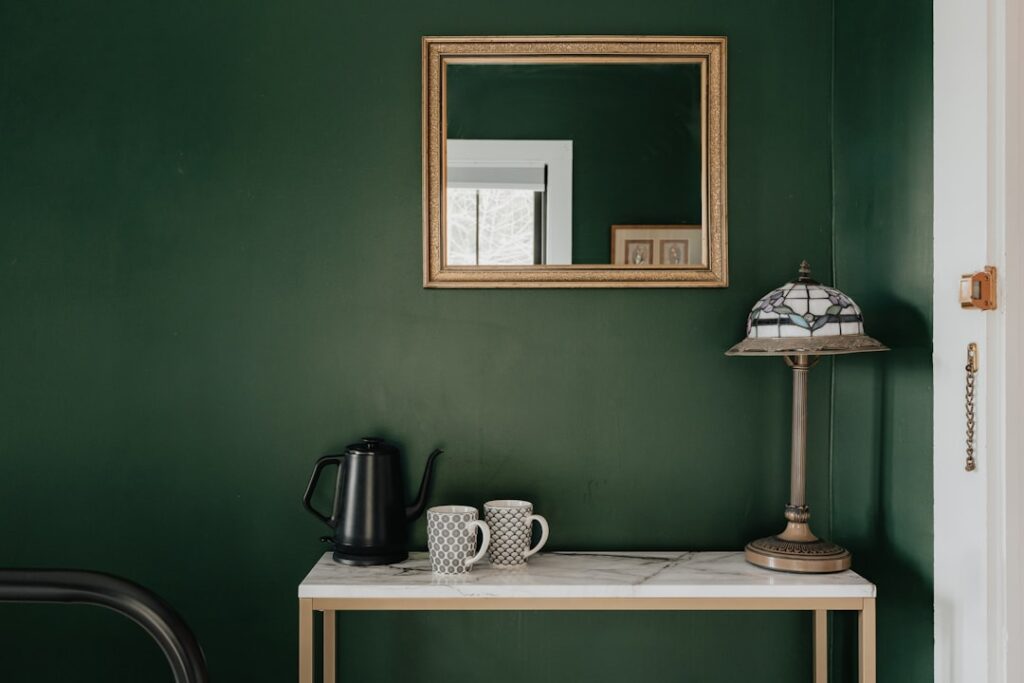
- Green and brass: Timeless. Brass lighting and hardware glow against deep greens.
- Green and blush pink: Soft and unexpected, ideal for bedrooms and nurseries.
Best Green Paint Colors by Room
Matching the shade to the room’s job produces the most satisfying result. In bedrooms, soft sages and gray-greens promote rest. Kitchens handle both muted olive cabinets and fresher green-gray walls, especially with white counters. Living rooms carry deeper forest or a warm sage on all four walls. Home offices benefit from a saturated green that signals focus without harshness. Bathrooms come alive with mint or sea-glass tones that echo water and freshness.
Finish and Sheen Matter
The same green looks different in matte versus satin. For walls, a matte or eggshell finish hides imperfections and gives green its soft, chalky depth. Trim and doors take satin or semi-gloss for durability and contrast. In a moody deep-green room, a matte or dead-flat finish reads especially luxurious, though it is harder to wipe clean, so reserve it for low-traffic rooms. Kitchens and baths call for a scrubbable satin that stands up to moisture and hands.
Application Tips for a Clean Finish
Green pigments, especially the deeper ones, can require two coats plus a tinted primer for full coverage. Skipping primer on a dark forest green often means a third coat and streaky results. Use a quality 3/8-inch nap roller for smooth walls, cut in edges with a good angled brush, and keep a wet edge to avoid lap marks. Let each coat dry the full recommended time, usually 4 hours, before recoating. Plan on one gallon per 350 to 400 square feet per coat.
Understanding Green’s Undertones
Every green carries a hidden undertone that surfaces once the paint is on the wall, and ignoring it is the fastest route to disappointment. Yellow-green undertones, common in sages and olives, read warm and cozy but can veer toward mustard in strong sun. Blue-green undertones, found in sea-glass and teal-leaning shades, feel cool and crisp but can turn cold in a north-facing room. Gray-green undertones give the muted, sophisticated look that dominates current design, sitting quietly between color and neutral.
To read a green’s undertone before you buy, compare the swatch against a pure white card. Next to true white, the underlying yellow, blue, or gray jumps out. Also look at the darkest color on the same paint strip, which exaggerates and reveals the undertone hiding in the lighter shade above it. This two-minute check saves you from the green that looked perfect on the chip and turned muddy on the wall.
Green in Small Spaces vs. Large Rooms
Scale changes how green behaves. In a small powder room, entryway, or home office, a deep green like forest or emerald wraps the space in a jewel-box richness that feels intentional rather than cramped, especially with the trim and ceiling painted the same tone. Small rooms are where you can be bold, because you are not committing the whole house.
Large, open rooms call for restraint. A saturated green across four big walls in an open-plan living space can overwhelm, so muted sages and gray-greens carry expansive rooms better, giving color without heaviness. If you love a deep green but the room is big, confine it to a single accent wall or a set of built-ins and let a soft neutral handle the rest. Balancing the intensity to the room size keeps green feeling like a designer choice instead of an accident.
Caring for Green Painted Walls
Green walls, especially deeper matte finishes, show fingerprints and scuffs around light switches, doorways, and behind furniture. Keep a small labeled jar of your leftover paint for touch-ups, since color-matching green after the fact is notoriously tricky. For routine cleaning, wipe gently with a barely damp microfiber cloth and mild soap; harsh cleaners can burnish matte paint and leave a shiny spot. In high-traffic zones, the scrubbable premium paint lines pay for themselves by surviving repeated cleaning without fading. With a little care, a good green holds its depth and color for a decade or more.
Making the Final Choice
The right green comes down to three questions: how much light the room gets, what mood you want, and what wood and metal tones are already in play. Start with a muted sage or gray-green if you are nervous, or commit to a rich olive or forest if the room can carry it. Whatever you choose, sample it large and live with it for a couple of days. Green wall paint colors reward patience, and the shade that survives a full day of changing light is the one that will keep making you happy long after the brushes are clean.