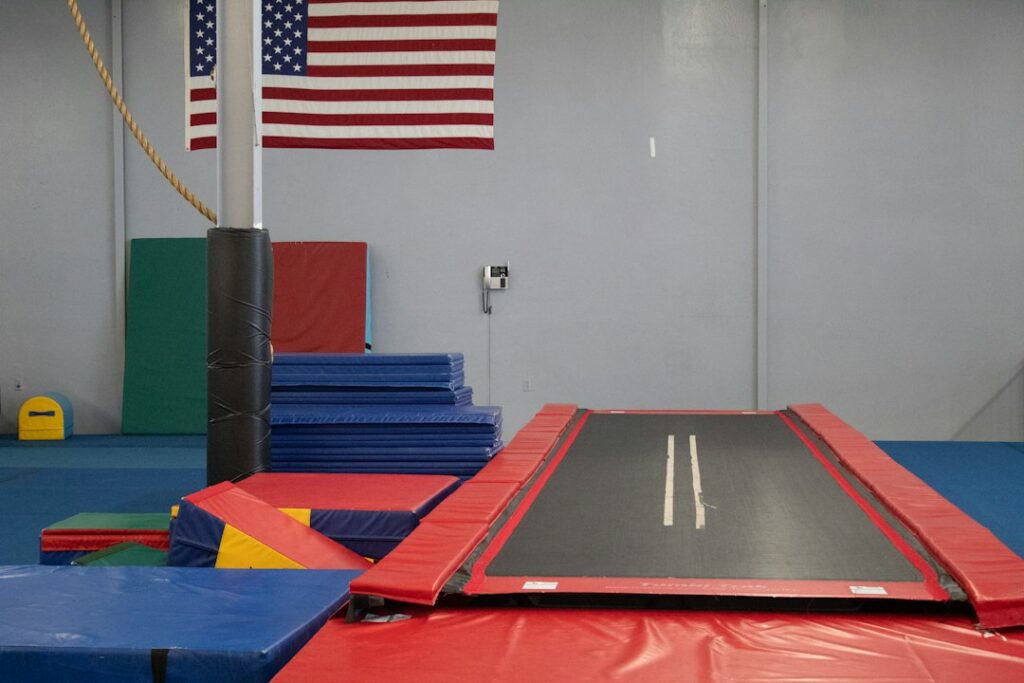
Setting up a home gymnastics space is no longer the exclusive territory of competitive families. A growing share of parents install gymnastic floor mats in basements, garages, and converted bedrooms for kids practicing cartwheels and back handsprings between weekly classes. The right mat thickness, foam density, and surface vinyl determine whether a 9-year-old learning a back walkover sticks the landing or bruises her tailbone. Expect to budget $180 to $1,400 for a usable home gymnastics setup depending on size and skill level.
Panel Mats — The Workhorse Category
Folding panel mats are the most-purchased gymnastic floor mat for home use. The standard configuration is four panels measuring 24×48 inches each, total 4×8 feet open, folding to 24×24 for storage. Foam thickness:
- 1.5-inch foam: entry level, suitable for stretching, basic floor work, kids under 50 lbs
- 2-inch foam: the standard recommended thickness for cartwheels, walkovers, and recreational skills
- 2.5-inch foam: for tumbling progressions including front and back handsprings
- 4-inch landing mats: for releases and harder skills (not foldable in the same way)
Standard expanded polyethylene (EPE) foam at 1.7 lbs/cu ft density is the industry baseline. Cheaper imports often use lower-density 1.2 lb/cu ft foam, which compresses permanently after a few months of regular use.
Top Brands Worth Considering
The serious gymnastics equipment brands carry products built for repeated impacts and frequent commercial use:
- Tumbl Trak: the industry leader, supplies Olympic training facilities and most US gyms. Standard 4×8 panel mat: $159-$229.
- Z-Athletic: mid-tier home and competition mats, frequent Amazon retailer. 4×8 panel mat: $129-$199.
- Norbert’s Athletic Products: commercial-grade beams, mats, and pits. Premium pricing $250+ for panel mats.
- FBSPORT: budget end, OK for very young kids learning stretches. 4×8 mat: $89-$129.
- Resilite: known for wrestling mats but offers gymnastics products built to NCAA specifications.
Skip generic Amazon brands without verified construction specs. A “2-inch foam” listing can mean anything from open-cell polyfoam (worthless for impact) to proper closed-cell EPE.
Surface Vinyl and Construction
The 18-ounce vinyl cover is what holds the mat together and resists tears. Specs that matter:
- 18-ounce minimum vinyl (commercial grade)
- Anti-bacterial and flame-retardant treated
- Welded seams (not stitched) on quality mats
- Hook and loop fastener strips along long edges to connect mats side by side
Lower-grade mats use 14-ounce or 16-ounce vinyl that tears at the panel corners within 18 months of regular use. Welded seams resist water and don’t unravel — important if the mat ever gets wet during cleaning.
Sizing for Home Use
Match mat coverage to skill level and available room:
- Single 4×8 panel mat: stretching, basic floor work, single skills. 32 sq ft footprint.
- Two connected 4×8 mats (4×16 ft strip): cartwheel pass, walkover series, kid-level tumbling.
- 4×10 ft long panel mat: one-piece option for back handspring practice with no panel seams to land on.
- 5×10 ft cheese wedge mat: separate piece for back handspring drills and progressions.
- Carpet bonded foam tiles (10×10 area): creates a competition-style sprung floor feel for $800-$1,400.
A basement with 8-foot ceilings limits skill development. Back tucks and similar aerials need 10-foot minimum ceiling height — anything less risks the gymnast hitting the ceiling.
Density and Impact Absorption
Foam density determines how the mat performs when a body lands on it. The metric is foam impact resistance, but most manufacturers don’t publish ASTM F1292 numbers for residential mats. Practical proxies:
- Drop a 25-lb medicine ball onto the mat from 3 ft height
- Quality 2-inch mat: ball bounces about 6-8 inches
- Soft/cheap mat: ball barely bounces, foam stays compressed
- Too-firm mat: ball bounces 18+ inches, foam doesn’t absorb
The right mat takes most of the impact energy without bottoming out to the floor below. If you can feel the floor through the mat when an adult jumps on it, the mat is too thin or too soft for the intended use.
Where to Place the Mat
The subfloor matters as much as the mat itself. Best surfaces for gymnastic mats:
- Concrete slab with 1/4-inch underlayment foam — most common home gym setup
- Wood subfloor — slightly more forgiving, fine for kids’ use
- Carpet over plywood — adds 1/2 inch of give, works for younger gymnasts
Avoid placing mats over thick plush carpet without a hard underlayment — the mat shifts during skills and can create rolled-ankle hazards. For garages with epoxied concrete, add a 1/4-inch EVA puzzle floor underneath the panel mat to soften impacts.
Cleaning and Maintenance
Vinyl-covered foam mats clean easily but need correct products. Use:
- Mild soap (Dawn dish detergent in warm water)
- Soft cloth, no scrub brushes
- Optional: Mat-Wash or similar antimicrobial formulated for gym equipment
Skip bleach, ammonia, and alcohol-based cleaners — they degrade the vinyl coating. A weekly wipe-down extends mat life by years. Store folded mats in a dry space; humid garages cause mildew growth at the foam seams within a season.
Storage and Folding
Most home setups need mats that fold compactly between sessions. The standard 4-panel design folds to 24x24x8 inches — fits behind a couch, under a bed, or against a basement wall. Look for:
- Reinforced fold lines (extra vinyl strip across the seam)
- Carrying handle (saves your back)
- Color-coded panels for easy reassembly
Five-panel and six-panel mats fold into longer narrower stacks (24x24x10 to 24x24x12) — useful for closet storage but harder to carry one-handed.
Cost vs Value
For a basic home setup with a 4×8 panel mat from Tumbl Trak ($199) and a 4×10 ft long panel mat for skill practice ($299), total investment is around $498. Add a cheese wedge ($229) and you’re at $727 for a setup that supports skills through Level 4 USAG gymnastics. Competition-track families typically scale up to $1,500-$3,500 in home equipment over several years.
Prefer to explore on your own?
See how new flooring looks in your actual room in seconds — free, no signup.
Try the free Floor Studio →