
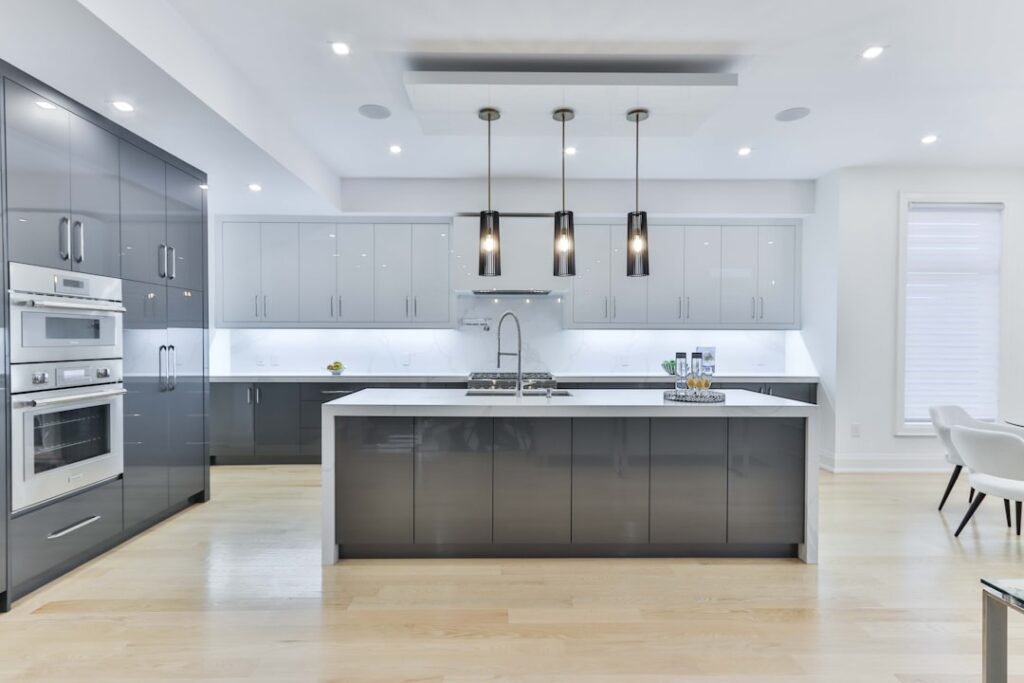
Walk into a kitchen lit by warm puck lights along the counter and there is a good chance you are looking at halogen. For years, halogen under cabinet lighting set the standard for crisp, warm task light that made countertops glow and food prep genuinely easier to see. The color rendering is excellent, colors look true, and the beam has a sparkle that older fluorescent strips never matched.
Part of our Kitchen Remodeling guide — explore the full guide →
But halogen has a dark side, literally the heat it throws off and the short bulb life it delivers. As LED technology has matured, many homeowners are weighing whether to keep, repair, or replace their halogen fixtures. This guide covers how these lights work, their real drawbacks, safety concerns, and when it makes sense to switch to LED.
How Halogen Under Cabinet Lights Work
Halogen is a refined type of incandescent lighting. A tungsten filament sits inside a small quartz capsule filled with halogen gas, and when current heats the filament, it glows white-hot. The halogen gas recycles evaporated tungsten back onto the filament, letting the bulb run hotter and brighter than a standard incandescent while lasting a bit longer.
In under-cabinet form, these usually appear as small round puck lights recessed or surface-mounted beneath wall cabinets, or as linear xenon and halogen strips. Most run on low-voltage 12-volt current through a transformer, though some are line-voltage 120-volt. Common bulbs are 10-, 20-, or 35-watt capsules with a bi-pin base like the G4 or GY6.35.
The Light Quality Advantage
Where halogen still wins is sheer light quality. Its color rendering index, or CRI, sits at or near 100, meaning colors under the light look exactly as they would in daylight. For a home cook checking whether meat is done or matching the ripeness of produce, that accuracy matters. The color temperature lands around 2,900 to 3,000 Kelvin, a warm white that flatters wood cabinets and granite.
Halogen also dims smoothly down to a candle-like glow without the flicker or color shift that plagues cheap LEDs. If you love the ambiance of dimmed warm light spilling across a backsplash, halogen delivers it effortlessly. That warmth and dimming grace are the main reasons some homeowners resist giving it up.
The Heat Problem
Here is the deal-breaker for many people. Halogen bulbs convert roughly 90 percent of their energy into heat and only about 10 percent into light. A 20-watt puck can reach surface temperatures well above 500 degrees Fahrenheit at the lens. Mounted an inch below a wooden cabinet, that heat is a genuine concern.
Practical consequences pile up fast:
- Cabinet bottoms discolor and can scorch over years of use
- Chocolate, oils, and produce stored on the counter below warm up
- The kitchen gains noticeable heat load in summer, working against your AC
- A bulb touched with bare fingers picks up skin oil that creates a hot spot and shatters the quartz
Always handle halogen capsules with a cloth or gloves. The oil from your fingertips is enough to cause premature failure or, in rare cases, a bulb rupture.
Short Lifespan and Running Cost
Halogen bulbs typically last 2,000 to 4,000 hours. Run your under-cabinet lights four hours a day and you are replacing capsules every two to three years, sometimes sooner if the transformer runs them hard. Compare that to LED strips rated for 25,000 to 50,000 hours and the maintenance gap becomes obvious.
Energy cost widens the gap further. A run of six 20-watt halogen pucks draws 120 watts. Replace them with LEDs producing the same brightness and you might draw 18 to 24 watts total. Over a year of daily use, that difference shows up on your electric bill and adds up to real money, especially in a kitchen where the lights burn every evening.
Safety and Maintenance Tips
If you are keeping your halogen fixtures, a few habits reduce the risks. Never exceed the fixture’s rated wattage; dropping in a 35-watt bulb where a 20 belongs overheats the housing. Keep flammable items off the counter directly beneath the lights, and make sure the cabinet has some airflow rather than sealing the fixtures in a tight recess.
When a bulb dies, cut power at the switch and let the capsule cool fully before touching it, since it can stay searing hot for several minutes. Use a clean cloth to seat the replacement. If a transformer buzzes loudly or the lights flicker across the whole run, the transformer, not the bulbs, is usually failing and should be replaced by someone comfortable with low-voltage wiring.
Should You Upgrade to LED
For most homeowners, the answer is yes. Modern LED under-cabinet lighting has closed the quality gap that once justified halogen. You can now buy LED strips and pucks with a CRI of 90 or higher in a warm 2,700 to 3,000 Kelvin range, giving you nearly the same flattering light without the heat, the constant bulb swaps, or the energy waste.
You have two upgrade paths. The simplest is a retrofit LED bulb that drops into your existing halogen sockets, though these do not always play nicely with old magnetic transformers. The cleaner solution is replacing the entire fixture with a dedicated LED strip or puck system, often a plug-in or hardwired kit that installs in an afternoon. Expect $30 to $150 for a quality LED kit that covers a typical run of cabinets.
Retrofit Bulb vs Full Fixture Swap
When you decide to move to LED, you face a fork in the road. The fast path is dropping a retrofit LED capsule into your existing halogen sockets. These come in the same G4, GY6.35, and bi-pin bases and cost only a few dollars each. The problem is compatibility: older magnetic transformers were designed for the heavy load of a halogen filament, and a low-draw LED can flicker, buzz, or refuse to light on them. If your system uses an electronic transformer, retrofit bulbs usually behave better.
The more reliable route is replacing the whole fixture with a dedicated LED unit. Modern LED pucks and linear bars have the driver built in, sized correctly for the diodes, so you get flicker-free performance and smooth dimming with a compatible LED dimmer. A hardwired or plug-in LED strip also runs cooler, sits slimmer under the cabinet, and often includes a color-temperature switch so you can dial in exactly the warmth you liked about halogen. For anything more than one or two bulbs, replacing the fixtures gives the cleanest, most trouble-free result.
Comparing Running Costs Over Time
Put numbers to the decision and the case for switching sharpens. Assume a run of six 20-watt halogen pucks burning four hours a day. That is 120 watts for four hours, roughly 175 kilowatt-hours a year, plus the cost and hassle of replacing capsules every couple of years. At an average US electricity rate, that lighting alone costs $25 or more annually just to run, before bulb replacements.
Swap in LEDs producing the same brightness at around 20 watts total for the whole run, and your annual energy drops to under 30 kilowatt-hours, cutting that operating cost by more than 80 percent. Factor in that the LEDs last 25,000 hours or more, meaning no bulb changes for a decade or longer, and the total savings over the life of the fixtures easily runs into the hundreds of dollars. The upgrade pays for itself and then keeps paying.
Making the Right Call
Choose deliberately. If your halogen under cabinet lighting still works, throws light you love, and the cabinets show no heat damage, there is no urgent reason to rip it out. But once bulbs start dying, a transformer hums, or you notice scorching above the fixtures, treat that as the signal to upgrade. Switching to LED cuts your energy use, eliminates the fire-adjacent heat, and ends the every-other-year bulb ritual, all while keeping the warm, crisp task light that made you choose under-cabinet lighting in the first place.


