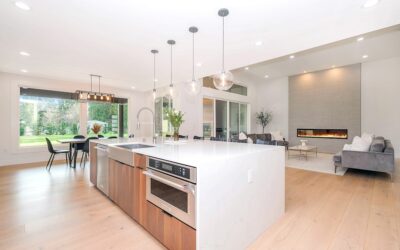
If butcher block has a default species, it’s hard maple. Every commercial butcher shop counter you’ve ever seen, every culinary school prep table, every classic New England kitchen island — hard maple, almost without exception. When a client asks me for “the” butcher block look with no further qualifiers, a hard maple butcher block countertop is what I spec, and after installing dozens of them I can tell you exactly why the species earned its reputation, where it falls short, and what you should be paying for it in 2026.
Part of our Countertops guide — explore the full guide →
- Why Hard Maple Became the Butcher Block Standard
- Grain Construction: Edge, End, and Face
- What a Hard Maple Butcher Block Countertop Costs in 2026
- Grade and Sapwood: Read the Fine Print
- Finishing: The Decision That Determines Everything Else
- Living With Maple: Honest Expectations
- Where I Spec Maple — and Where I Don't
Why Hard Maple Became the Butcher Block Standard
Hard maple — Acer saccharum, the sugar maple, the same tree that gives you syrup — rates 1,450 on the Janka hardness scale. That puts it well above red oak (1,290), cherry (995), and walnut (1,010), the other common butcher block species. For a work surface that takes knife strikes, dropped pans, and rolling-pin pressure, that hardness matters in a way it doesn’t on a floor.
But hardness isn’t the whole story. Hard maple has a tight, closed grain structure. Open-grained woods like red oak have visible pores that trap food particles and moisture — a genuine sanitation issue on a prep surface. Maple’s closed grain wipes clean, resists bacterial harborage, and takes an even finish without pore-filling. The USDA and NSF both historically approved hard maple for commercial food-contact surfaces for exactly this reason. It’s also blessedly stable: maple moves less seasonally than beech (the European butcher block standard) and machines cleanly without the tearout you fight with hickory.
The color is the third selling point. Hard maple sapwood runs pale cream to nearly white, brightening kitchens the way white oak or ash does but with a finer, calmer grain. If your kitchen leans Scandinavian, farmhouse, or classic white-shaker, maple reads correct in a way walnut’s chocolate tones never will.
Grain Construction: Edge, End, and Face
Every maple top is built one of three ways, and the construction affects price more than the species does.
- Edge grain — boards ripped into strips 1 to 2 inches wide, turned on edge, and glued face-to-face. This is the workhorse construction: stable, durable, and the most common. You see long parallel rails of grain running the length of the top. Expect $35–$75 per square foot for prefab maple edge grain.
- End grain — small blocks arranged so the tree’s growth rings face up, creating the classic checkerboard. This is the true “chopping block” construction; the vertical fibers close up around knife cuts and are kindest to blade edges. It’s also the most expensive ($90–$150+ per square foot) and the most demanding about humidity swings.
- Face grain (blank or plank style) — wide boards glued edge-to-edge showing their full faces. Prettiest cathedral grain, least resistant to knife scarring. Fine for an island you won’t cut on directly.
For most kitchens I recommend edge grain maple at 1.5-inch thickness. It balances cost, durability, and that clean linear look, and it’s thick enough to sand and refinish at least four or five times over its life.
What a Hard Maple Butcher Block Countertop Costs in 2026
Maple sits in the middle of the butcher block price range — cheaper than walnut, comparable to red oak, pricier than birch or acacia imports.
| Product | Typical Price (per sq ft) | Notes |
|---|---|---|
| Big-box prefab maple (1.5 in, edge grain) | $25–$40 | Often blended or “hardwood mix”; check the label |
| Quality domestic edge grain | $40–$75 | John Boos, Hardwood Reflections, regional mills |
| End grain maple | $90–$150+ | Custom shops mostly |
| Custom fabrication and install | $100–$200 installed | Templated, cut, finished, installed |
A typical 10-foot run of standard 25-inch-deep counter is roughly 21 square feet, so a DIY-installed prefab maple top lands around $600–$1,200 in material, while a custom fabricated and installed job on the same footprint runs $2,100–$4,200. That still undercuts mid-range quartz in most markets, which is a big part of maple’s appeal on islands and coffee stations.
Grade and Sapwood: Read the Fine Print
Here’s where buyers get burned. “Maple butcher block” on a label can mean several different things:
- Hard maple vs. soft maple. Soft maple (red maple, silver maple) rates around 950 Janka — 35 percent softer. It’s a legitimate wood, but it dents noticeably easier and is often sold under the generic “maple” label at a hard-maple-adjacent price. Ask specifically for hard maple or sugar maple.
- Select grade vs. character grade. Select tops are nearly all creamy sapwood with uniform color. Character or “natural” grade includes mineral streaks, brown heartwood stripes, and small knots. Character grade runs 20–30 percent cheaper and honestly looks great in rustic kitchens — just know what you’re ordering.
- Finger-jointed vs. full-length rails. Budget tops butt short pieces end-to-end within each rail, showing zipper-like joints every 12–30 inches. Full-length rails run unbroken and cost more. Finger joints are structurally fine; the objection is purely visual.
Finishing: The Decision That Determines Everything Else
Your finish choice matters more than any other decision because it determines whether you can actually cut on the surface.
Food-safe oil (mineral oil or oil-wax blends)
If you want a true working chop surface, finish with food-grade mineral oil or a mineral oil/beeswax conditioner. Flood the surface, let it drink, wipe the excess. New tops want oiling weekly for a month, then monthly for life. Maple’s pale color barely shifts under oil — it goes slightly warm, not orange. The tradeoff: oiled maple stains if you leave a wine spill or a wet cast iron pan overnight, and it needs that ongoing maintenance.
Film finish (polyurethane or hardwax oil)
For an island or perimeter counter you’ll treat like furniture, a waterborne polyurethane or a hardwax oil like Rubio Monocoat or Osmo gives real spill protection. Waterborne poly keeps maple’s pale color best — oil-based poly ambers noticeably, which fights the whole reason you chose maple. Once film-finished, you use cutting boards; knife cuts through the film create moisture entry points.
My standing advice: oil the section you’ll prep on, film-finish everything else, or just film-finish the whole top and use boards. Around sinks, film finish is non-negotiable — an oiled maple sink run will show black water staining at the seams within a year in most households.
Living With Maple: Honest Expectations
Maple’s hardness means it dents less than walnut or cherry, but it still dents — this is wood, not quartz. What maple does uniquely well is hide repairs. Because the color is uniform and pale, a sanded-and-reoiled patch blends invisibly, whereas walnut repairs can leave lighter halos. Small dents in maple often steam out entirely with a damp cloth and a hot iron.
Two maple-specific quirks worth knowing. First, maple shows dirt and gray oxidation more than darker species; an annual light sanding (180–220 grit) and reoil keeps it bright. Second, maple can yellow slightly with UV exposure over years — less than cherry darkens, but a sun-drenched south-facing counter won’t stay showroom white forever. Waterborne finishes with UV inhibitors slow this considerably.
Seasonal movement is real but manageable. A 25-inch-deep hard maple top will move roughly 1/8 inch across its width between humid summers and dry winters. Install with slotted screw holes or figure-eight fasteners — never glue or rigidly bolt a wood top down — and keep indoor humidity between 35 and 55 percent.
Where I Spec Maple — and Where I Don’t
Maple is my first pick for working islands, baking stations, coffee bars, and full kitchens going for a bright, clean aesthetic. It’s the best-value species that’s genuinely hard enough for daily prep, and its food-surface pedigree is unmatched.
I steer clients elsewhere in two situations. If the kitchen design calls for warmth and contrast against white cabinets, walnut earns its premium — maple against white can read flat. And around undermount sinks, I increasingly suggest skipping wood altogether in favor of a quartz sink run with a maple island; that hybrid gives you the wood warmth where you touch it and the waterproofing where you need it.
Buy hard maple specifically, not generic “maple.” Get 1.5-inch thickness so you have refinishing headroom for decades. Decide your finish strategy before installation day, not after. Do those three things and a hard maple top will outlast every appliance in the kitchen — I’ve resurfaced 40-year-old maple counters that came back looking newer than the cabinets under them.