
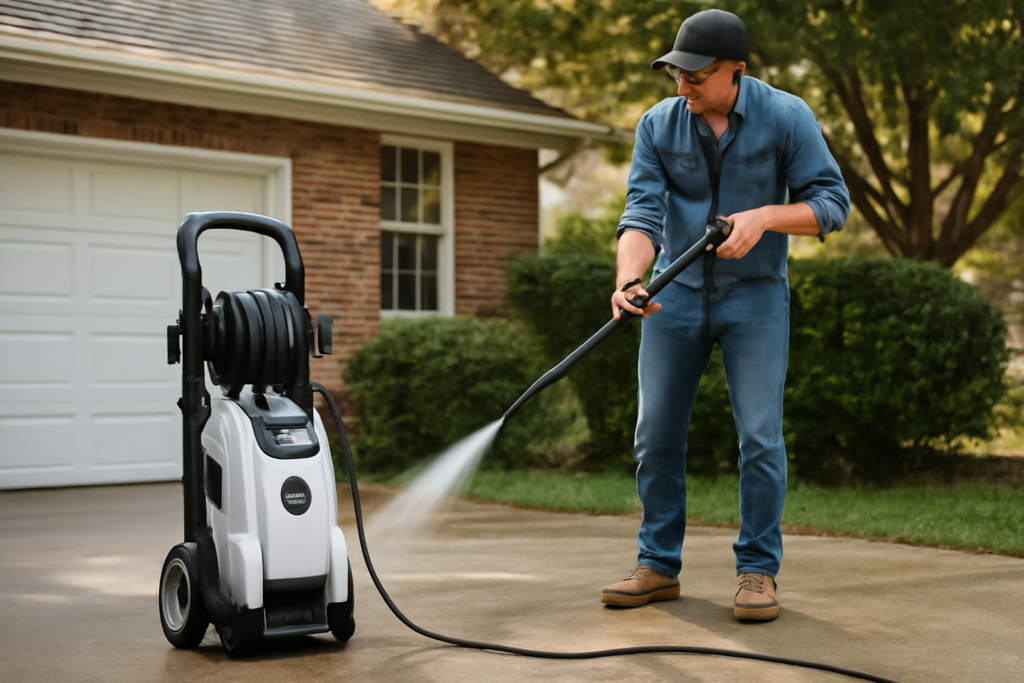
The HART pressure washer lineup shows up at Walmart at prices that make people do a double-take, and I get asked constantly whether they’re any good or just cheap plastic. Short answer: for a homeowner doing driveways, patios, siding, and cars, they punch well above their price. Longer answer is below, including the failure points I’ve seen and how they stack up against Ryobi, which shares the same corporate parent.
HART is a house brand owned by TTI, the same company behind Ryobi, Milwaukee, and Ridgid. That matters because a lot of the engineering and even some parts overlap with Ryobi’s electric washers, which have a long track record.
- The HART Lineup: Electric, 40V, and Gas
- Understanding PSI and GPM
- Nozzle Tips: Use the Right Color
- Common Problems and How to Fix Them
- Maintenance That Keeps It Alive for Years
- Detergent, Foam Cannons, and Surface Cleaners
- Real-World Cleaning Times and Expectations
- HART vs. Ryobi: Same Family, Different Badge
- Setup and First-Use Tips
- Is the HART Pressure Washer Worth It?
The HART Lineup: Electric, 40V, and Gas
HART sells a few tiers, and they cover most of what a homeowner needs:
- Corded electric (1800-2300 PSI): The bread and butter. The common 1800 PSI unit runs around $99-$129, and the higher 2300 PSI model with a brushless-style induction motor lands near $199. These plug into a standard outlet.
- 40V cordless: Part of HART’s battery platform, these deliver roughly 600-700 PSI for light jobs like patio furniture, screens, and quick car rinses. Convenient, but not a driveway machine.
- Gas models: HART has offered gas units in the 3000+ PSI range for tougher jobs. These bring the muscle for concrete and stripping but need oil changes and fuel like any gas engine.
For 90 percent of buyers, the corded electric is the right call. It’s quiet, needs no fuel, and 2000 PSI cleans concrete and siding just fine with the right technique.
Understanding PSI and GPM
PSI (pounds per square inch) is the pressure that blasts grime loose. GPM (gallons per minute) is the flow that rinses it away. People obsess over PSI and ignore GPM, but cleaning speed is really PSI multiplied by GPM, sometimes called cleaning units.
Most HART electrics push 1.2 to 1.4 GPM. That’s typical for electric washers running off a household circuit. A gas unit might do 2.5 GPM, which is why gas cleans a big driveway faster even at similar PSI. For a homeowner, 2000 PSI at 1.3 GPM handles cars, fences, decks, and moderate concrete without complaint.
Nozzle Tips: Use the Right Color
HART washers ship with a set of quick-connect nozzle tips, color-coded by spray angle. Learning these is the difference between cleaning a deck and gouging it:
- Red (0 degrees): A pinpoint blast. Extremely aggressive. I rarely use it because it will etch concrete and shred wood. Skip it on siding entirely.
- Yellow (15 degrees): Heavy stripping, rust, and caked mud on concrete.
- Green (25 degrees): The everyday tip for most surfaces. Start here.
- White (40 degrees): Gentle, for siding, cars, and windows.
- Black (soap): Low pressure, wide fan, draws detergent from the tank.
Rule of thumb: start with a wider angle from a safe distance and step down only if the surface can take it. Test on an inconspicuous spot first.
Common Problems and How to Fix Them
No electric washer is trouble-free, and HART has a few recurring complaints worth knowing before you buy:
- Pulsing or surging pressure: This is the most common gripe and it’s usually air in the line or a starved water supply. Purge air by running water through the gun before you start, and make sure your garden hose delivers full flow.
- Unloader valve issues: The unloader diverts water when the trigger is off. If the motor cycles on and off rapidly or the pump won’t build pressure, the unloader may be sticking. Some are adjustable; a small amount of pump-safe grease can help.
- Fitting leaks: Drips at the hose connections are almost always a worn O-ring. A $5 O-ring kit fixes it. Don’t overtighten plastic fittings.
- Pump not priming: Kinked inlet hose or clogged inlet screen. Clean the little filter screen where the garden hose attaches.
Most of these are user-side or cheap fixes, not dead machines. The biggest killer of any electric washer is running it dry, so never pull the trigger without water flowing.
Maintenance That Keeps It Alive for Years
Electric washers are low-maintenance, but a little care doubles their life:
- Never run the pump dry, even for a few seconds. Dry running burns the seals fast.
- After each use, disconnect and drain the hose and gun so water doesn’t sit in the pump.
- Before winter, run pump antifreeze or storage fluid through it if you store it in an unheated garage. A frozen pump cracks and it’s not repairable.
- Keep the inlet screen clean so grit never reaches the pump.
- Store the trigger gun with the safety lock on and the nozzles in their holder so you don’t lose the green tip you actually use.
The higher-end 2300 PSI HART uses an induction motor, which runs cooler and quieter and lasts longer than the universal motors in the cheapest units. If you’ll use it regularly, that model is worth the extra money.
Detergent, Foam Cannons, and Surface Cleaners
Most HART electrics have an onboard detergent tank you fill with pressure-washer soap, and the black soap nozzle draws from it at low pressure. That’s fine for a quick pass, but the tank siphon is weak. If you want thick clinging suds for a car or siding, add a foam cannon that threads onto the wand with an M22 or 3/8-inch quick connect. A decent foam cannon runs $20 to $35 and transforms the results.
The other attachment worth buying is a flat surface cleaner, a spinning disc on wheels that rides on concrete and cleans a wide, even path with no zebra striping. A 12- to 15-inch surface cleaner rated for 2000-plus PSI costs $40 to $70 and turns a two-hour driveway job into a 20-minute one. HART’s higher-GPM models feed these better; the 1800 PSI unit at 1.2 GPM will run a small surface cleaner but slowly.
Only use detergents labeled safe for pressure washers. Household dish soap and bleach can attack the pump seals over time. Run clean water through the system after every soap job to flush the detergent line, or it gums up and clogs the siphon.
Real-World Cleaning Times and Expectations
Setting expectations keeps people happy. With a 2000 PSI HART at around 1.3 GPM, plan on roughly 30 to 45 minutes for a standard two-car driveway using just the wand, or half that with a surface cleaner. A car wash is 15 to 20 minutes. A wood deck for cleaning before staining takes an hour or more because you must use the white or green tip and keep moving to avoid furring the wood.
Vinyl siding on a single-story house is an afternoon job with the 40-degree tip and a downstream house-wash mix. Don’t expect an electric to strip old paint or clean second-story soffits without a telescoping lance; that’s where the 1.3 GPM flow shows its limits against a 2.5 GPM gas machine. Know the job before you assume the tool is underpowered.
HART vs. Ryobi: Same Family, Different Badge
Since both come from TTI, people ask which to buy. Ryobi’s electric washers have been around longer and have a broader accessory ecosystem and slightly more dealer support through Home Depot. HART, sold at Walmart, usually undercuts the comparable Ryobi by $20 to $40 and includes a hose reel on several models, which Ryobi charges extra for.
Performance between comparable PSI models is close enough that I wouldn’t lose sleep either way. Buy on price, warranty, and which store is easier for you to return to. HART’s typical warranty runs a few years on the tool, which is fair for the price.
Setup and First-Use Tips
Getting a new HART running correctly the first time prevents most early complaints. Feed it from a garden hose that delivers strong flow; a 5/8-inch hose no longer than 50 feet is ideal, and open the spigot all the way. These pumps are gravity-and-supply fed, so a trickle from a kinked or narrow hose causes the surging people mistake for a defect.
- Connect the garden hose to the inlet and run water through with the trigger open for 30 seconds to purge air before you ever hit the power switch.
- Snap on the green 25-degree tip to start and keep the wand two feet from the surface until you learn how it bites.
- Engage the power only with water flowing and the trigger ready, and always set the gun’s safety lock when you pause.
- When you finish, kill the power, squeeze the trigger to release the trapped pressure, then disconnect.
That trapped-pressure step matters. An electric washer’s pump holds pressure after shutoff, and pulling fittings apart under load spits water and stresses the couplers. Bleed it every time.
Is the HART Pressure Washer Worth It?
For a homeowner, yes. A HART electric in the 2000 PSI range for around $130 to $200 cleans driveways, decks, siding, fences, patio furniture, and vehicles without drama, as long as you respect the nozzles and never run it dry. It’s not a contractor’s daily-driver, and if you clean acres of concrete you want gas and 2.5 GPM. But for weekend cleanup and seasonal projects, it’s one of the better values on the shelf. Add a surface cleaner attachment and a 90-degree gutter wand and you’ve got a setup that handles almost anything around the house.


