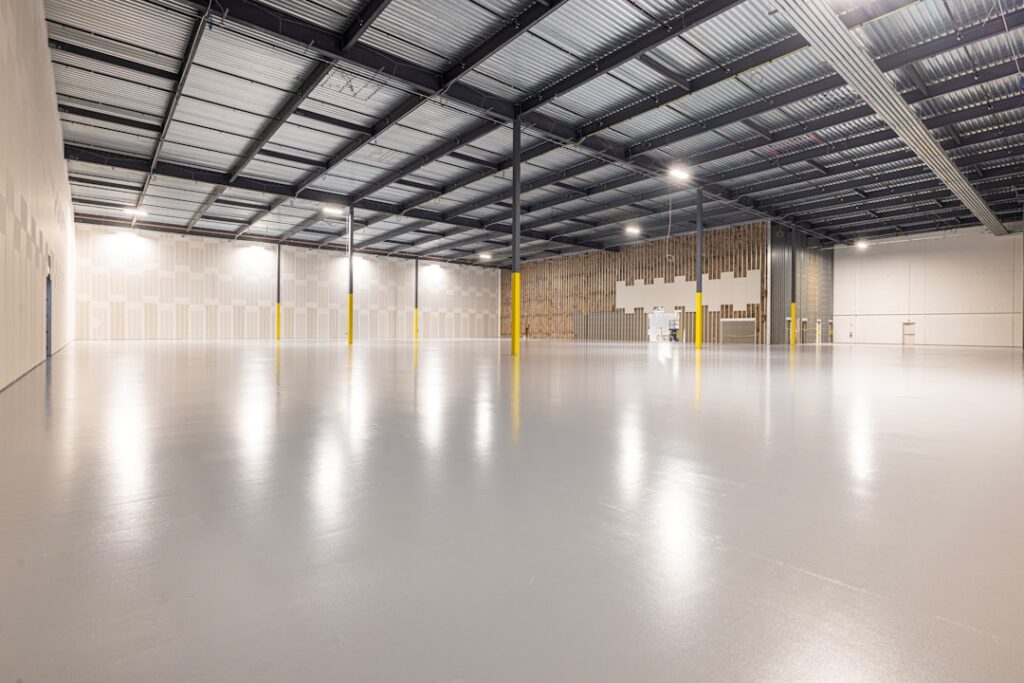
When a client tells me they park a diesel truck in the garage, run a welding shop out back, or need a warehouse floor that shrugs off forklift traffic, I point them straight at heavy duty epoxy flooring. This isn’t the thin roll-on kit from the big-box store that peels in two years; it’s a professionally applied, high-build resin system that bonds to concrete and turns a dusty, staining slab into a seamless, chemical-resistant surface tough enough for industrial abuse. Done right, it lasts 10 to 20 years and takes hits that would destroy tile, wood, or vinyl.
Part of our Epoxy, Concrete & Garage Floors guide — explore the full guide →
What “Heavy Duty” Actually Means
The difference between a bargain epoxy and a heavy-duty system comes down to thickness, solids content, and build. Cheap DIY kits are water-based epoxies that go down at 3 to 5 mils and often contain 50 percent or less solids, meaning half of what you roll on evaporates. A true heavy-duty system uses 100-percent-solids epoxy applied at 20 to 40 mils or more, sometimes built up in multiple coats or as a troweled mortar system reaching 1/8 inch or thicker for extreme loads.
These systems are usually multi-layer: a penetrating primer that soaks into the concrete, one or two build coats of pigmented 100-percent-solids epoxy, often a broadcast of quartz sand or vinyl flakes for texture and strength, and a clear topcoat, frequently a polyaspartic or polyurethane, for UV stability and abrasion resistance. That layered build is what separates a floor that survives a dropped engine block from one that scratches when you slide a toolbox.
Where Heavy Duty Epoxy Belongs
Garages are the classic residential application, especially for gearheads who work on cars, store heavy equipment, or want a showroom-clean floor that wipes up oil drips. But the real muscle shows in commercial and industrial settings: auto shops, warehouses, manufacturing floors, commercial kitchens, breweries, aircraft hangars, and loading docks. Anywhere you have rolling loads, dropped tools, chemical exposure, or forklift traffic, a high-build epoxy earns its keep.
It also solves problems specific to concrete. Bare slabs generate dust as they slowly abrade, stain permanently from oil and chemicals, and are hard to clean. A heavy-duty epoxy seals all of that into a non-porous surface. Add a quartz broadcast or an anti-slip additive and it becomes a safe, cleanable, forklift-rated floor that meets health-code requirements in food and beverage facilities.
The Real Advantages
Toughness is the whole point. A properly installed 100-percent-solids system resists impact, abrasion, and compression loads measured in thousands of pounds per square inch. Drop a wrench, roll a two-ton floor jack across it, or park a loaded trailer on it, and the floor stands up. Chemical resistance is equally strong: gasoline, motor oil, brake fluid, antifreeze, battery acid, and most solvents bead up and wipe off without staining or etching the surface.
Maintenance is genuinely easy for such a rugged product. The seamless, non-porous surface has no grout lines or seams to trap dirt, so you sweep it and mop it, and oil spills wipe up with a rag. It’s also bright; a light-colored or flaked epoxy reflects overhead lighting and can noticeably brighten a dim garage or shop, improving both the look and workplace safety. With an anti-slip additive it stays safe even when wet.
Honest Costs
You get what you pay for, and heavy-duty epoxy is not a cheap floor. A professionally installed high-build system runs $5 to $12 per square foot for standard garage-grade work, and $8 to $20 per square foot for industrial systems with thick mortar builds, quartz broadcasts, and polyaspartic topcoats. For a typical 2-car, 400-square-foot garage, budget roughly $2,000 to $4,800 installed for a real heavy-duty job.
That’s many times the cost of a $150 DIY kit, and the difference is entirely in the prep and the materials. Proper concrete grinding, 100-percent-solids resin, and multi-coat builds cost real money and labor. But amortized over a 10-to-20-year lifespan on a floor that never needs replacing, the math works out favorably compared to re-coating a failed DIY floor every couple of years. Get itemized quotes and confirm the mil thickness and solids content in writing.
The Downsides You Should Weigh
Surface prep is unforgiving and it’s where most failures start. The concrete must be mechanically ground or shot-blasted to open the pores, fully cured (a new slab needs 28 days minimum), and free of moisture, oil, and old coatings. If there’s vapor pushing up through the slab, epoxy can delaminate and peel in sheets. A proper moisture test, a calcium chloride or relative humidity test, is mandatory, and slabs over about 3 pounds of moisture emission may need a special vapor-barrier primer.
Cost and installation complexity are the other honest downsides. This is not a weekend DIY project at the heavy-duty level; it demands grinders, proper mixing, and fast work within the epoxy’s pot life before it kicks. Standard epoxy can also amber and chalk under direct UV, which is why a polyaspartic or urethane topcoat is essential for sun-exposed areas. The surface can be slippery when wet without an anti-slip additive, and once cured, this floor is genuinely permanent; removing it later means grinding it off.
Epoxy vs. Polyaspartic and Polyurea
Straight epoxy is the rigid, high-build workhorse that provides thickness and chemical resistance, but it cures slowly and isn’t UV-stable on its own. Polyaspartic and polyurea coatings cure fast, often walkable in a day, resist UV yellowing, and flex slightly with the concrete, which helps in temperature-swinging garages. The best heavy-duty systems combine them: an epoxy base build for thickness and adhesion, topped with a polyaspartic clear coat for UV stability, abrasion resistance, and faster return to service.
For a home garage, a hybrid epoxy-and-polyaspartic flake system is often the sweet spot, curing in a day or two and handling sunlight through an open door. For a chemical-heavy industrial floor, a thick 100-percent-solids epoxy mortar system may be the priority. Match the system to the actual loads and exposure rather than buying the most expensive option by default.
Texture, Color, and Safety Options
A heavy-duty floor doesn’t have to be a plain gray slab. The most popular residential finish is a full broadcast of decorative vinyl flakes, sometimes called chips, scattered into a wet base coat and sealed under clear topcoat; the flakes hide dirt and minor imperfections, add slip resistance, and come in blends from subtle gray to bold color combinations. For industrial and commercial floors, a quartz sand broadcast delivers even greater thickness, impact strength, and a pronounced anti-slip texture that meets safety codes in wet processing areas.
Slip resistance deserves real thought before you commit to a finish. A smooth, glossy epoxy looks stunning but turns treacherous the moment water, oil, or snowmelt hits it, which is a genuine hazard in a garage or shop. Adding an aluminum-oxide or polymer-grit anti-slip additive to the topcoat, or relying on a flake or quartz broadcast for texture, keeps the floor safe underfoot without sacrificing cleanability. Color choice also affects the space: a light gray or tan floor brightens a dim shop and makes dropped parts easy to spot, while darker tones hide tire marks but need more lighting overhead.
Getting a Job That Lasts
Vet your installer hard, because prep separates a 15-year floor from a 2-year peel. Ask whether they diamond-grind or shot-blast the slab (they should, not acid-etch for heavy-duty work), whether they moisture-test, what mil thickness and solids percentage the system delivers, and what the topcoat is. Get the warranty in writing and check references on floors that are several years old, since failures show up over time, not on install day.
Once it’s down, care is minimal: sweep regularly, dust-mop or hose it out, and wipe chemical spills reasonably promptly even though the surface resists them. Use a walk-off mat where vehicles enter to reduce grit abrasion, and avoid dragging sharp steel edges across the finish. Treated sensibly, heavy duty epoxy flooring delivers a decade or two of forklift-rated, chemical-proof, dust-free service that no other affordable floor can match. For garages, shops, and industrial spaces, it’s the surface I trust when the floor has to take a real beating and keep looking sharp.