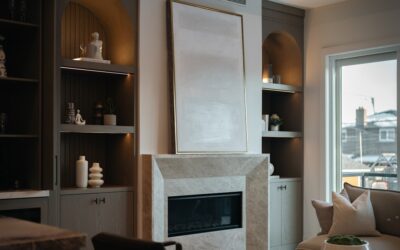
A television over the mantel looks clean in the showroom photo, but the cords dangling down the chimney breast ruin the effect fast. Hiding tv wires above fireplace walls is harder than on an ordinary stud wall because you are working around masonry, firestopping, a flue and a heat source that can reach several hundred degrees at the opening. The safe answer comes down to one rule: low-voltage signal cables can be concealed in several ways, but the TV power cord itself must never be pushed through a wall cavity.
For most homes, the practical choices are a paintable surface raceway run down the side of the chimney breast, a UL-listed in-wall power kit installed in a framed wall section next to or above the firebox, or a mantel chase that carries cables behind a wood mantel shelf. If you want an outlet right behind the TV, that is a new recessed outlet, and it belongs to a licensed electrician. The rest of this guide walks through how to pick the right route for your fireplace construction and how to do the low-voltage work yourself.
- Hiding TV Wires Above Fireplace: Know Your Wall First
- Why the Power Cord Stays Out of the Wall
- Heat and Clearance Limits That Change the Plan
- Option 1: Paintable Surface Raceway
- Option 2: In-Wall Power Kit in a Framed Chase
- Option 3: Mantel Chase and Surround Tricks
- Troubleshooting Common Problems
- Cost Ranges
- When to Call a Licensed Professional
- Frequently Asked Questions
Before you drill anything, check the TV and fireplace manufacturers’ manuals. Both publish clearance and temperature limits, and those numbers override any rule of thumb you read online, including this one.
Hiding TV Wires Above Fireplace: Know Your Wall First
Every decision flows from what the chimney breast is actually made of. Tap the wall and look at the edges of the surround, then check from the attic or basement if you can.
- Solid masonry chimney (brick or stone, often pre-1970s): There is no hollow cavity to fish through. Cutting a chase into masonry is dusty, slow and can weaken the chimney. Surface raceway or a mantel chase is almost always the better call.
- Framed chase with a factory-built (prefab) fireplace: Common in newer homes. The chimney breast is a wood-framed box covered in drywall, with a metal firebox and flue inside. Hollow bays exist, but the maker specifies clearances to combustibles and often requires firestop spacers at each floor level. Do not disturb insulation shields or firestops.
- Stone or brick veneer over framing: Thin veneer glued to a backer board. You may be able to fish cable behind the backer in a side bay, but drilling veneer cleanly takes a carbide or diamond bit and patience.
- Gas insert or direct-vent unit: Often sits in a framed chase with a vent pipe running up or out the back. Gas lines and vent pipes are no-go zones for drills and fish tape.
If you cannot identify the construction or find a flue, gas line or vent inside the bay you planned to use, stop. That wall is not a place for guesswork.
Why the Power Cord Stays Out of the Wall
The TV’s detachable power cord is a flexible cord, not in-wall-rated building wire. Running it through a stud cavity violates the National Electrical Code’s restrictions on flexible cords and creates a hidden fire risk: the cord can be pinched, chafed on framing, or cooked by heat radiating from the firebox with no one ever seeing it. The same goes for extension cords, power strips tucked inside the wall and cheap “cord kits” that just feed a regular cord through two holes.
Your code-compliant options for power are:
- A UL-listed in-wall power kit. These use a recessed inlet box behind the TV and an outlet box near the floor, joined by in-wall-rated cable. You plug a short jumper cord into the lower inlet, and the TV plugs into the upper receptacle. No permanent wiring connection to your home circuit is made, which is why many homeowners install them. Still, on a fireplace wall, have a licensed electrician confirm the route and box placement.
- A new recessed outlet behind the TV. This extends a branch circuit and requires a licensed electrician, and often a permit. A recessed (clock-style) box keeps the plug flush so the mount can sit tight to the wall.
- Surface-mounted cord cover. The power cord stays a cord but runs in a listed raceway on the wall surface, never inside it.
HDMI, coaxial, Ethernet and speaker wires are low voltage. They carry signals, not household current, which is why they have more concealment options. Buy in-wall-rated versions (look for CL2 or CL3 on the jacket) whenever they will run inside a cavity.
Heat and Clearance Limits That Change the Plan
Heat is the second reason fireplace walls need extra care. Warm air rolls up off the opening and collects under the mantel and against the wall above it. Many TV manuals cap operating temperatures around 95 to 104°F, and cable jackets, surge protectors and streaming sticks do not love heat either.
Practical checks before you commit:
- Read the fireplace manual for the required clearance from the opening to combustible materials, including mantels, trim and anything mounted on the wall.
- Run a normal fire for an hour, then tape a cheap thermometer where the TV and cable exits will sit. If it reads well above the TV’s rated limit, raise the TV, add a deeper mantel as a heat shelf, or rethink the location.
- Keep power supplies, surge protectors and cable boxes off the mantel shelf directly over the firebox. Put electronics in a side cabinet or a nearby closet instead.
- Never coil excess cable behind the TV where heat builds up. Trim to length or store slack in a cooler spot.
Wood-burning, gas and electric fireplaces all qualify here. Even an electric insert pushes warm air upward. Combustion fireplaces should also have working carbon monoxide alarms on that level of the house.
Option 1: Paintable Surface Raceway
For hiding tv wires above fireplace masonry, raceway is the safest and easiest route, and on solid masonry it is usually the only sensible one. A slim plastic or aluminum channel runs from the TV bracket down one side of the chimney breast to the floor or to a nearby outlet.
Tools and materials
- Listed cord-cover raceway sized for the cable count (a wide one-channel or a two-channel style)
- Masonry anchors and a hammer drill, or the raceway’s adhesive strips on smooth drywall
- Paint matched to the wall or grout color
- Level, pencil, fine-tooth saw or miter shears
Steps
- Mount the TV bracket first so you know exactly where the cables exit.
- Plan the raceway run in the inside corner where the chimney breast meets the side wall. Corners hide channels far better than the middle of the face.
- Cut sections to length, including inside and outside corner fittings.
- Fasten the base to masonry with small anchors every 16 to 24 inches. Adhesive alone rarely holds on textured brick.
- Lay the power cord and the low-voltage cables in, snap the cover on, then paint it to match.
On stone, some people route raceway along a mortar joint and paint it to mimic mortar. It reads as part of the wall from across the room.
Option 2: In-Wall Power Kit in a Framed Chase
When the chimney breast is a framed box, an in-wall power kit gives the cleanest look. The work lives in a side bay, away from the flue.
Steps
- Find a clear bay. Use a stud finder and a small inspection hole to confirm the cavity has no flue, vent pipe, gas line, firestop or insulation shield. Choose a bay beside the firebox rather than directly above it when possible.
- Turn off the breaker for any circuit near your cut lines and confirm power is off with a non-contact voltage tester before cutting.
- Cut the upper box hole behind the TV, inside the bracket footprint, and the lower hole near the floor in the same bay.
- Fish the in-wall-rated cable supplied with the kit, plus your low-voltage cables, between the openings. If you meet a horizontal fire block, do not remove it. Drill a hole just large enough for the cables, then seal around them with fire-rated caulk or putty.
- Install the recessed boxes, connect the kit’s cable exactly as its instructions show, and plug the jumper cord into a nearby grounded outlet.
Many kits include a separate pass-through plate for HDMI and Ethernet. Label both ends of each cable before you close anything up. If the bay is tight, or the kit layout means extending a real circuit, stop and hire a licensed electrician.
Option 3: Mantel Chase and Surround Tricks
A hollow wood mantel shelf or a new surround can hide cables with no holes in masonry. Some homeowners build a slim box mantel with a cavity at the back and run the cables horizontally inside it, then down a trim-covered corner.
- Keep the chase to low-voltage cable plus a power cord inside a listed raceway channel. The mantel is a surface cover, not a wall cavity, but heat still applies.
- Respect the fireplace maker’s mantel clearance. Deeper mantels need to sit higher.
- Use metal or noncombustible spacers where the manual calls for them.
Built-in cabinets flanking the fireplace are another route. Cables drop behind the TV, turn at a raceway along the top of the surround, and disappear into a cabinet that holds the electronics, well away from the firebox heat.
Troubleshooting Common Problems
- Picture flickers after the run: Long or cheap HDMI cables lose signal. Use certified high-speed cables, or an active or fiber HDMI cable for runs over roughly 25 feet.
- Fish tape stops halfway: You likely hit a fire block or a horizontal brace. Locate it with a small inspection hole instead of forcing the tape.
- Raceway pops loose: Adhesive failed on textured masonry or warm surfaces. Switch to screws and anchors.
- TV shuts off during long fires: Overheating protection is kicking in. Raise the TV or add a heat-deflecting mantel.
- Outlet feels warm or a breaker trips: Stop using it and call a licensed electrician.
Cost Ranges
Budget for hiding tv wires above fireplace walls depends mostly on the route. A paintable raceway kit usually runs in the tens of dollars. An in-wall power kit typically costs a bit more but still sits well under a couple hundred dollars. Hiring a handyman to mount a TV and run raceway is often a few hundred dollars. A licensed electrician adding a recessed outlet on a fireplace wall commonly lands in the low-to-mid hundreds, more for masonry, long runs or permit fees. Custom mantel chases or built-ins range widely based on carpentry.
When to Call a Licensed Professional
Hire a licensed electrician for any new outlet, circuit extension or recessed receptacle behind the TV, and whenever the route passes near a flue, vent or gas line. Many jurisdictions require a permit for new receptacles. Call a chimney professional before cutting into masonry or into a factory-built chase, because breaking a firestop or insulation shield can void the fireplace listing. Anything involving a gas insert, gas line or vent pipe is licensed-pro work only. If you ever smell gas, leave the house and call the utility.
Frequently Asked Questions
Can I run the TV power cord inside the wall above my fireplace?
No. A TV power cord is not rated for in-wall use. Use a UL-listed in-wall power kit, a recessed outlet installed by a licensed electrician, or a surface raceway.
What is the easiest way to hide TV cables over a fireplace made of brick?
A paintable surface raceway anchored in an inside corner of the chimney breast is the easiest and safest route on solid brick or stone.
Is it safe to hide TV wires over a gas fireplace?
Low-voltage cables can be hidden if you avoid the vent pipe and gas line entirely. Follow the insert maker’s clearances and have a pro confirm any in-wall route.
Do I need special HDMI cables inside the wall?
Yes. Choose in-wall-rated cables marked CL2 or CL3 so the jacket meets fire-safety requirements for concealed runs.
How hot is too hot for a TV above a fireplace?
Check your TV manual, but many sets list a maximum operating temperature around 95 to 104°F. Measure the wall during a fire before mounting.