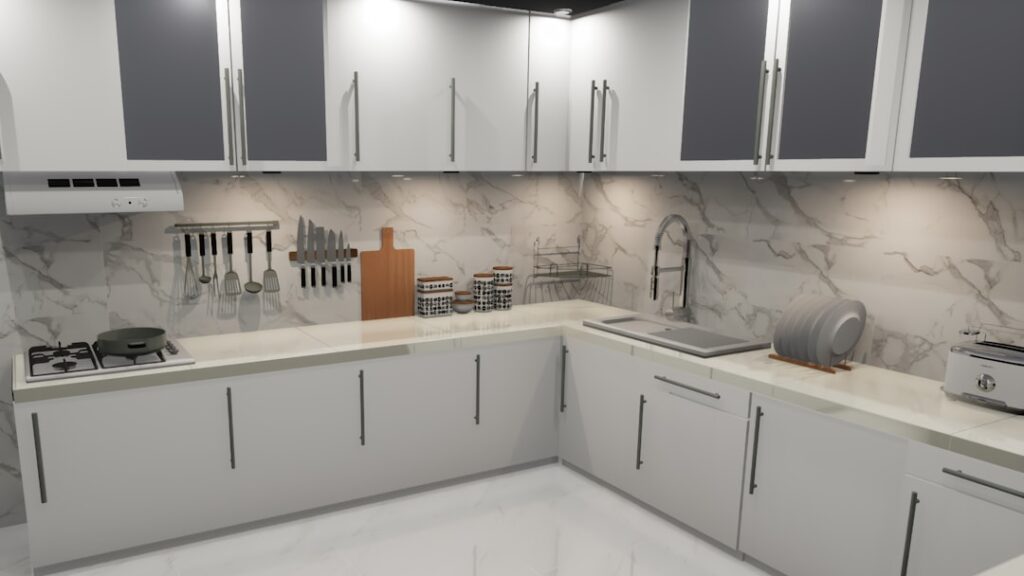
Weak faucet pressure turns every dish into a chore. Sometimes the problem is your house plumbing, but more often it’s the faucet itself, throttling flow to meet federal efficiency rules without giving you the velocity you need for real cleanup. A proper high pressure kitchen faucet uses a smarter aerator and a wider waterway to deliver punchy spray patterns at the 1.8 GPM federal limit. Picking the right one means understanding flow versus pressure, not just chasing big-number marketing claims.
Part of our Kitchen Remodeling guide — explore the full guide →
- Flow Rate vs Pressure: What the Numbers Actually Mean
- Moen Arbor 7594ESRS: The All-Around Winner
- Delta Leland 9178-AR-DST: Best Pull-Down for Deep Sinks
- Kohler Sensate K-72218: Best Touchless Option
- Spray Pattern Modes That Actually Matter
- Installation: The Three Mistakes That Kill Pressure
- Pull-Down vs Pull-Out vs Stationary Spout
- Whole-House Solutions When the Faucet Isn't Enough
- Maintenance That Preserves Pressure Over Time
- Final Recommendation
Flow Rate vs Pressure: What the Numbers Actually Mean
GPM (gallons per minute) measures how much water comes out. Pressure measures the force behind it. The federal maximum for residential kitchen faucets is 1.8 GPM at 60 PSI, lowered from 2.2 GPM in 2021. Within that limit, manufacturers tune the spray head to feel more powerful by narrowing aerator passages and adding pulse patterns. A well-designed 1.8 GPM faucet feels stronger than a poorly engineered 2.2 GPM model from a decade ago.
Your house pressure matters too. Most municipal supplies run 50 to 70 PSI at the meter. If you’re under 40 PSI at the faucet, no fixture will perform well. Test with a $12 gauge on an outdoor hose bibb before blaming the faucet.
Moen Arbor 7594ESRS: The All-Around Winner
Moen’s Arbor sits in the sweet spot for most kitchens. The Power Boost spray mode increases velocity at the head by roughly 50 percent compared to the standard stream, while staying within the 1.8 GPM cap. The pull-down hose retracts cleanly thanks to Moen’s Reflex docking system. Pricing runs $279 to $349 at most plumbing supply houses, and the limited lifetime warranty actually gets honored — Moen ships replacement parts directly to homeowners without dealer involvement.
Delta Leland 9178-AR-DST: Best Pull-Down for Deep Sinks
If you have a 10-inch-deep apron sink, the Delta Leland’s 20-inch hose reach is the differentiator. The MagnaTite docking pulls the spray head firmly back into the spout with a magnet stronger than most competing systems. Touch-Clean spray holes resist mineral buildup, which is the leading cause of pressure loss after year three. Street price is $269 to $329 for the arctic stainless finish, slightly more for matte black.
Kohler Sensate K-72218: Best Touchless Option
Touchless faucets used to be gimmicky, but Kohler’s third-generation Sensate works reliably. The Konnect sensor responds within 20 milliseconds of hand placement, and the Sweep spray pattern uses a single wide jet to push food residue off plates more efficiently than typical aerated streams. Power is hardwired to a 120V adapter under the sink — no batteries to replace. Expect to pay $549 to $699, which is a premium, but the touchless feature genuinely matters during meal prep with raw chicken on your hands.
Spray Pattern Modes That Actually Matter
Multi-function spray heads are standard now, but most patterns are marketing fluff. The three you’ll actually use are aerated stream for filling pots, full-pressure spray for rinsing dishes, and a focused jet for scrubbing pans. Pause buttons are useful for switching between sink basins without splashing the counter. Skip “boost” modes that exceed the GPM cap by toggling regulators — they’re often disabled at factory.
Check the spray head material. Plastic heads with rubber nozzles resist mineral scale better than chrome heads with brass nozzles. Hard water above 10 grains per gallon will clog a brass aerator within two years.
Installation: The Three Mistakes That Kill Pressure
Most pressure problems on new installs come down to three things. First, the supply line shutoffs under the sink are partially closed — open them fully both directions. Second, the new faucet’s inline filter screen is clogged with construction debris from the rough-in plumbing; remove the aerator and flush the lines before final connection. Third, the supply line itself has been crimped during installation, which is common with 3/8-inch braided lines tucked behind a garbage disposal.
Use 1/2-inch supply stubs to the faucet if you’re remodeling the rough plumbing. Standard 3/8-inch supplies create a measurable bottleneck on demanding pull-down faucets. Replace any galvanized supply lines under the sink — internal corrosion can drop pressure by 30 percent over 20 years.
Pull-Down vs Pull-Out vs Stationary Spout
Pull-down faucets have a tall arched spout with the spray head pulling down toward the sink. They give you the longest reach for filling tall pots and rinsing the back wall of the sink. Pull-out faucets have a shorter spout with the spray head pulling out horizontally. They work better with low cabinets above the sink where a tall arch won’t fit. Stationary spouts with side sprayers are largely obsolete but still ship in builder-grade configurations.
For most kitchens with standard upper cabinets, a pull-down faucet at 16 to 18 inches tall is the right fit. If you have a window above the sink, measure the clearance carefully — many pull-down faucets won’t fit under a low sill.
Whole-House Solutions When the Faucet Isn’t Enough
If your house pressure is below 50 PSI, no fixture upgrade will fix it. Install a booster pump like the Grundfos SCALA2 at the main supply line. These deliver constant 60 PSI regardless of well or city supply variations, typically run $750 to $1,100 with installation, and self-prime if the supply runs dry. For homes on private wells with old pressure tanks, replacing a waterlogged 40-gallon tank often restores normal pressure for $400.
Maintenance That Preserves Pressure Over Time
Unscrew the aerator every six months and soak it in white vinegar for two hours. Mineral scale is the number one cause of pressure loss in residential faucets, and a $0.40 vinegar soak restores most of the original performance. Pull-down spray heads need the same treatment — most unscrew at the hose connection without tools.
Replace the supply line braided hoses every 10 years. They look fine externally, but the internal rubber liner swells and chokes flow. New stainless braided lines run $8 to $15 each and take 15 minutes to swap.
Final Recommendation
For most homeowners, a Moen Arbor or Delta Leland will deliver the pressure feel you’re looking for at a fair price. Spending more than $400 buys finish options and touchless features, not better water pressure. If pressure is genuinely weak across the whole house, fix the supply side first — no high pressure kitchen faucet can compensate for 35 PSI at the meter.