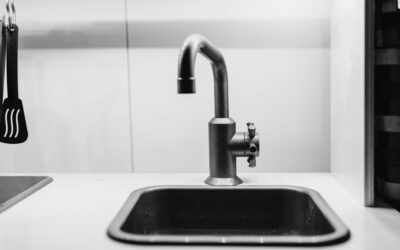
A single kitchen faucet uses one lever to control both water volume and temperature, giving you full command of the sink with just one hand. That simplicity is exactly why it has become the most common style in modern kitchens, replacing the two-handle designs that dominated older homes.
Part of our Kitchen Remodeling guide — explore the full guide →
Whether you are remodeling, replacing a worn-out fixture, or building new, understanding the types, deck configurations, and install steps helps you pick a faucet that fits your sink and lasts for years. This guide covers everything from valve technology to typical cost.
- What Makes a Single-Handle Faucet Different
- Common Types of Single Kitchen Faucets
- Understanding Sink Hole Configurations
- Installing a Single Kitchen Faucet
- Materials and Finishes
- Single-Handle vs. Two-Handle Faucets
- Spout Height and Reach
- Water Efficiency and Flow Rate
- Cost and Value
- Pull-Down vs. Pull-Out: Which to Choose
- Touchless and Smart Options
- Maintenance Tips
What Makes a Single-Handle Faucet Different
The defining feature is the mixing valve hidden inside the body. Move the lever up and down to change flow, side to side to change temperature. Most quality units use a ceramic disc cartridge, which resists mineral wear and rarely drips, while cheaper models rely on ball or compression valves that wear faster.
Because a single handle does the work of two, the faucet needs fewer holes in your countertop or sink deck. That clean footprint is part of the appeal, but it also means you should confirm your existing hole layout before buying a replacement.
Common Types of Single Kitchen Faucets
- Pull-down faucets — a tall gooseneck with a spray head that pulls straight down into the sink; excellent for filling pots and rinsing.
- Pull-out faucets — a lower spout whose head pulls toward you; better for small sinks or low clearance under a window.
- High-arc (gooseneck) — a dramatic curved spout that gives generous clearance for large cookware.
- Low-arc — a shorter spout that reduces splashing in shallow sinks.
- Touchless or touch-activated — a single-handle body with a motion or tap sensor for hands-free use.
Understanding Sink Hole Configurations
Kitchen sinks and countertops are drilled with one to four holes. A true single kitchen faucet needs only one hole for the body, but many are sold with an optional deck plate (also called an escutcheon) that covers up to three extra holes left by a previous faucet or a discontinued sprayer.
Before you shop, count your holes:
- One hole — install the faucet directly, no plate needed.
- Three holes — use the included deck plate to cover the outer two, or fit a soap dispenser and separate sprayer.
- Four holes — plan for accessories like a soap pump or filtered-water tap to fill the extras.
Installing a Single Kitchen Faucet
A straightforward swap takes most homeowners one to two hours. The steps are consistent across brands:
- Shut off the hot and cold supply valves under the sink and open the old faucet to release pressure.
- Disconnect the supply lines and remove the mounting nuts holding the old faucet down.
- Clean the deck, then feed the new faucet’s lines and mounting shank through the hole.
- Secure the mounting hardware from below and check that the faucet sits square.
- Connect the supply lines, hand-tighten, then give a quarter turn with a wrench.
- For pull-down models, attach the spray hose and clip on the counterweight.
- Turn the water back on slowly and check every joint for leaks.
Use plumber’s tape on threaded connections and never overtighten plastic nuts, which can crack. If your shutoff valves are old and stuck, replacing them at the same time saves a future headache.
Materials and Finishes
The faucet body is usually brass, zinc alloy, or stainless steel. Solid brass resists corrosion best and carries the most weight in your hand, a good proxy for quality. Stainless steel is a strong, lead-free alternative that suits modern kitchens.
Finishes affect both looks and upkeep:
- Chrome — bright, affordable, shows water spots.
- Brushed or stainless nickel — warm, hides fingerprints and spots well.
- Matte black — bold and modern, but can show hard-water film.
- Bronze — traditional look that pairs with warm cabinetry.
Single-Handle vs. Two-Handle Faucets
If you are deciding between styles, it helps to weigh the single-handle design against the traditional two-handle setup. A single-handle faucet lets you adjust flow and temperature with one hand, which is genuinely convenient when your other hand is full of dishes or produce. It also has a cleaner, more modern footprint and fewer parts that can leak.
Two-handle faucets offer more precise separate control of hot and cold and a classic look that suits traditional kitchens, but they require more deck space and have two valves that can eventually wear. For most modern kitchens, the one-handle design wins on convenience and simplicity, which is why it has become the default choice in new construction and remodels alike.
Spout Height and Reach
Beyond style, the physical dimensions of the spout affect how usable the faucet is day to day. Spout height determines how much clearance you have for filling and washing large pots, while spout reach controls how far the water lands into the sink basin:
- Tall high-arc spouts — great clearance for big cookware, but can splash in a shallow sink.
- Low-arc spouts — less splashing, but tighter clearance for tall items.
- Adequate reach — the stream should land near the center of the basin, not against the back wall or over the front edge.
If a window sits behind your sink, measure the clearance so a tall gooseneck does not block it from opening.
Water Efficiency and Flow Rate
Modern faucets are rated by flow rate in gallons per minute, and choosing an efficient model saves both water and the energy used to heat it. Many quality faucets flow around 1.5 to 1.8 gallons per minute, which feels ample for kitchen tasks while using less than older 2.2-gallon fixtures. Some include an aerator that blends air into the stream for good pressure at lower flow. Over a year of daily use, a lower flow rate meaningfully reduces both your water bill and your water-heating cost without any drop in everyday performance.
Cost and Value
A basic single-handle faucet starts around $60 to $120. Mid-range pull-down models with ceramic cartridges and quality finishes run $150 to $300, and premium touchless or designer units can exceed $400. Professional installation typically adds $150 to $250 if you hire a plumber, though the job is well within reach for a confident DIYer.
When comparing options, weigh the warranty. Many reputable brands offer a limited lifetime warranty on the finish and cartridge, which tells you the maker expects the valve to last. Spending a little more on a ceramic-disc cartridge is the single best way to avoid drips down the road.
Pull-Down vs. Pull-Out: Which to Choose
Among single-handle faucets, the two most popular sprayer styles are pull-down and pull-out, and the right one depends on your sink and kitchen. A pull-down faucet has a tall gooseneck spout with a spray head that pulls straight down into the basin. It offers great clearance for large pots and a commanding look, making it the favorite for deep, single-bowl sinks.
A pull-out faucet has a lower spout, and the head pulls out horizontally toward you. It works better under a low window, in a smaller kitchen, or for filling containers on the counter beside the sink. Both give you a flexible sprayer with one-handle control; the choice comes down to spout height, sink depth, and the clearance above your faucet.
Touchless and Smart Options
Single-handle faucets increasingly come with hands-free features that add real convenience in a busy kitchen. Touchless models use a motion sensor to start and stop the water with a wave, which is handy when your hands are messy with raw meat or dough and keeps the handle cleaner. Touch-activated versions turn on with a tap anywhere on the spout or handle. Some connect to voice assistants or dispense a measured amount of water on command. These features add cost and require batteries or a power connection, but for many cooks the ability to run water without touching the faucet is worth it for both hygiene and ease.
Maintenance Tips
A single kitchen faucet asks for little upkeep. Wipe the finish with a soft cloth and mild soap; skip abrasive cleaners that scratch. If flow weakens, unscrew the aerator at the spout tip and soak it in vinegar to clear mineral buildup. Should the handle start to drip, replacing the cartridge is a 20-minute job with a matching part from the manufacturer.
With ceramic internals, a decent single-handle faucet routinely lasts 10 to 15 years or more. Choose the right spout height for your sink, confirm your hole count, and pick a solid finish, and you will have a fixture that looks clean and works reliably every day.