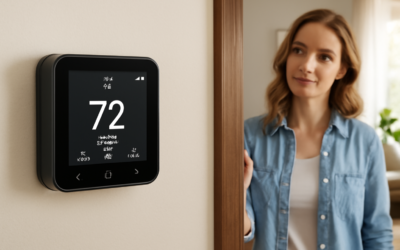
Most homeowners shopping for a new gas furnace assume Honeywell makes the unit itself. They do not. A Honeywell furnace in 2026 typically refers to a furnace fitted with Honeywell controls, gas valves, and thermostats — components that sit inside cabinets built by Lennox, Goodman, Trane, and others. Understanding that distinction will save you from being upsold on a “Honeywell system” at twice the price of an equivalent unit, while still letting you appreciate why HVAC pros consistently recommend Honeywell-equipped furnaces for reliability.
- What Honeywell Actually Manufactures for Your Furnace
- Honeywell Thermostats Worth Pairing With a New Furnace
- Honeywell Furnace Cost: What You Will Actually Pay
- Common Error Codes and What They Mean
- Maintenance That Keeps a Honeywell Furnace Running 20+ Years
- Honeywell vs Nest vs Ecobee: Which Pairs Best
- When to Repair vs Replace
- Sizing the Furnace Correctly
- Smart Home Integration
What Honeywell Actually Manufactures for Your Furnace
Resideo, the spinoff that owns the Honeywell Home brand, builds the brains and several critical safety parts for residential heating systems. Inside the cabinet you will find a Honeywell gas valve regulating fuel flow, a Honeywell limit switch shutting things down if the heat exchanger overheats, and on most modern installs a Honeywell smart thermostat tying everything together. The blower motor, heat exchanger, and burner assembly are made by the furnace OEM.
This matters because warranty service splits between two companies. The cabinet warranty comes from the OEM (Lennox, for example), and the gas valve or control board warranty comes from Resideo. Keep both registration numbers handy.
Honeywell Thermostats Worth Pairing With a New Furnace
Whatever brand of furnace you install, the thermostat sets the experience. Honeywell’s current lineup ranges from utility models to fully smart units. My top picks based on price and feature balance:
- Honeywell Home T9 Smart Thermostat ($199) — Wi-Fi, geofencing, supports up to 20 remote room sensors. Best for medium homes with hot or cold rooms.
- Honeywell T6 Pro Z-Wave ($89) — solid two-stage compatibility, no Wi-Fi but works with SmartThings and Hubitat.
- Honeywell VisionPro 8000 ($240) — the contractor favorite for variable-speed and multi-stage furnaces. Buttery interface, no subscription nag.
- Honeywell Pro 1000 ($35) — the no-frills 5-2 programmable. Fine for rentals or backups.
Honeywell Furnace Cost: What You Will Actually Pay
For a 60,000 to 100,000 BTU gas furnace with Honeywell controls, installed in an existing US home, expect a full project price between $4,200 and $8,500 depending on AFUE rating, region, and whether ductwork modification is needed.
- 80% AFUE single-stage — equipment $1,400 to $1,900, total install $4,200 to $5,500
- 96% AFUE two-stage — equipment $2,400 to $3,200, total install $6,000 to $7,800
- 98% AFUE modulating with variable-speed blower — equipment $3,400 to $4,500, total install $7,500 to $9,500
Add roughly $400 to $800 if your venting needs to convert from B-vent metal to PVC for a high-efficiency condensing unit. Permit fees range from $75 in rural counties to $300 in California.
Common Error Codes and What They Mean
The little LED behind the inspection door blinks a code when something fails. Honeywell control boards in furnaces produced after 2010 use this pattern:
- 2 flashes: pressure switch stuck open. Often a clogged condensate drain or a blocked exhaust pipe.
- 3 flashes: pressure switch stuck closed. Usually a failed switch itself.
- 4 flashes: open high-limit switch. Indicates overheating — restricted return air or dirty filter.
- 5 flashes: flame sensed when no call for heat. Sticky gas valve.
- 6 flashes: ignition lockout after three failed attempts. Often a dirty flame sensor that wipes clean with fine steel wool in 90 seconds.
Maintenance That Keeps a Honeywell Furnace Running 20+ Years
The furnace itself rarely fails. What fails is the small stuff around it. Twice a year, take 30 minutes to:
- Replace the air filter. A 1-inch MERV 8 lasts about 60 days; a 4-inch MERV 11 lasts 6 months.
- Vacuum the burner compartment with a brush attachment.
- Pull the flame sensor and polish it with a Scotch-Brite pad.
- Check the condensate trap and pour a cup of warm water down it to clear sludge.
- Test CO output with a $40 plug-in monitor. Anything over 35 ppm at any vent calls for a pro.
Have a licensed HVAC tech inspect the heat exchanger every two years. A cracked exchanger is the one failure mode that turns a furnace into a carbon monoxide source.
Honeywell vs Nest vs Ecobee: Which Pairs Best
Nest looks the prettiest but its learning algorithm fights two-stage and modulating equipment, sometimes short-cycling stages. Ecobee handles staging well and integrates with Apple HomeKit. Honeywell’s own thermostats simply communicate native staging signals over the proprietary IAQ wire on Lennox or the proprietary RedLink wire on Honeywell-controlled multi-stage systems. For a high-end variable-speed furnace, stick within the Honeywell family.
When to Repair vs Replace
The 50% rule is a useful guide: if a single repair quote exceeds half the cost of a new install and the furnace is over 12 years old, replace it. A new high-efficiency unit typically pays itself back in 7 to 9 years through fuel savings, especially if your old unit was 80% AFUE and you upgrade to 96%. Federal tax credits up to $600 plus state and utility rebates often shave another $1,000 off the install in 2026.
Sizing the Furnace Correctly
Bigger is not better. An oversized furnace short-cycles, leaving rooms unevenly heated and stressing the ignition components. Have a contractor run a Manual J load calculation that accounts for your insulation level, window count, infiltration rate, and climate zone. The result is usually 25% to 40% smaller than the BTU number a quick rule-of-thumb would suggest. Right-sized equipment runs longer cycles, dehumidifies better, and lasts noticeably longer than oversized installs.
Smart Home Integration
Modern Honeywell controls communicate over RedLink, Z-Wave, or Wi-Fi depending on the model. Pair the thermostat with leak sensors near the condensate pump and a CO monitor in the utility room, and you have a system that texts you within seconds of any abnormal condition. The integration costs about $80 in extra sensors and pays back the first time it catches a clogged drain before the basement floods.