Use a wire that is too small for the current it carries, and it overheats long before the breaker trips, a leading cause of electrical fires. That is why a house wiring wire size chart matters: it matches each circuit’s amperage to a wire thick enough to carry it safely. This reference will help you understand how wire gauges, amp ratings, and circuits fit together, but the figures here are standard starting points only. Every real installation must be verified against current code and performed by a licensed electrician.
- How Wire Gauge Works
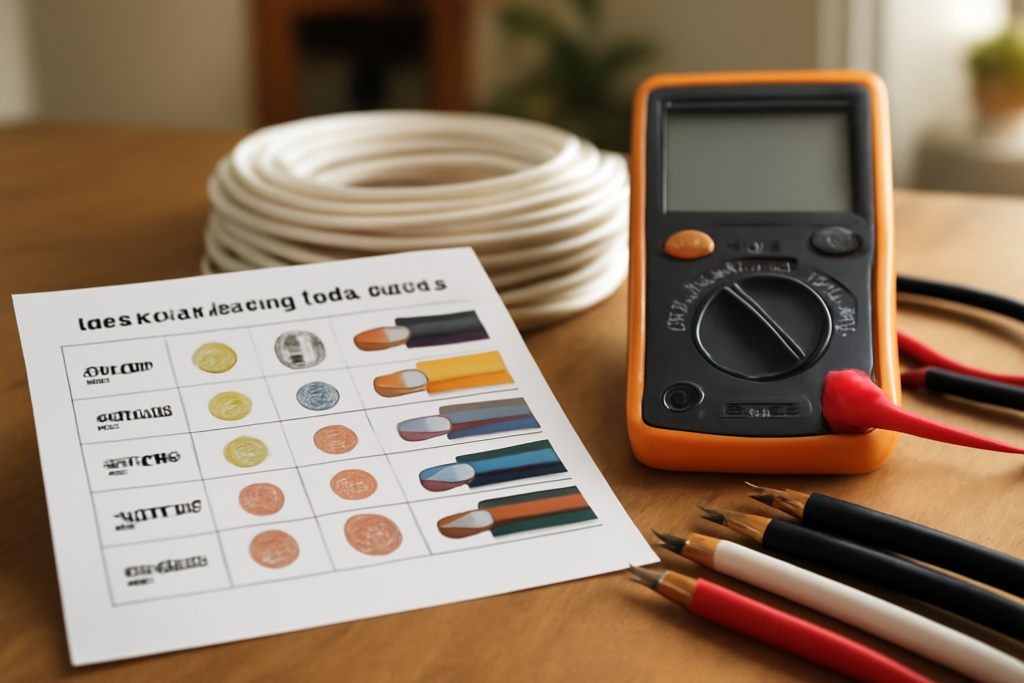
- Standard Wire Size Chart for Copper
- The Critical Wire-to-Breaker Rule
- Factors That Change the Right Size
- Common Circuits and Their Wiring
- Why You Can't Skip the Electrician
- Signs Your Wiring May Be Undersized
- Copper Versus Aluminum Wiring
- Understanding Cable Labels
- The Bottom Line
How Wire Gauge Works
Wire size in the United States is measured in American Wire Gauge, or AWG. The counterintuitive part is that smaller numbers mean thicker wire. A 14 AWG wire is thinner than a 12 AWG wire, which is thinner than a 10 AWG wire. Thicker wire carries more current without overheating.
The amount of current a wire can safely carry is its ampacity. The whole point of matching wire to circuit is ensuring the wire’s ampacity comfortably exceeds the load and matches the breaker protecting it.
Standard Wire Size Chart for Copper
The figures below are common reference values for copper wire on typical residential circuits. They are a teaching guide, not a substitute for code or an electrician’s calculation.
- 14 AWG: rated for 15-amp circuits, used for general lighting and standard outlet circuits.
- 12 AWG: rated for 20-amp circuits, used for kitchen and bathroom receptacles, garages, and many appliance circuits.
- 10 AWG: rated for 30-amp circuits, used for electric water heaters and some large appliances.
- 8 AWG: rated for 40-amp circuits, used for electric ranges and larger loads.
- 6 AWG: rated for 55-amp circuits, used for electric ranges, large air conditioners, and subpanels.
Aluminum wire has lower ampacity than copper of the same gauge and requires different sizing and connectors, another reason professional judgment is essential.
The Critical Wire-to-Breaker Rule
The single most important safety principle is that the breaker must protect the wire. A 15-amp circuit on 14 AWG wire uses a 15-amp breaker; a 20-amp circuit on 12 AWG uses a 20-amp breaker. The breaker is sized so it trips before the wire overheats.
This is why you must never replace a tripping breaker with a larger one to “fix” the trips. Putting a 20-amp breaker on 14 AWG wire removes the protection, the wire can now overheat and catch fire before the larger breaker ever trips. That dangerous shortcut causes house fires.
Factors That Change the Right Size
The simple chart is only a starting point. Several real-world factors push the required wire size up, and only a pro can weigh them all.
- Distance: long runs suffer voltage drop, so an electrician may upsize the wire to compensate.
- Continuous loads: circuits running at full load for hours are derated, requiring more capacity.
- Bundling and heat: wires packed together or run through hot spaces carry less current safely.
- Wire type and insulation: different cable types and temperature ratings change ampacity.
Because of these variables, the “right” wire for a given circuit on paper can differ from what your specific installation actually needs.
Common Circuits and Their Wiring
To make the chart concrete, here is how it maps to everyday household circuits.
- Bedroom and living-room lights and outlets: usually 14 AWG, 15-amp.
- Kitchen countertop and bathroom receptacles: 12 AWG, 20-amp, with GFCI protection.
- Electric water heater: often 10 AWG, 30-amp.
- Electric clothes dryer: commonly 10 AWG on a 30-amp 240-volt circuit.
- Electric range or oven: typically 8 or 6 AWG on a 40- or 50-amp 240-volt circuit.
These are typical examples; your home’s actual circuits depend on its appliances, panel, and local code.
Why You Can’t Skip the Electrician
Knowing the chart helps you understand your home and talk to a professional intelligently, but it does not qualify anyone to do the wiring. Sizing wire correctly involves load calculations, derating, voltage-drop math, and conformance to the National Electrical Code as adopted and amended by your local jurisdiction.
A licensed electrician verifies every figure against current code, pulls a permit, and has the work inspected. They also know never to work on live circuits and how to handle the panel safely. The stakes, fire and electrocution, are simply too high for guesswork.
Signs Your Wiring May Be Undersized
Some warning signs suggest existing wiring or breakers don’t match. Watch for breakers that trip under normal use, outlets or switch plates that feel warm, lights that dim when an appliance kicks on, or a faint burning smell near outlets. Any of these warrants an electrician’s inspection, not a DIY fix.
If you live in an older home, have a professional evaluate whether the wiring matches today’s loads. Homes wired decades ago were built for far fewer high-draw appliances than a modern household runs.
Copper Versus Aluminum Wiring
Most modern household branch circuits use copper wire, but aluminum appears in some applications, particularly larger feeders and service entrances, and in some older homes that were wired with aluminum branch circuits during a period when copper was costly. Aluminum has lower ampacity than copper of the same gauge, so it must be sized larger for the same load.
Older aluminum branch wiring is a known concern because the connections can loosen and overheat over time at outlets and switches. If your home has aluminum branch circuits, have a licensed electrician inspect the connections and recommend approved remediation. This is not a DIY assessment; the right connectors and methods are specific and code-driven.
Understanding Cable Labels
The printing on residential cable tells you what you have, and learning to read it helps you talk to your electrician. A common label like “12-2 with ground” means two 12 AWG insulated conductors, a hot and a neutral, plus a bare grounding wire. A “14-3” cable adds a third insulated conductor, often used for three-way switches or split circuits.
The jacket also notes the cable type and temperature rating. While reading the label is useful, interpreting it for a specific installation, and confirming it matches the breaker and load, is the electrician’s job. The label confirms what’s in the wall; it doesn’t certify that the circuit is correctly designed or safe to modify.
The Bottom Line
A house wiring wire size chart connects each circuit’s amperage to a wire thick enough to carry it safely, 14 AWG for 15 amps, 12 AWG for 20 amps, 10 AWG for 30 amps, and so on, with the breaker always sized to protect the wire. Treat these as reference values, never as a green light to do your own wiring. Verify everything against current local code and hire a licensed electrician to plan, install, and inspect the work. In home wiring, the right wire size is a fire-safety decision, not a shortcut.