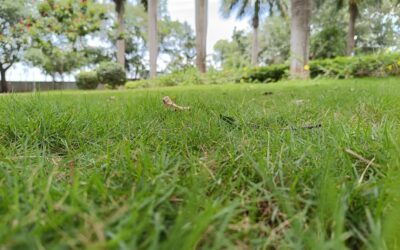
Most thin lawns that fail to thicken after overseeding were not short on effort. They were short on seed, or the seed landed in stripes. Knowing how much grass seed to overseed comes down to three numbers: the recommended rate for your grass type, the true square footage of your lawn, and a spreader setting that actually delivers that rate. Get all three right and you buy the correct number of bags the first time.
As a quick answer, overseeding usually calls for about half of the rate used to seed a brand-new lawn. For tall fescue, that means roughly 4 to 5 pounds per 1,000 square feet instead of 8 to 10. Kentucky bluegrass needs far less by weight because its seeds are tiny, typically 1 to 1.5 pounds per 1,000 square feet for overseeding. Perennial ryegrass sits in between at about 4 to 5 pounds.
- How Much Grass Seed to Overseed by Grass Type
- Tools and Materials You Will Need
- Step-by-Step: Measure the Lawn and Calculate Seed
- How to Calibrate a Broadcast Spreader
- Preparing the Lawn So the Seed Actually Grows
- Troubleshooting Common Overseeding Problems
- General Cost Ranges for Overseeding
- When to Call a Pro
- Frequently Asked Questions
Those figures assume an existing lawn with thin spots rather than bare dirt. If more than half of an area is bare soil, treat that section like a new seeding and use the full rate. The rest of this guide walks through the rates, the measuring, the math, and the spreader calibration that ties it all together.
How Much Grass Seed to Overseed by Grass Type
Seed size varies enormously between species. A pound of Kentucky bluegrass contains roughly 1 to 2 million seeds, while a pound of tall fescue holds closer to 200,000. That is why rates are listed per species rather than as one universal number. When people ask how much seed for overseeding a lawn, the honest reply always starts with “which grass?”
| Grass type | Overseeding rate (lbs/1,000 sq ft) | New lawn rate (lbs/1,000 sq ft) |
|---|---|---|
| Tall fescue | 4-5 | 8-10 |
| Kentucky bluegrass | 1-1.5 | 2-3 |
| Perennial ryegrass | 4-5 | 7-9 |
| Fine fescue blends | 2-3 | 4-5 |
| Sun and shade mixes | 3-4 | 6-8 |
| Bermudagrass (hulled) | 0.5-1 | 1-2 |
| Annual or perennial rye over dormant warm-season turf | 5-10 | Not applicable |
Always check the bag label as well. Seed producers print a recommended rate, and coated seed is the most common reason the label disagrees with a chart. Coatings that hold moisture or fertilizer can add 30 to 50 percent to the weight, so a coated tall fescue product may call for 6 or 7 pounds per 1,000 square feet to deliver the same number of actual seeds.
Light Thickening vs Heavy Renovation
Use the low end of each range when the lawn is mostly full and you simply want to boost density before it thins further. Use the high end after a hard summer, grub damage, or dog spots that left a patchwork of bare soil. For a true renovation where you have killed off weeds and dethatched heavily, move up to the new-lawn rate.
Tools and Materials You Will Need
- A measuring wheel or a 100-foot tape measure
- Graph paper or a phone app for sketching the lawn
- Grass seed matched to your region, sun exposure, and existing turf
- A broadcast spreader for large areas, or a drop spreader for tight strips along beds and walks
- A kitchen or luggage scale for calibration
- A tarp or a few large trash bags
- A leaf rake or a core aerator, depending on how you prepare the soil
- A starter fertilizer, if a soil test or local guidance supports it
A broadcast spreader is the practical choice for most yards larger than about 2,000 square feet. It throws seed in a wide fan, so you finish quickly and the edges of each pass blend together. A drop spreader places seed precisely but leaves visible stripes if your passes do not line up perfectly.
Step-by-Step: Measure the Lawn and Calculate Seed
- Sketch the yard. Draw the front, back, and side lawns as simple rectangles, triangles, and circles. Leave out the house, driveway, patio, and planting beds.
- Measure each shape. Rectangles are length times width. Triangles are base times height divided by two. Circles are 3.14 times the radius squared.
- Add the pieces together. A typical suburban lot might total 5,000 to 8,000 square feet of actual turf even when the lot itself is a quarter acre.
- Divide by 1,000. This gives you the number of “thousand-square-foot units” that seeding rates are based on.
- Multiply by the rate. For a 6,000-square-foot tall fescue lawn at 5 pounds, you need 6 times 5, or 30 pounds of seed.
- Add a buffer. Buy roughly 10 percent extra for bare patches, edges, and a spring touch-up. That turns 30 pounds into about 33.
Here is a second worked example. Suppose your Kentucky bluegrass lawn measures 4,500 square feet and you are overseeding at 1.5 pounds. That is 4.5 times 1.5, or about 6.75 pounds. A 7-pound bag covers it, and a small extra bag handles any bare spots you seed at the heavier rate.
How to Calibrate a Broadcast Spreader
Spreader settings printed on seed bags are only a starting point. Walking speed, seed size, humidity, and even the wear on the spreader gate all change how much seed actually leaves the hopper. A five-minute calibration test prevents running out halfway across the yard or dumping a double dose in the first section.
- Mark a test area. Measure out exactly 1,000 square feet, such as a 20-by-50-foot rectangle, on the driveway or a lawn section you plan to seed anyway.
- Weigh a known amount of seed. Pour, for example, 10 pounds into the hopper and note the exact weight.
- Set the gate to the bag’s suggested number. If the bag lists no setting, start at a mid-range opening.
- Walk the test area at your normal pace. Keep a steady speed and open the gate only while moving.
- Weigh what is left. Subtract from the starting weight to find how much you applied per 1,000 square feet.
- Adjust and repeat. Open the gate if you applied too little, close it if you applied too much, then retest until you are within about half a pound of the target.
If you calibrate on pavement, lay a tarp down first so you can sweep the seed back into the bag. One more trick helps with even coverage: set the spreader to deliver half the target rate, then cover the lawn twice in perpendicular directions. The crisscross pattern hides small errors and leaves far fewer thin stripes.
Preparing the Lawn So the Seed Actually Grows
Even the right quantity of seed fails if it sits on top of thatch or compacted soil. Seed needs contact with bare soil, steady moisture, and light. Mow the existing lawn short, around 2 inches for cool-season grass, and bag the clippings. Then either rake vigorously to loosen the surface or run a core aerator to pull plugs that give seed pockets to settle into.
After spreading, lightly rake the seeded areas so the seed drops into the soil surface rather than sitting on leaves and debris. Water once or twice daily in short sessions to keep the top quarter inch consistently damp until germination, then taper to deeper, less frequent watering. Hold off on the first mow until the new grass reaches the normal mowing height.
Timing Matters as Much as Quantity
Cool-season grasses such as tall fescue, Kentucky bluegrass, and ryegrass germinate best when soil temperatures run between about 50 and 65°F, which in most northern and transition-zone states means late August through early October. Warm-season grasses such as bermudagrass are overseeded in late spring or early summer once soil stays above 65°F. Seeding at the wrong time wastes seed no matter how carefully you measured.
Troubleshooting Common Overseeding Problems
- Stripes of thick and thin grass: passes did not overlap, or a drop spreader was used without edge-to-edge alignment. Reseed the thin stripes by hand or with the crisscross method.
- Patchy germination: seed dried out between waterings, or it never reached soil. Rake bare spots, reseed at the higher rate, and water more frequently.
- Seed washed into low areas: watering was too heavy. Use shorter cycles and a sprinkler that produces fine droplets.
- Ran out of seed early: the spreader was set too wide open or the lawn was larger than measured. Recalibrate before buying more.
- Grass came up weak and yellow: soil may be compacted or low in nutrients. A soil test through your county extension office tells you what to add.
- Birds eating the seed: a thin layer of straw or peat moss over bare areas hides the seed and holds moisture.
General Cost Ranges for Overseeding
Quality cool-season seed generally runs from a few dollars to around ten dollars per pound depending on species, blend quality, and coating. Kentucky bluegrass tends to cost more per pound but covers more ground, so its cost per 1,000 square feet often lands close to tall fescue. For a typical 5,000-square-foot lawn, expect seed costs to fall somewhere in the range of roughly $40 to $150.
Renting a core aerator for a half day is usually a modest expense, and a homeowner-grade broadcast spreader is an affordable tool that lasts many seasons. Hiring a lawn care company to aerate and overseed generally costs more per visit, with pricing that depends on lawn size and region, but it includes professional equipment and seed.
When to Call a Pro
Most homeowners can handle overseeding on their own. Consider bringing in a lawn care professional if the lawn is larger than about an acre, if heavy thatch over half an inch needs power dethatching, or if large areas are dying for reasons you cannot identify. A pro can also slit-seed, which cuts seed directly into the soil and often produces better results on thin, compacted lawns than broadcasting.
A local extension office is another underused resource. Their staff can recommend grass varieties proven in your area and help interpret a soil test, which often solves problems that more seed never will.
Frequently Asked Questions
How much grass seed to overseed 1,000 square feet of tall fescue?
Plan on about 4 to 5 pounds of uncoated tall fescue per 1,000 square feet. If the seed is coated, follow the bag rate, which is often closer to 6 or 7 pounds because the coating adds weight.
Can I put down too much seed when overseeding?
Yes. Heavy seeding creates crowded seedlings that compete for water and light, which leads to weak, disease-prone turf. Stick close to the recommended rate and fix thin areas with a second light pass instead.
How much seed do I need for a quarter-acre lawn?
A quarter acre is about 10,900 square feet, but the actual turf area is usually much smaller once you subtract the house, driveway, and beds. Measure only the grass, then multiply the thousands of square feet by your grass type’s rate.
Should I overseed at the same rate every year?
Not necessarily. A dense, healthy lawn may only need the low end of the range, while a lawn recovering from drought or pests benefits from the higher end. Adjust each season based on how thin the turf looks.
Is hand spreading seed accurate enough?
For small patches under a few hundred square feet, hand spreading works fine. For whole lawns, a calibrated spreader gives far more even coverage and uses seed more efficiently.