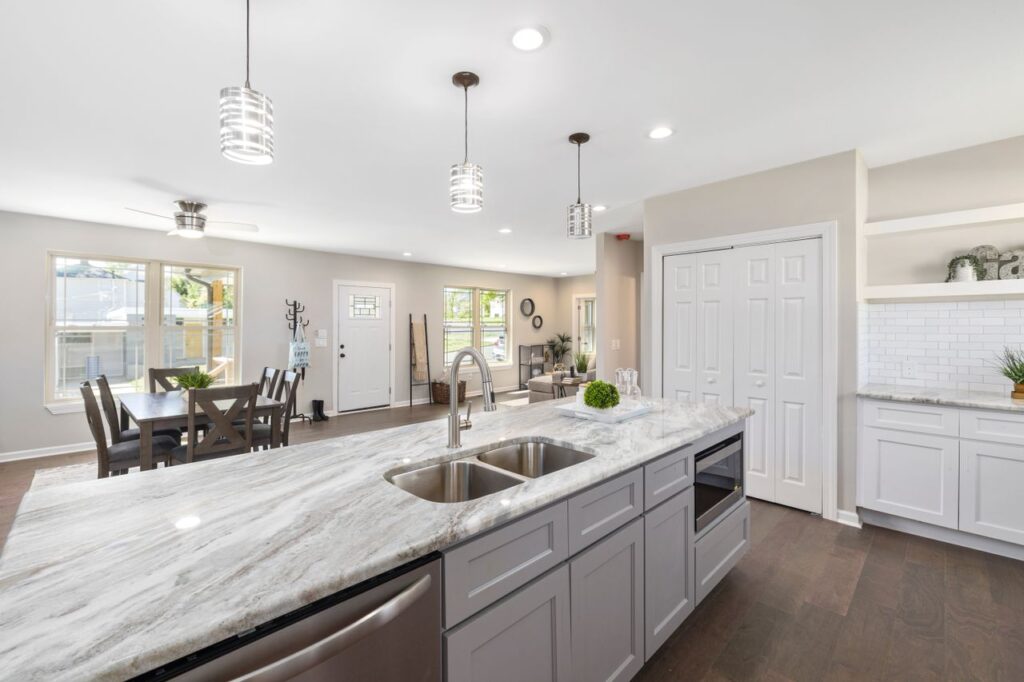
Ask three different showrooms for a quartz quote and you might get numbers that vary by thousands of dollars for the same kitchen. So how much is a quartz countertop, really? Installed, most homeowners pay between $50 and $200 per square foot, with a typical kitchen landing around $3,000 to $7,000. The wide range isn’t showrooms gouging you; it reflects real differences in quartz grade, edge work, fabrication, and installation complexity that are worth understanding before you sign anything.
Part of our Countertops guide — explore the full guide →
The Short Answer: Cost Per Square Foot
Quartz is priced by the square foot, installed, and that figure bundles the slab, fabrication, and installation together. Here’s how the tiers generally break down:
- Entry-level quartz — $50 to $70 per sq ft, basic colors and patterns from value lines.
- Mid-range quartz — $70 to $100 per sq ft, more color choices and convincing marble-look patterns.
- Premium quartz — $100 to $150 per sq ft, designer brands with dramatic veining and larger slabs.
- Luxury and specialty — $150 to $200+ per sq ft, high-end collections and complex installations.
For a standard 30 square foot kitchen counter, that math works out to roughly $1,500 on the low end and $6,000 or more on the high end, before extras.
What Actually Drives the Price
Several factors push a quote up or down, and knowing them helps you see where your money goes:
- Brand and grade — names like Caesarstone, Cambria, and Silestone command a premium for their patterns and warranties.
- Color and pattern — solid, simple colors cost less than intricate marble-look veining that requires slab matching.
- Thickness — a 3cm slab costs more than 2cm but needs no plywood backing and looks more substantial.
- Edge profile — a basic eased edge is included, while ogee, waterfall, or mitered edges add $10 to $50 per linear foot.
The pattern you fall in love with often has the biggest single impact on the final number, so ask which grade tier a slab belongs to before you get attached to it.
Fabrication and Installation Costs
The slab itself is only part of the story. Fabrication, the cutting, edging, and cutout work, plus installation typically accounts for a large share of the installed price. Sink and cooktop cutouts, faucet holes, and seams all require skilled labor.
A farmhouse sink cutout, an undermount sink, or a cooktop opening each add cost because they demand precise cutting. Complex layouts with many corners and seams take longer to template and install than a simple straight run, and you’ll see that reflected in the quote.
Extra Charges to Budget For
Beyond the base per-square-foot rate, watch for add-ons that can meaningfully raise the total:
- Waterfall edges — where quartz cascades down the side of an island, effectively adding square footage.
- Backsplash — a matching quartz backsplash is priced separately by the square or linear foot.
- Tear-out and disposal — removing old countertops runs $50 to $300 depending on material.
- Plumbing reconnection — disconnecting and reconnecting the sink and faucet, if not included.
Always get an itemized quote so you can see exactly what’s bundled and what’s billed on top. A suspiciously low per-foot price sometimes hides these extras.
How Quartz Compares to Other Materials
Quartz sits in the mid-to-upper range of countertop pricing. Laminate is far cheaper at $20 to $50 per square foot installed but lacks durability and resale appeal. Granite overlaps with quartz at roughly $50 to $150 per square foot but requires periodic sealing. Natural marble runs higher and stains easily.
Quartz earns its price with a nonporous surface that never needs sealing, strong stain and scratch resistance, and consistent patterning. For many homeowners, that low-maintenance durability justifies paying more than granite or laminate.
How to Save Without Cutting Corners
You can trim the cost of a quartz project intelligently. Choose a slab from the entry or mid-range tier in a simple pattern, since those often look nearly as good as premium lines for a fraction of the price. Stick with a standard eased or beveled edge rather than an ornate profile.
Get at least three itemized quotes from local fabricators, not just big-box installers, since independent shops frequently price more competitively. And if you’re handy, handling the old-counter tear-out and the sink reconnection yourself shaves a few hundred dollars off the bill.
How to Measure Your Square Footage
Since quartz is priced by the square foot, an accurate measurement keeps your budget realistic before you ever call a fabricator. Measure the length and depth of every countertop run in inches, multiply them, and divide by 144 to get square feet. A standard counter is about 25 inches deep, and an island can run 36 inches or more.
Add up all the sections, then add roughly 10 percent for waste, since slabs are cut to fit and offcuts can’t always be reused. Don’t forget to include the island and any peninsula separately. For example, a 10-foot main run at 25 inches deep is about 17 square feet, and a 6-foot island at 40 inches adds another 17, landing you near 34 square feet before waste. Bring these numbers to the showroom so your quotes reflect your actual kitchen rather than a rough guess.
The Bottom Line on Quartz Pricing
So, how much is a quartz countertop? Plan on $50 to $200 per square foot installed, with a realistic mid-range kitchen landing around $3,000 to $5,000 once edges and cutouts are included. Nail down the slab’s grade tier, get itemized bids, and factor in the extras before you commit. Do that homework and you’ll pay a fair price for a surface that delivers years of low-maintenance beauty and strengthens your home’s resale value in the process.