
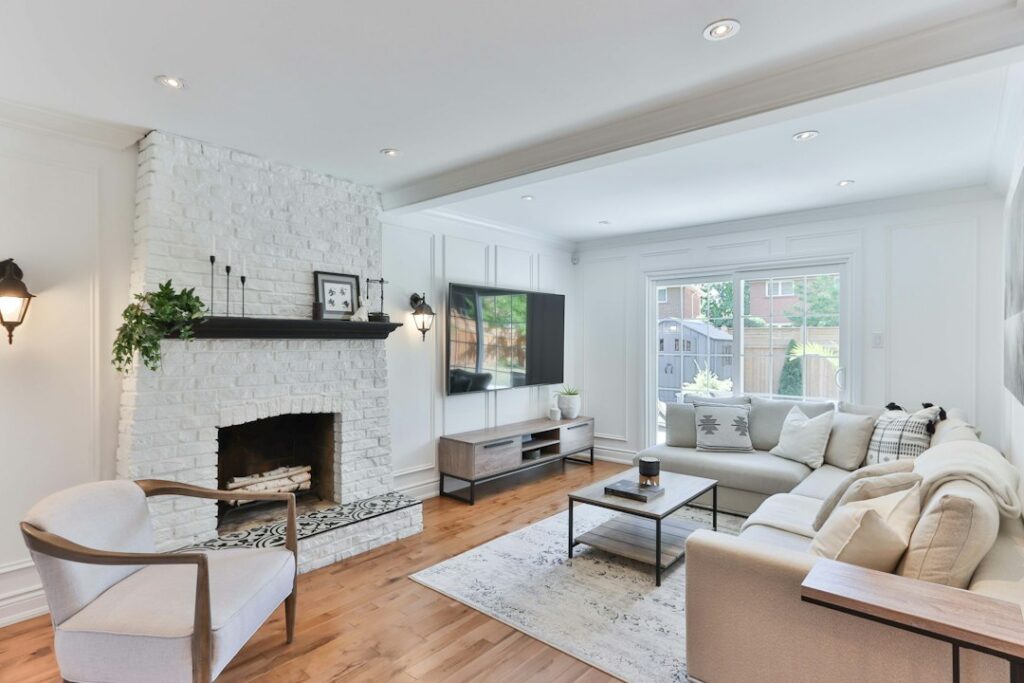
Most mantels look cluttered or bare for the same reason: the pieces were added one at a time with no plan behind them. Learning how to decorate a fireplace mantel well is less about buying the right objects and more about building in layers, starting with one large anchor, then adding height on either side, then filling with smaller texture. A mantel styled that way reads as intentional from across the room, and it is easy to change with the seasons.
The quick version: hang or lean one large piece centered over the firebox (a mirror, a framed print or a round wreath), flank it with two taller objects to form a loose triangle, then add two or three medium and small items in odd-numbered groups. Leave at least a third of the shelf empty so each piece has room to breathe. If the fireplace is used, every flammable item stays well back from the opening and nothing hangs where it could fall toward the flames.
- How to Decorate a Fireplace Mantel: Start With Measurements
- Tools and Materials
- Step 1: Choose and Secure the Anchor Piece
- Step 2: Build the Height Triangle
- Step 3: Layer Medium and Small Objects
- Step 4: Edit and Leave Breathing Room
- Fire Safety on a Working Mantel
- Seasonal Swaps Without Starting Over
- Troubleshooting Common Mantel Problems
- Typical Costs
- When to Call a Pro
- Frequently Asked Questions
That framework works on a narrow farmhouse shelf, a chunky stone ledge or a modern floating beam. Measuring, choosing the anchor, building the triangle, layering and seasonal swaps are the five moves that turn a bare ledge into a finished focal point.
How to Decorate a Fireplace Mantel: Start With Measurements
Before you move a single candlestick, measure three things: the length of the mantel shelf, its depth, and the clear wall height between the shelf and the ceiling. A 60-inch shelf that is 6 inches deep can hold far less than a 72-inch shelf that is 10 inches deep, and the depth decides if you can lean art or must hang it.
Write down the width of the firebox opening as well. Your anchor piece usually looks best somewhere between two thirds and the full width of the firebox, or roughly half to two thirds of the mantel length. A piece that is too small looks like it floated in by accident, while one wider than the shelf looks top-heavy.
- Shelf depth under 6 inches: hang the anchor on the wall; keep objects slim and light.
- Shelf depth 6 to 10 inches: lean a framed piece with a small ledge or museum putty behind the base.
- Shelf depth over 10 inches: you can layer two pieces of art, one leaning in front of another.
Tools and Materials
You do not need much, but having the right fasteners on hand saves a second trip to the store.
- Tape measure, pencil and painter’s tape for marking layouts
- Stud finder and a 24-inch level
- Rated picture hooks, or heavy-duty wall anchors and screws for masonry or drywall
- Museum putty or removable gel to steady vases and candlesticks
- Battery-operated flameless candles and timers
- Your anchor piece, two tall accents, and a handful of small objects, books and greenery
Step 1: Choose and Secure the Anchor Piece
The anchor is the largest element and the visual center of the whole arrangement. Popular choices include an oversized wall mirror, a large framed print, a round wreath, a vintage window frame or a piece of textile art. A mirror is a smart first pick in a dim room, because it bounces light from windows and lamps back into the space.
Heavy anchors need real support. A large framed mirror can easily weigh 30 to 60 pounds, and a mantel wall is often brick, stone or plaster over masonry. Locate studs in framed walls with a stud finder and drive screws into wood, or use masonry anchors rated for the weight when the chimney breast is brick. Before drilling, check for hidden wiring and pipes; chimney walls sometimes carry wiring for a TV or sconces. If you are drilling near an outlet or a switch box, turn off that breaker first and confirm the power is off with a non-contact voltage tester. Two hooks spaced apart hold a heavy piece level and resist tipping far better than a single nail.
Hang the bottom of the anchor about 4 to 8 inches above the shelf so it relates to the mantel rather than floating near the ceiling. If you lean it instead, set the base against a small strip of non-slip shelf liner and tuck a dab of putty behind each bottom corner.
Step 2: Build the Height Triangle
Once the anchor is set, place a tall object near each end of the shelf. Think candlesticks, slim vases with branches, tall lanterns or a stack of books topped with a small sculpture. The two sides do not have to match. Asymmetry often looks more relaxed: a tall vase of branches on one side can balance a pair of shorter lanterns on the other, as long as the visual weight feels even.
Step back about 10 feet and squint. You should see a rough triangle, with the anchor at the peak and the two tall pieces forming the base corners. If one side looks heavier, nudge it inward or swap in something lighter in color.
Step 3: Layer Medium and Small Objects
Layering is what makes a mantel feel collected. Work from back to front and tall to short:
- Lean a smaller framed print or a cutting board slightly off center, partly overlapping the anchor.
- Add medium objects such as a bowl, a clock or a short vase in front of the tall pieces.
- Group small items in threes or fives, mixing heights and textures: a small plant, a stacked pair of books, a ceramic bird.
- Run a soft element, such as a short garland or a draped length of greenery, along the front edge if the fireplace is not in use.
Mix finishes. Pair something glossy with something matte, something woven with something smooth, wood with metal. A mantel full of one material reads flat, even when the shapes vary.
Step 4: Edit and Leave Breathing Room
Here is where most mantels go wrong. After layering, remove one or two items. Empty space lets the eye rest and makes the pieces you keep look deliberate. A good rule is to leave roughly a third of the shelf length clear, usually in small gaps between groupings rather than one big hole.
Check the view from where people actually sit. Objects that look balanced while standing at the hearth can disappear or block the anchor from a sofa 12 feet away.
Fire Safety on a Working Mantel
If you burn wood or run a gas insert, the mantel is close to real heat, and decor choices matter. Keep garland, stockings, dried flowers, paper and fabric well clear of the firebox opening, and never drape anything that could slip and fall into the fire. Avoid hanging long garland that dangles toward the opening on a mantel above an active fire. Near the heat, choose flame-resistant or artificial greenery over dried natural stems, which ignite easily.
Battery-operated flameless candles are the better choice on a working mantel. They look convincing, and many include timers so you can set them for evening glow. If you do use real candles, keep them on stable holders, away from greenery and fabric, and never leave them burning unattended. Make sure a working smoke alarm and a carbon monoxide alarm are installed on that level of the home, and follow the clearances in your fireplace or insert manual, since mantel trim itself has required distances from the opening.
If you add lighting such as a pre-lit garland or a string of fairy lights, use battery or plug-in sets rated for indoor use, keep cords and battery packs away from the heat, and do not coil or bunch light strings where heat can build up.
Seasonal Swaps Without Starting Over
The anchor and the tall pieces usually stay put all year. What changes is the softer top layer. That approach keeps seasonal updates fast and inexpensive.
Fall
Learning how to decorate a fireplace mantel for fall usually means warm textures: small faux pumpkins or gourds in mixed sizes, a few stems of artificial wheat or eucalyptus, and a plaid or knit runner. Keep the palette to two or three colors so it does not tip into clutter.
Winter and Holidays
Swap in a faux garland, a wreath over the mirror, and battery candles in lanterns. Stockings can hang from weighted holders set on the shelf, positioned so they do not hang in front of the firebox when the fire is lit.
Spring and Summer
Strip back to the essentials. Add a vase of fresh or faux stems, lighter books, and maybe a woven tray. Summer mantels often look best with the fewest objects of the year.
Troubleshooting Common Mantel Problems
It looks cluttered. Remove the smallest items first, then group what remains into two or three clusters. Clutter is usually a count problem, not a style problem.
It looks bare. The anchor may be too small, or the tall pieces too short. Size up the anchor or add a leaning second print behind it.
Things keep falling over. Use museum putty under vases and candlesticks, especially in homes with kids or pets, and keep heavy objects toward the back of the shelf.
The TV sits above the mantel. Treat the TV as the anchor and keep shelf decor low so it does not block the screen. Long, low groupings work better than tall ones.
Typical Costs
Styling a mantel can cost almost nothing if you shop your own home. Pulling books, bowls and plants from other rooms is a perfectly good start. A new anchor mirror or large print usually runs from about $75 to $400 depending on size and frame. Seasonal greenery, candles and small accents generally add $30 to $150 per season, and good-quality artificial garland and flameless candles last for many years, which lowers the per-season cost over time.
When to Call a Pro
Bring in a handyman or contractor if you need to hang a very heavy mirror or art on stone or brick and are not comfortable drilling masonry, or if the mantel shelf itself feels loose. A sagging or wobbly mantel should be re-secured to framing before you load it with decor. If you want sconces or an outlet added on the chimney wall for a TV or lighting, hire a licensed electrician, since new circuits and outlets require permits in most areas. And schedule an annual chimney inspection for any wood-burning fireplace you use regularly.
Frequently Asked Questions
What is the rule of three for mantel decorating?
Group objects in odd numbers, usually threes, with varied heights so the eye moves across them. Three items of different sizes look more natural than two matching pieces.
How high should a mirror hang above a mantel?
Hang the bottom edge roughly 4 to 8 inches above the shelf. Higher than that and the mirror loses its connection to the mantel and looks like it is floating.
Is it safe to put garland on a mantel with a working fireplace?
It can be if you choose flame-resistant or artificial garland, keep it well back from the opening, and make sure nothing hangs down toward the firebox or can fall in while the fire is burning.
Should a mantel be symmetrical?
Not necessarily. Symmetry suits formal rooms, while balanced asymmetry feels more relaxed. Either way, the visual weight on each side should feel roughly even.
How do I dress up a fireplace mantel on a budget?
Shop your own home for books, bowls and plants, add foraged branches in a vase away from the heat, and invest in one good anchor piece. A single strong anchor does more than many small purchases.


