A walk-in tub typically costs $5,000 to $15,000 once installation is included, which puts it out of reach for many older adults on fixed incomes. If you are researching how to get a free walk-in tub for seniors, the honest answer is that no single national program hands out free tubs, but several funding sources can pay for part or all of one when there is a documented medical need. Medicaid waivers, veterans’ benefits, state aging agencies, rural housing programs, and nonprofits all play a role. This guide explains how each works, what eligibility usually looks like, and the steps that improve your odds of approval.
- How to Get a Free Walk-in Tub for Seniors: Start With the Right Expectations
- Does Medicare Pay for a Walk-in Tub?
- Medicaid Waivers and State Programs
- Help for Veterans
- Rural, Housing, and Nonprofit Programs
- Step-by-Step: How to Apply
- Beware of "Free Walk-in Tub" Scams and High-Pressure Sales
- Other Ways to Lower the Cost
- Choosing a Certified Installer
How to Get a Free Walk-in Tub for Seniors: Start With the Right Expectations
Funding programs rarely pay for a walk-in tub simply because it would be nice to have. They pay when a bathing modification is necessary for someone to live safely at home, and they generally want to see the least expensive option that meets that need. That matters, because a curbless shower, a tub transfer bench, or a set of grab bars often costs a fraction of a walk-in tub and may be what a program approves instead.
Most successful applications share three ingredients:
- A documented medical need, such as limited mobility, fall history, arthritis, or a condition where hydrotherapy is prescribed.
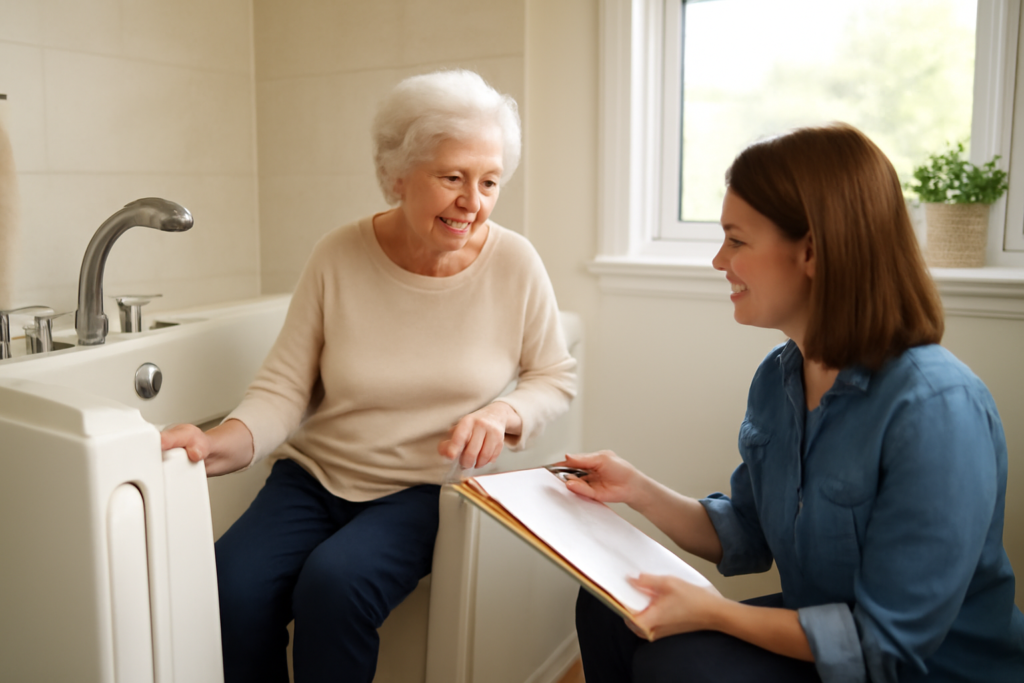
- A professional home assessment, ideally by an occupational therapist (OT) who can explain why a walk-in tub is appropriate rather than a shower conversion.
- Financial eligibility for the specific program, which often involves income and asset limits.
Think of the process as assembling a case, not filling out a single form. Some families end up combining two sources, for example a nonprofit grant plus a partial payment from a waiver program.
Does Medicare Pay for a Walk-in Tub?
Original Medicare (Parts A and B) generally does not cover walk-in tubs. Medicare classifies them as home modifications rather than durable medical equipment, so they fall outside Part B coverage even with a doctor’s prescription. Bathroom safety items like grab bars and raised toilet seats are also typically excluded.
Medicare Advantage (Part C) is different. Since 2019, federal rules have allowed Medicare Advantage plans to offer expanded supplemental benefits, and some plans include in-home safety assessments, bathroom safety devices, or modest home modification allowances. Coverage for an entire walk-in tub is uncommon, but a plan may help with related items. Call the member services number on your card and ask specifically about home safety or home modification benefits, and get any answer in writing.
Medicaid Waivers and State Programs
Medicaid is often the most promising route for low-income seniors. Through Home and Community-Based Services (HCBS) waivers, states can pay for services that help people avoid moving into a nursing home, and many waivers include environmental accessibility adaptations, which can cover bathroom modifications. Each state designs its own waivers, so covered items, spending caps, and waiting lists vary widely.
General eligibility usually requires:
- Meeting your state’s Medicaid income and asset limits.
- Needing a nursing-facility level of care, as determined by a state assessment.
- Living in a home you own or a rental where the landlord permits modifications.
- Showing that the modification is medically necessary and the most cost-effective solution.
Some states also run separate, state-funded aging programs that pay for home modifications for people who do not qualify for Medicaid. To find what is available where you live, contact your state Medicaid office or your local Area Agency on Aging, which you can locate through the federal Eldercare Locator at 1-800-677-1116 or eldercare.acl.gov.
Help for Veterans
Veterans have some of the strongest options. The Department of Veterans Affairs offers the Home Improvements and Structural Alterations (HISA) benefit, which helps eligible veterans pay for medically necessary changes to their home, including bathroom accessibility work, when prescribed by a VA provider. The VA also administers larger adaptive housing grants, known as Specially Adapted Housing and Special Housing Adaptation grants, for veterans with certain service-connected disabilities.
Benefit amounts depend on disability rating and program rules, and they change periodically, so confirm current figures directly with the VA. Start by talking with your VA primary care provider or the prosthetics department at your VA medical center, and consider working with an accredited Veterans Service Officer, whose help is free. Some state veterans’ affairs departments offer additional home modification assistance on top of federal benefits.
Rural, Housing, and Nonprofit Programs
USDA Home Repair Program
Homeowners age 62 and older in eligible rural areas may qualify for the USDA Rural Development Section 504 Home Repair program, which offers grants to very-low-income seniors to remove health and safety hazards, as well as low-interest loans. Accessibility improvements can qualify. Check address eligibility on the USDA’s eligibility website and contact your local Rural Development office.
Community Development and Local Housing Agencies
Many cities and counties use federal Community Development Block Grant (CDBG) funds for home repair and accessibility programs aimed at older and disabled homeowners. Availability depends entirely on your locality and funding cycle. Call your city or county housing department and ask whether they run a senior home repair or accessibility modification program.
Nonprofits and Charities
National and local nonprofits, including Rebuilding Together affiliates, Habitat for Humanity home repair programs, disability organizations, and faith-based groups, sometimes fund or perform accessibility modifications for older homeowners at low or no cost. Some focus on specific conditions, such as multiple sclerosis or Parkinson’s disease, and may help with bathing equipment. These programs usually have limited budgets and waiting lists, so apply early and to more than one.
Step-by-Step: How to Apply
- Talk to your doctor. Ask for a letter of medical necessity describing your diagnosis, mobility limitations, fall risk, and why bathing in a standard tub is unsafe.
- Get an occupational therapy home assessment. An OT can recommend the right solution, whether a walk-in tub, curbless shower, or transfer bench, and document it. Your doctor can often order this, and it may be covered by Medicare Part B as outpatient therapy.
- Call your Area Agency on Aging. Ask what home modification funding exists in your county, including Medicaid waivers, state programs, and local nonprofits.
- Check veteran status. If you or a spouse served, contact the VA or a Veterans Service Officer about HISA and related grants.
- Gather documents. Most programs ask for proof of age, income, assets, homeownership or landlord approval, and the medical documentation above.
- Collect written bids. Get two or three itemized quotes from licensed contractors. Programs frequently require multiple bids.
- Do not sign a contract before approval. Many programs will not reimburse work started before funding is approved.
Beware of “Free Walk-in Tub” Scams and High-Pressure Sales
Search results and TV ads sometimes promise free or government-paid walk-in tubs. Be cautious. Legitimate government programs do not cold-call seniors, charge application fees, or require a signed sales contract before eligibility is determined. Warning signs include in-home sales pitches that last hours, “today-only” discounts of 40 or 50 percent, pressure to finance at high interest, and claims that Medicare will cover the purchase.
The Federal Trade Commission’s cooling-off rule generally gives you three business days to cancel a sale of $25 or more made in your home, and some states provide more. If you or a loved one feels pressured, ask the salesperson to leave and verify any funding claim directly with the program named.
Other Ways to Lower the Cost
If free funding does not come through, you still have options. When a walk-in tub is primarily for medical care, part of the cost may be deductible as a medical expense on your federal return; IRS Publication 502 explains that improvements made for medical reasons can count to the extent they do not increase your home’s value, and many accessibility changes qualify in full. Some states offer their own tax credits or deductions for accessibility improvements. Manufacturers and dealers often have financing, and some offer discounts to veterans or seniors, but compare the total financed cost carefully.
Also consider whether a walk-in tub is truly the best fit. A walk-in tub requires you to sit inside while it fills and drains, which can take 6 to 15 minutes each way unless it has a fast-drain system, and it needs a water heater large enough to fill 50 to 80 gallons with hot water. A curbless roll-in shower with a fold-down bench, a handheld sprayer on a slide bar, and ADA-style grab bars rated for 250 pounds of force often costs $3,000 to $8,000 and suits wheelchair users better. An OT can help you decide.
Choosing a Certified Installer
Whoever pays, the installation should be done by a licensed plumber or contractor experienced with accessible bathrooms, and a Certified Aging-in-Place Specialist (CAPS) designation is a helpful signal. Confirm that the floor can support the filled tub, which can weigh 500 to 800 pounds or more with water and a bather, and that electrical work for jets or heaters goes on a GFCI-protected circuit installed by a licensed electrician. Ask about the door seal warranty, since that is the component most likely to need service.
Learning how to get a free walk-in tub for seniors takes persistence, but with a doctor’s letter, an OT assessment, and a call to your local aging agency, many families find at least partial funding for a safer bathroom.