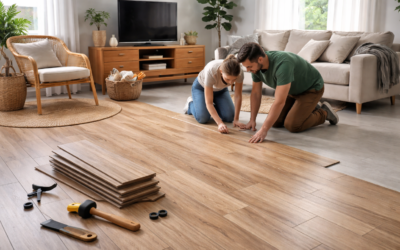
Walk into a hospital, school, or busy retail store and the resilient floor underfoot is often a vinyl tile most homeowners have never heard named. HVT flooring stands for heterogeneous vinyl tile, a type of commercial-grade vinyl tile built in multiple distinct layers, including a printed design layer and a clear protective wear layer. It’s engineered for heavy traffic and design flexibility. If you’ve seen the term and weren’t sure what it meant, this guide explains it honestly, along with the pros, cons, and how to buy it.
What HVT Flooring Means
HVT is a category within resilient vinyl flooring. “Heterogeneous” means the tile is made of several different layers bonded together, each doing a specific job. This contrasts with homogeneous vinyl, where the color and composition run uniformly through the entire thickness. The layered construction lets manufacturers print detailed wood, stone, and abstract patterns and cap them with a tough, clear wear layer for protection.
Because the design sits in its own layer under a clear top coat, HVT can offer far more visual variety than solid-color homogeneous vinyl, while still standing up to commercial use.
HVT vs Homogeneous Vinyl
The two are easy to confuse, so here’s the honest distinction:
- Heterogeneous (HVT): Multiple layers with a printed design and a separate clear wear layer; more pattern options and often used where looks matter.
- Homogeneous: A single uniform composition throughout; extremely durable and easy to renew by buffing, common in hospitals and labs where deep cleaning and abrasion matter most.
Neither is universally better; they serve different priorities. HVT wins on design range, homogeneous wins on the ability to sand or buff back to a fresh surface since the color goes all the way through.
The Layers in HVT
A typical heterogeneous vinyl tile is built up like this:
- Wear layer (top): A clear protective coating that resists scratches, scuffs, and stains.
- Design/print layer: The decorative film carrying the wood, stone, or pattern look.
- Core layers: Backing layers that provide stability, thickness, and underfoot comfort.
The thickness of the wear layer is the single most important durability spec, just as it is with luxury vinyl. Thicker wear layers handle heavier traffic for longer.
Pros of HVT Flooring
HVT earns its place in commercial settings for good reasons:
- Design variety: A wide range of wood, stone, and decorative looks thanks to the print layer.
- Durability: Built for heavy foot traffic in schools, offices, and healthcare.
- Resilience underfoot: Softer and warmer than tile, with some give for comfort.
- Easy maintenance: The wear layer resists stains and cleans up simply.
- Water resistance: Vinyl construction handles spills and humidity well.
The Cons to Weigh
It isn’t the right fit for every job:
- Can’t be sanded back: Unlike homogeneous vinyl, you can’t renew the surface by abrading the color layer.
- Wear-layer dependent: Once the clear top wears through, the print is exposed and the tile is done.
- Commercial focus: It’s less commonly stocked for residential DIY than standard LVT.
- Install matters: Most is glue-down, which demands a clean, flat, dry subfloor.
Where HVT Is Used
HVT is primarily a commercial product, well suited to spaces that need both looks and toughness: schools, healthcare facilities, offices, retail stores, and hospitality. It’s chosen when a designer wants varied, realistic visuals in a high-traffic area without the cost or coldness of stone tile. For a typical home, standard luxury vinyl tile or plank is usually the easier, more widely available choice, though HVT can work in a residence if you can source it.
Cost and Buying Tips
Pricing tracks with commercial resilient flooring, generally in the range of roughly $3 to $7 per square foot for materials, with installation adding to that for glue-down work. When evaluating HVT:
- Compare wear-layer thickness first; it determines how long the floor lasts under traffic.
- Match the product’s traffic rating to your space’s actual use.
- Confirm whether it’s glue-down or click and plan subfloor prep accordingly.
- Ask about slip resistance if it’s going in a wet or high-safety area.
- Check the warranty terms for commercial versus residential coverage.
Maintaining HVT Floors
One reason facilities choose HVT is the straightforward upkeep. To get the full service life out of the wear layer:
- Sweep or dust-mop daily to keep abrasive grit from grinding into the surface.
- Damp-mop with a neutral pH cleaner; harsh chemicals can dull or degrade the finish.
- Use walk-off mats at entries to trap dirt before it reaches the floor.
- Apply a floor finish/polish if recommended, which can be stripped and reapplied to renew the look without replacing the tile.
- Address spills promptly to prevent staining in high-use areas.
Because you can’t sand HVT back like homogeneous vinyl, protecting the wear layer with good maintenance is the key to longevity.
How to Decide if HVT Is Right for You
The choice usually comes down to priorities. If your space needs varied, realistic wood or stone visuals and will see steady commercial traffic, like an office, school corridor, or retail floor, HVT is an excellent fit. If your priority is extreme durability with the ability to renew the surface by abrading the color layer, such as a hospital operating area or a lab, homogeneous vinyl may serve better. For a residential project, weigh availability: standard luxury vinyl tile is far easier to source and install for a homeowner, while HVT shines when sourced through commercial flooring suppliers. Match the product to the traffic, the look you need, and how you plan to maintain it.
HVT vs Luxury Vinyl Tile
Homeowners often wonder how HVT relates to the LVT they see at retail, and the line between them can blur. Both are layered vinyl with a printed design and a clear wear layer, so in construction they’re cousins. The practical differences are market and grade: HVT is typically positioned as a commercial product sold through contract suppliers, often glue-down, and chosen for high-traffic durability and design coordination across large spaces. Consumer LVT, including click-together planks and tiles, is widely stocked at home centers and engineered for easy DIY residential installation. For a homeowner, LVT is usually the more accessible and convenient option, while HVT makes sense for commercial fit-outs or when an interior designer specifies it. Judge either one by wear-layer thickness, which is the truest predictor of how long the floor will hold up.
The Bottom Line
HVT flooring is heterogeneous vinyl tile, a multi-layer commercial vinyl built for heavy traffic and rich design options. Its strength is visual variety with real durability; its limit is that, unlike homogeneous vinyl, it can’t be sanded back once the wear layer is gone. Judge it by wear-layer thickness and traffic rating, and consider it when you need a tough, good-looking resilient floor for a busy commercial space.
Prefer to explore on your own?
See how new flooring looks in your actual room in seconds — free, no signup.
Try the free Floor Studio →