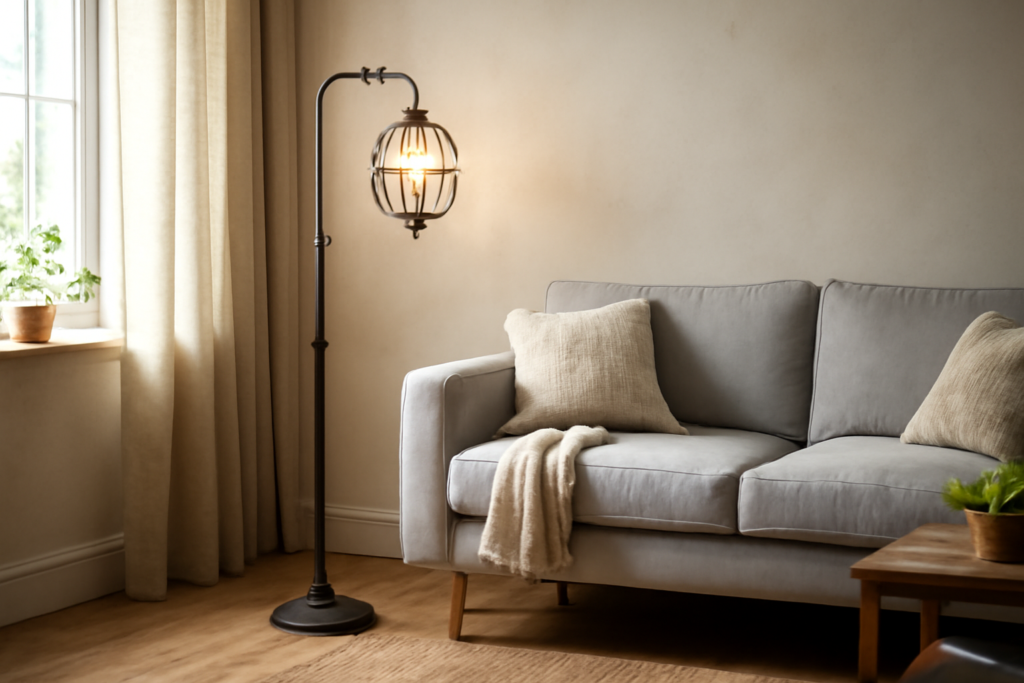
An industrial floor lamp brings warehouse-loft character into a room with its mix of raw metal, weathered wood, exposed hardware, and visible bulbs. It is the kind of statement piece that does double duty: it lights a reading corner or living space while serving as a sculptural focal point. The style spans everything from slim tripod lamps to towering articulated task lights modeled on factory equipment. Choosing the right one comes down to the look you want, the kind of light you need, and how the lamp fits your floor plan.
This guide covers the main styles, finishes, bulb choices, placement, and what to look for when buying.
What Defines the Industrial Look
Industrial lighting borrows from early factory and machine-shop fixtures. The hallmarks are honest materials and exposed mechanics: black or aged-metal frames, brushed steel or brass accents, reclaimed or distressed wood, visible cords and pipe-style joints, and bulbs left bare or behind metal cage guards. Nothing is hidden, and that raw, utilitarian honesty is the whole point.
The palette tends toward matte black, gunmetal, bronze, and natural wood, which lets these lamps anchor both true industrial rooms and softer modern-rustic or transitional spaces.
Common Styles
Industrial floor lamps come in several distinct shapes, each suited to a different job:
- Tripod lamps: Three splayed legs, often wood and metal, with a drum or cone shade. Stable, stylish, and great for ambient light.
- Task and architect lamps: Articulated arms inspired by drafting and factory lights, adjustable for reading or work.
- Pipe and gear lamps: Built to look like assembled plumbing pipe with exposed Edison bulbs, maximum industrial character.
- Tree and multi-head lamps: Several caged or shaded heads on one pole to light a larger area.
- Arc lamps: A long curved arm that extends light out over a sofa or table without a base in the way.
Choosing the Right Bulb
Because industrial lamps so often leave the bulb exposed, the bulb itself is part of the design. Vintage-style Edison LED bulbs, with their visible filament loops, are the classic choice and give a warm amber glow. Look for LED versions rather than incandescent for energy savings and far longer life, typically 15,000 hours or more.
Match the color temperature to the room’s purpose. A warm 2200 to 2700 Kelvin reads cozy and authentic for living rooms and bedrooms, while a neutral 3000 to 3500 Kelvin gives clearer light for reading and task areas. A dimmer or a dimmable bulb adds flexibility to shift from ambient to task lighting.
Where to Place It
A floor lamp earns its keep when it lights a function, not just a corner. Position a tripod or arc lamp beside a sofa or armchair to create a reading nook, with the bottom of the shade roughly at eye level when seated to avoid glare. Task and architect lamps belong next to a desk or workbench. Tree and multi-head lamps suit open living areas that need fill light.
Mind the cord and the base footprint so the lamp does not become a trip hazard in a walkway, and place it near an outlet to avoid running cords across the floor.
Matching It to Your Decor
Industrial lamps are surprisingly flexible. In a true loft or industrial space they reinforce the theme with pipe and gear designs. In a modern-rustic or farmhouse room, a wood-and-metal tripod softens the look. In a transitional or even mid-century space, a single clean industrial accent adds contrast without taking over.
The trick is restraint. One strong industrial fixture often makes more impact than a room full of competing pieces. Let the lamp be a focal point and keep surrounding lighting simpler.
Caring for Metal and Wood Finishes
Industrial lamps wear their materials openly, so a little upkeep keeps them looking intentional rather than neglected. Dust metal frames regularly with a dry microfiber cloth, and wipe occasional fingerprints from brushed or polished surfaces with a barely damp cloth, drying immediately to avoid water spots. For aged or raw metal with a patina, avoid abrasive cleaners that would strip the finish you paid for.
Wood elements benefit from an occasional wipe and, if the wood is sealed, a light furniture polish once or twice a year. Keep lamps out of damp areas, since untreated metal can develop surface rust and unsealed wood can swell over time.
Bulb Safety and Heat
Because industrial lamps often expose the bulb, pay attention to safety. Stick to LED bulbs, which run far cooler than incandescent and nearly eliminate the burn and fire risk of a hot exposed filament bulb near fabric shades or curtains. Always match the bulb wattage to the lamp’s rated maximum, listed on the socket or in the manual, and never exceed it.
If a lamp uses a fabric or paper shade close to the bulb, the cool operation of LEDs matters even more. Position any floor lamp where the bulb and shade are not pressed against drapes, bedding, or other flammable materials.
What to Look for When Buying
Quality varies widely. Prioritize a heavy, stable base, since a top-heavy industrial lamp can tip. Check that the metal finish is consistent and the wood is sealed, and confirm the lamp is UL or ETL listed for safety. Adjustable lamps should move smoothly and hold their position without drooping.
Prices range broadly, commonly $80 to $400 depending on size, materials, and brand, with designer pieces higher. A solid mid-range lamp with a metal base, real wood, and a dimmable LED bulb hits the sweet spot of looks and durability.
Chosen well, an industrial floor lamp delivers warm, characterful light and a sculptural focal point in one piece. Match the style to your room, pick a warm dimmable bulb, place it where it actually lights a function, and it will earn its spot for years. Because the industrial aesthetic is built on timeless materials rather than passing trends, a well-made metal-and-wood lamp tends to stay relevant through several redecorating cycles, moving easily from a living room to an office to a den as your needs change.
Prefer to explore on your own?
See how new flooring looks in your actual room in seconds — free, no signup.
Try the free Floor Studio →