A door that sticks, drags on the carpet, or refuses to latch is one of the most common household annoyances, and it is almost always fixable in an hour with tools you already own. Most interior door repair jobs trace back to just a handful of causes: loosened hinge screws, a settling frame, humidity swelling the wood, or a strike plate that has drifted out of alignment. Learning to diagnose which one you have is more than half the battle.
Part of our Windows & Doors guide — explore the full guide →
This guide walks through the usual failures in order of how often they occur, gives you the exact fix for each, and covers patching the holes that hollow-core doors seem to attract. None of it requires a carpenter.
- Diagnosing Why a Door Sticks
- Fixing Loose and Stripped Hinge Screws
- Planing a Door That Still Binds
- Curing Latch and Strike Plate Problems
- Patching Holes in Hollow-Core Doors
- Silencing Squeaks and Rattles
- Fixing a Door That Won't Stay Open or Closed
- Tools and Materials to Keep on Hand
- Preventing Future Door Problems
- When to Replace Instead of Repair
Diagnosing Why a Door Sticks
Before you touch a plane or a screwdriver, find out where the door binds. Close it slowly and watch the gap around the perimeter, called the reveal. A consistent even gap means the problem is elsewhere; a spot where the door rubs shows you the trouble zone. Slide a dollar bill or thin shim around the edge to feel exactly where it drags.
Rubbing at the top of the latch side usually means the door has sagged and the top corner has dropped into the frame. Rubbing at the bottom often points to seasonal swelling or a hinge issue. Sticking that appears only in humid summer months and vanishes in winter is moisture, not mechanics, and calls for a different fix than a permanently dragging door.
Fixing Loose and Stripped Hinge Screws
The single most common cause of a sagging, sticking door is hinge screws that have backed out of the jamb. Over years of slamming, the screws in the top hinge loosen and the door tilts. Start every repair here, because it is free and it fixes a surprising number of doors.
- Tighten every hinge screw with a hand screwdriver, not a drill, so you feel when they seat.
- If a screw spins without biting, the hole is stripped. Replace one top-hinge screw with a 3-inch screw that reaches through the jamb into the wall framing behind it, which pulls the whole door snug against the frame.
- For badly stripped holes, tap in a few wooden matchsticks or golf-tee tips with wood glue, let it set, then drive the original screw into the fresh wood.
That single 3-inch screw trick solves more sagging doors than any other repair, and it costs about a dime.
Planing a Door That Still Binds
If the door drags after the hinges are tight, you may need to remove material. Mark the rubbing spot with a pencil, then decide whether you can plane it in place or need to take the door down. Light rubbing on the latch edge can often be sanded with 80-grit paper wrapped on a block. Heavier binding calls for a block plane or a power planer, taking off no more than 1/16 inch at a pass.
Always plane toward the ends of the door on the edges to avoid tearing out the grain, and seal any bare wood you expose with primer or paint. Raw wood absorbs humidity and swells again, undoing your work by the next damp season. If the door binds only in summer, sometimes the smartest fix is to wait for dry weather and remove less material.
Curing Latch and Strike Plate Problems
A door that closes but pops back open, or that you have to lift to latch, has a strike-plate alignment problem. The latch bolt is missing the hole in the strike plate on the jamb. Rub a little lipstick or a carpenter’s pencil on the latch bolt, close the door, and the mark it leaves on the strike plate shows you which way it is off.
If the latch hits just above or below the hole, unscrew the strike plate and either reposition it or enlarge the opening slightly with a file. When the latch misses by more than an eighth of an inch, you may need to move the plate entirely, filling the old screw holes with dowels first. A worn or grinding latch mechanism itself is a cheap swap; a standard passage latch set runs $10 to $25.
Patching Holes in Hollow-Core Doors
Hollow-core doors are a cardboard honeycomb behind thin wood veneer, so a doorknob punched into drywall or an angry foot leaves a real hole. Because the interior is empty, you cannot just spackle over a large opening; the filler has nothing to grip. Here is the reliable method for a fist-sized hole:
- Trim the ragged edges of the hole clean with a utility knife.
- Stuff the cavity loosely with paper towel to create a backing about half an inch below the surface.
- Spray expanding foam sparingly onto the paper, let it cure, then slice it flush with the veneer once hardened.
- Skim two or three thin coats of lightweight spackle or auto-body filler over the foam, sanding between coats.
- Prime and paint the whole door face or panel so the patch disappears.
For small doorknob dents, a preventive fix beats a repair: install a wall bumper or a door stop so the knob never hits drywall again.
Silencing Squeaks and Rattles
A squeaking hinge is the easiest fix in the house. Lift the hinge pin partway with a nail set and a hammer, wipe it, apply a drop of household oil, powdered graphite, or even petroleum jelly, then tap it back down and swing the door to spread the lubricant. Avoid overspraying aerosol lube, which drips onto the floor and attracts dust.
Rattling in a closed door usually means the latch fits loosely in the strike. Bend the metal tab inside the strike plate slightly inward with a screwdriver so it grips the latch bolt, or add a stick-on felt bumper to the stop molding to cushion the door.
Fixing a Door That Won’t Stay Open or Closed
A door that drifts shut on its own, or swings open by itself, is not haunted; it is out of plumb. Because gravity pulls the door toward the low side, a frame that has settled off-vertical lets the door swing on its own. You can confirm it by holding a level against the hinge jamb. The classic field fix is to bend one hinge pin very slightly, which adds just enough friction to hold the door wherever you leave it.
Pull the middle hinge pin, set it on a hard surface, and give it a gentle tap with a hammer to introduce a tiny bow, then drive it back in. The added friction stops the drift without affecting normal operation. For a door that pops open because it will not stay latched, revisit the strike plate alignment covered earlier, since a latch that never fully seats will let the door creep open with the slightest draft.
Tools and Materials to Keep on Hand
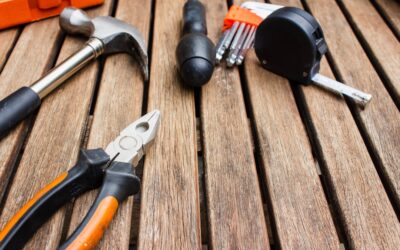
Most interior door repairs draw from a small, inexpensive kit that lives in any homeowner’s toolbox. Assemble these and you can handle nearly every door problem without a trip to the store mid-project:
- Screwdrivers and 3-inch wood screws: for tightening and re-anchoring hinges into the framing.
- Wood glue, toothpicks, or golf tees: to rebuild stripped screw holes.
- A block plane or sanding block with 80-grit paper: for trimming a binding edge.
- Lightweight spackle and a putty knife: for dents and small holes.
- Expanding foam and a utility knife: for backing larger hollow-core repairs.
- A level, a nail set, and household oil or graphite: for diagnosis, hinge-pin work, and squeaks.
None of these costs much, and together they cover the overwhelming majority of door problems a home throws at you over the years.
Preventing Future Door Problems
A little prevention keeps you off the repair ladder. Tighten hinge screws once a year as part of routine home maintenance, since slamming slowly backs them out and is the root of most sagging. Install door stops or wall bumpers so knobs never punch drywall, and use soft-close hinges or felt bumpers on doors that get slammed by kids or drafts.
Control humidity where you can, because wood doors swell in damp air and shrink when it is dry, and a well-sealed door resists that seasonal movement. Keep doors painted or sealed on all edges, especially the top and bottom, which are easy to forget and drink moisture fastest. A door maintained this way rarely needs anything more than the occasional drop of oil on a squeaky hinge.
When to Replace Instead of Repair
Some doors are past saving. A hollow-core door that is delaminating, water-damaged along the bottom, or cracked across a panel is cheaper to replace than to rebuild, with a basic pre-hung interior door running $60 to $200 plus installation. A warped solid door that will not close flat is also usually a replacement job, since flattening warped wood is rarely permanent.
For everything short of that, though, the tools and techniques above cover the vast majority of problems. Approach each interior door repair by diagnosing the exact point of failure first, start with the cheapest fix, and you will keep your doors swinging smoothly for years without ever calling a handyman.