
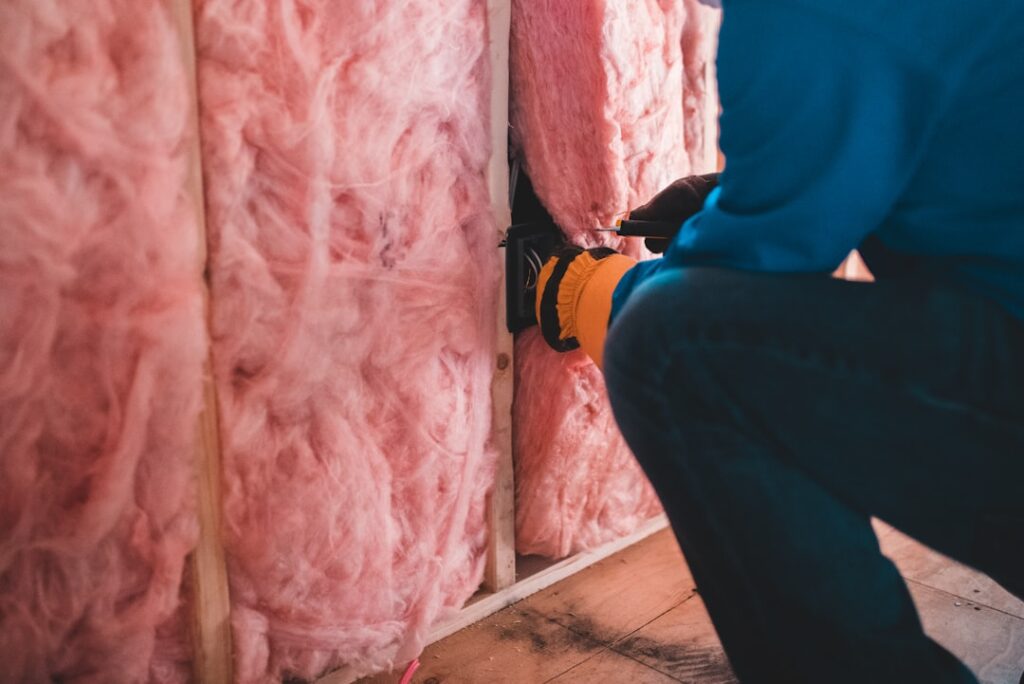
Most homeowners comparison-shop pink versus yellow fiberglass without realizing the third major player has been formaldehyde-free longer than anyone. Johns Manville insulation has shipped its entire residential fiberglass line without added formaldehyde since 2002, more than a decade before the rest of the industry followed. Backed by Berkshire Hathaway money and 160-plus years of manufacturing history, JM makes a deeper product catalog than most people know — batts, blown-in fiberglass, two families of spray foam, mineral wool, and commercial board products. Here is what the brand actually offers, what it costs, and where it beats the competition.
- Who Johns Manville Is
- The Formaldehyde-Free Advantage
- Batt and Roll Products
- Blown-In: Climate Pro and Attic Protector
- Spray Foam: JM Corbond
- Mineral Wool and Commercial Products
- How JM Stacks Up Against Owens Corning and Knauf
- Where to Buy and What You'll Pay
- Installation Notes From the Field
- Verdict
Who Johns Manville Is
Johns Manville traces to 1858 (the H.W. Johns Manufacturing Company) and merged into its current form in 1901. The company’s history includes the asbestos litigation that pushed it into bankruptcy in 1982 — a chapter it survived by exiting asbestos entirely and reorganizing around fiberglass, roofing, and engineered products. Berkshire Hathaway bought JM in 2001, and Warren Buffett’s ownership matters in a practical way: the company is well-capitalized, its warranties are backed by one of the largest balance sheets in America, and it has invested steadily in plants rather than being flipped between private equity owners. Headquarters are in Denver, with about 40 manufacturing facilities across North America and Europe. Alongside Owens Corning, CertainTeed, and Knauf, JM is one of the four fiberglass majors in the U.S. market.
The Formaldehyde-Free Advantage
Traditional fiberglass batts used phenol-formaldehyde binders — the resin that holds the glass fibers together and gives old-school insulation its faint chemical odor. JM switched its entire residential fiberglass line to an acrylic binder in 2002 and marketed it hard as Formaldehyde-free. Off-gassing from any modern certified fiberglass is minimal, but JM’s early move means its products carry long-standing GREENGUARD Gold certification, which caps total VOC emissions at levels safe for schools and healthcare facilities. If someone in the house has asthma or chemical sensitivity, this is the cleanest mainstream fiberglass pedigree you can buy, and installers notice less odor and slightly less itch during handling.
Batt and Roll Products
JM’s core residential line covers every standard cavity:
- R-13 and R-15 for 2×4 walls (3.5-inch cavity)
- R-19 and R-21 for 2×6 walls (5.5-inch cavity)
- R-30 and R-38 for attics and floors (8.25 to 12 inches thick)
- R-11 sound-control batts for interior partition walls
Batts come unfaced, kraft-faced (the standard vapor retarder for most U.S. climates), and foil-faced (FSK) for specific commercial assemblies. Widths fit 16-inch and 24-inch on-center framing. Pricing at big-box stores runs roughly $0.55 to $0.75 per square foot for kraft-faced R-13 and $1.00 to $1.30 per square foot for R-30 — consistently a few cents under Owens Corning’s equivalent SKU. JM also sells ComfortTherm, its poly-wrapped batt line, where the fiberglass is sealed inside perforated plastic. ComfortTherm costs about 20 percent more but nearly eliminates skin itch, which makes it popular for DIY basement and garage jobs.
Blown-In: Climate Pro and Attic Protector
JM Climate Pro is the machine-blown loose-fill fiberglass pros use for attics and dense-pack walls, competing directly with Owens Corning’s AttiCat material. It is Class A fire rated, does not settle appreciably (fiberglass loft is mechanically stable, unlike cellulose which settles 15 to 20 percent), and reaches R-49 at about 20 inches of depth. Coverage runs about 40 to 44 square feet per bag at R-49; a 1,200-square-foot attic takes roughly 28 to 32 bags at $38 to $45 per bag. Attic Protector is the retail-channel version sold where blowing machines are rented free with a 10- or 20-bag purchase. Blown fiberglass is lighter than cellulose — relevant for old ceilings with marginal drywall fastening — and it does not absorb moisture or support mold growth the way ground-paper products can if a roof leaks.
Spray Foam: JM Corbond
Most people do not associate JM with spray foam, but the company owns the Corbond line, applied by certified contractors rather than sold retail:
- JM Corbond III and IV closed-cell — roughly R-6.5 to R-7 per inch, adds structural rigidity, qualifies as a Class II vapor retarder at 1.5 inches or more. Installed cost typically $1.30 to $2.00 per board foot.
- JM Corbond open-cell — about R-3.8 per inch, half the cost, excellent air sealing and sound absorption for unvented attic rooflines in milder climates. Installed cost around $0.50 to $0.80 per board foot.
Having spray foam in the catalog matters for hybrid “flash and batt” jobs — one inch of Corbond closed-cell against the sheathing for air sealing and condensation control, with JM batts filling the rest of the cavity. One brand, one spec sheet, one warranty.
Mineral Wool and Commercial Products
JM’s TempControl mineral wool batts serve the fire-and-sound niche dominated by Rockwool: R-15 in a 2×4 cavity, R-23 in a 2×6, a melting point above 2,000°F, and better sound-transmission blocking than fiberglass of the same thickness. Expect $1.10 to $1.50 per square foot. The commercial side of the catalog is deep — polyiso roof boards (ENRGY 3), duct wrap and duct liner (Microlite, Linacoustic), pipe insulation (Micro-Lok), and Spider Plus, a blown-in-blanket (BIBS) fiberglass for netted wall cavities that hits R-15 in a 2×4 wall at a true R-4.2 per inch with no settling. If your insulation contractor quotes a BIBS system, there is a good chance the material is JM Spider.
How JM Stacks Up Against Owens Corning and Knauf
Performance-wise, an R-13 batt is an R-13 batt regardless of logo, so the brands separate on binder chemistry, availability, and price. Owens Corning has the widest retail distribution and the famous pink branding; Knauf’s ECOSE bio-based binder matches JM’s no-added-formaldehyde claim with a brown-colored batt. JM typically prices 3 to 8 percent under Owens Corning at the same R-value, held its formaldehyde-free position longest, and offers a broader single-brand span (fiberglass, mineral wool, and spray foam under one roof). We cover the competitors in dedicated reviews — the short version is that if all three are on the shelf at the same price, JM’s binder history and GREENGUARD Gold certification make it the tiebreaker winner for indoor air quality.
Where to Buy and What You’ll Pay
JM residential products sell through Home Depot (its strongest big-box partner), Menards, and independent lumberyards and insulation distributors like SPI and IDI. Lowe’s shelves lean Owens Corning and Knauf, so check the orange store first. Typical project math: insulating a 1,500-square-foot attic to R-38 with JM batts costs about $1,600 to $2,100 in material; blown Climate Pro installed by a contractor runs $1.50 to $2.50 per square foot to R-49. Walls in a 2,000-square-foot new build take roughly $1,400 to $1,900 of R-15 and R-21 batts. Keep receipts and product labels — JM insulation qualifies for the federal 25C Energy Efficient Home Improvement tax credit, worth 30 percent of material cost up to $1,200 per year on qualifying envelope upgrades.
Installation Notes From the Field
A few JM-specific practicalities improve results. The batts are slightly softer and loftier than some competitors, which makes friction-fitting easy but also makes them easy to overstuff — a compressed R-21 crammed behind a wire performs closer to R-16, so split batts around cables and pipes rather than jamming them behind. Kraft facing staples to the face of the studs, not the inside of the cavity, in most manufacturer instructions; inset stapling leaves air channels along the drywall that measurably cut performance. For Climate Pro blown jobs, respect the bag chart taped inside every bag flap: the stated bag count per 1,000 square feet at each R-value is a minimum, and short-bagging an attic by 10 percent is the most common contractor shortcut — count the empty bags before the crew leaves. And with ComfortTherm poly-wrapped batts, remember the plastic wrap is a vapor retarder in its own right; use the perforated (breathable) version in climates where a Class II retarder on the cavity face would be wrong.
Verdict
Johns Manville is the quiet professional of the insulation aisle. It rarely out-markets the pink panther, but it delivers identical thermal performance with the industry’s longest formaldehyde-free track record, a deeper product bench than any competitor except CertainTeed, and pricing that usually undercuts the category leader. Buy it with confidence for batts and blown-in; ask for Corbond by name if your foam contractor offers it; and put the few dollars saved per roll toward air-sealing caulk and foam, which improves real-world performance more than any brand choice will.


