Ask who makes mineral wool in America and most people name a Danish company — but the oldest mineral wool brand on the continent is Thermafiber insulation, spinning molten rock into fiber in Wabash, Indiana since 1934. Now the mineral wool division of Owens Corning, Thermafiber dominates a market most homeowners never see: the fire-stopping safing and curtain-wall insulation inside commercial high-rises, including One World Trade Center. Its residential line, UltraBatt, brings the same fire and sound performance to wood-framed walls. Here is what the brand offers, the specs that matter, and how it stacks up on price and availability.
- The Owens Corning Connection
- SAFB: The Commercial Workhorse
- UltraBatt: The Residential Line
- Fire and Sound Specs at a Glance
- Made in USA, and Why It Shows Up in Spec Language
- Installing UltraBatt: Practical Tips
- Thermafiber vs Rockwool: Availability and Price
- The Rest of the Lineup Worth Knowing
- Verdict
The Owens Corning Connection
Thermafiber operated independently (and under USG ownership for a period) until Owens Corning acquired it in 2013, giving the fiberglass giant a mineral wool arm to answer growing demand for noncombustible insulation. Production runs from Wabash, Indiana, with a second plant in Joplin, Missouri added in 2018 to expand capacity. That matters practically: Thermafiber is a domestic product with domestic freight, while much competing stone wool historically shipped from Canadian or European plants. The mineral wool itself is made by melting rock and blast-furnace slag at around 2,600°F and spinning it into fibers — Thermafiber products contain up to 70 percent recycled content, among the highest in the insulation industry.
SAFB: The Commercial Workhorse
The product that built the brand is SAFB — Sound Attenuation Fire Blankets. These are unfaced, semi-rigid mineral wool batts (2.5 pcf nominal density) sized for steel-stud commercial partitions, and they do two jobs at once:
- Fire: SAFB is noncombustible per ASTM E136 with a melt point around 2,000°F, and it is a listed component in hundreds of UL fire-rated wall and floor-ceiling assemblies (1-hour through 4-hour designs). The related FireSpan and safing products seal the perimeter gap between floor slabs and curtain walls — the detail that stops floor-to-floor fire jump in high-rises.
- Sound: in a standard 3-5/8-inch steel stud wall with one layer of 5/8-inch drywall each side, adding SAFB pushes STC from the high 30s to roughly STC 45-50, and higher with resilient channel or double layers. Its density absorbs mid and low frequencies better than lightweight fiberglass sound batts.
SAFB comes in 1 to 5-inch thicknesses, 16 and 24-inch widths for friction-fit in steel framing. Residential remodelers quietly love it for interior sound walls: home theaters, bedroom party walls, laundry closets — anywhere you want dense, rigid batts that stand up in the cavity without sagging.
UltraBatt: The Residential Line
UltraBatt is Thermafiber’s answer to residential stone wool batts for wood framing:
- R-15 at 3.5 inches for 2×4 walls (~R-4.3 per inch)
- R-23 at 5.5 inches for 2×6 walls
- R-30 at 7.25 inches for 2×8 framing and floors
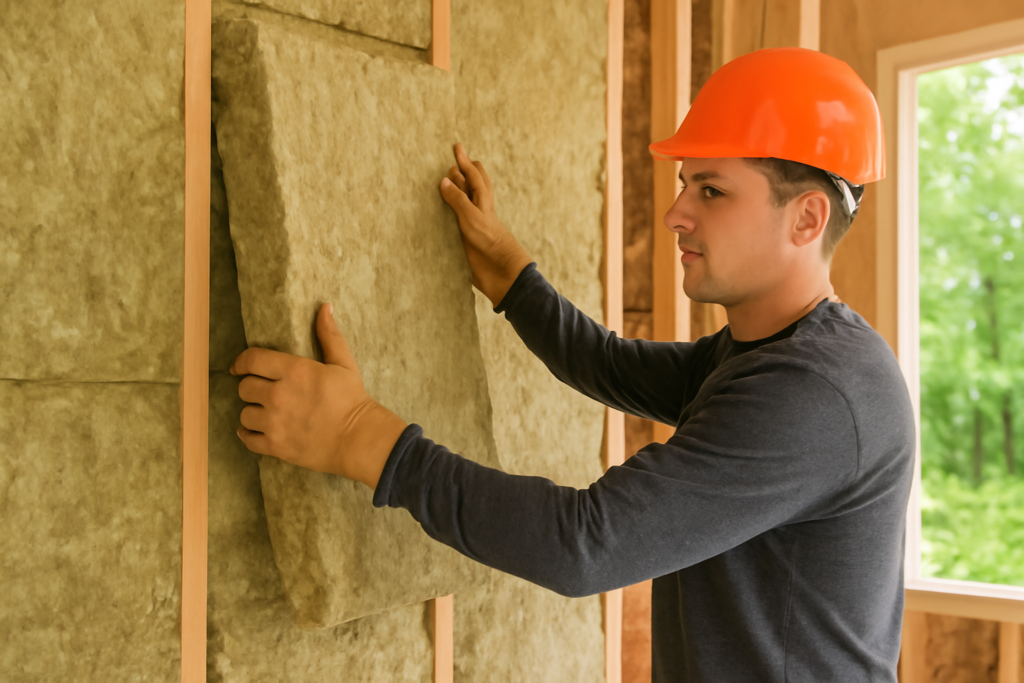
Batts friction-fit at 16 or 24 inches on center, cut cleanly with a serrated bread knife, and hold their shape around wiring and boxes better than fiberglass — you split the batt and sandwich cables rather than compressing around them. Being mineral wool, UltraBatt is hydrophobic (sheds bulk water and dries without slumping), vapor-open, doesn’t feed mold, and keeps its R-value when damp conditions would flatten fiberglass. It is also dense enough (about 1.6-2.5 pcf) to add meaningful sound damping in exterior walls facing traffic noise. Downsides are the usual mineral wool ones: it itches (wear sleeves and an N95), it is heavier to handle overhead, and it costs more than fiberglass.
Fire and Sound Specs at a Glance
- Noncombustible, ASTM E136; melt point ~2,000°F
- Flame spread 0, smoke developed 0 (ASTM E84)
- Component in UL assemblies up to 4-hour ratings (commercial)
- NRC around 0.95-1.05 for 2-3 inch thicknesses — near-total absorption in acoustic terms
- R-4.2 to R-4.3 per inch typical across the batt lines
For a homeowner, the practical translation: a mineral wool-filled wall buys real minutes in a fire and a noticeably quieter room, for a modest premium over pink batts.
Made in USA, and Why It Shows Up in Spec Language
Thermafiber’s Indiana/Missouri manufacturing gives it two spec-sheet advantages: Buy American / domestic-content compliance for government and institutional projects, and shorter, more stable lead times for commercial distributors in the central US. The One World Trade Center job — where Thermafiber supplied the curtain-wall and safing insulation — remains the brand’s calling card in architectural specs. None of this changes performance in your garage wall, but it explains why the brand you rarely see at retail is everywhere in commercial submittals.
Installing UltraBatt: Practical Tips
Working with Thermafiber batts rewards a slightly different technique than fiberglass. Cut with a serrated knife against a board — measure the bay, add 1/4 inch, and let the friction fit do the holding; there is no facing to staple and no need for supports in walls. Around electrical boxes, carve a pocket in the back of the batt rather than stuffing the batt beside the box, so full-depth material stays behind it. For wiring runs, split the batt’s thickness and sandwich the cable — mineral wool splits cleanly along its plane, which fiberglass never does. Overhead work (floors, ceilings between joists) is where the density bites back: batts are heavy enough that insulation supports or netting are smart insurance even though friction usually suffices. Dress for it — long sleeves, gloves, safety glasses, and an N95, since cutting kicks up mineral dust. One planning note: because UltraBatt is unfaced, cold-climate walls that require an interior vapor retarder get it separately — a smart membrane like CertainTeed MemBrain or careful latex-primed drywall per your local code — and that is a feature, not a gap, since you can tune the vapor strategy to the climate instead of defaulting to kraft paper.
Thermafiber vs Rockwool: Availability and Price
Performance-wise the two brands’ batts are near-equivalents — similar density, similar R per inch, both noncombustible — so the decision usually comes down to logistics. Rockwool (ComfortBatt/Safe’n’Sound) owns the retail channel: it is stocked on shelves at Home Depot and Lowe’s in most markets, typically at $1.20-$1.70 per sq ft for R-15. Thermafiber UltraBatt and SAFB move mainly through insulation distributors and drywall supply houses (Service Partners, L&W, ABC), though Home Depot lists UltraBatt in some regions; pricing lands within about 10 percent of Rockwool either way — R-15 UltraBatt around $65-$85 per bag covering ~60 sq ft. If you need batts today, Rockwool’s shelf presence usually wins; if your supply house stocks Owens Corning, Thermafiber often quotes better on whole-job volume.
The Rest of the Lineup Worth Knowing
Beyond SAFB and UltraBatt, a few Thermafiber products solve specific residential problems. FireSpan and Safing insulation handle perimeter fire containment in commercial curtain walls, but the same 4-pcf safing material is what a remodeler wants for packing around chimneys, flues, and fireplace inserts where combustible insulation is prohibited. VersaBoard is the rigid mineral wool board (comparable to Rockwool ComfortBoard) for exterior continuous insulation and interior thermal breaks — vapor-open, fireproof, and increasingly specified over foam in wildfire-prone regions. And RainBarrier serves drained cavity-wall construction behind brick and panel cladding. For a homeowner, the takeaway is that the brand covers the full mineral wool menu; if your insulation contractor is already ordering Owens Corning fiberglass for the attic, adding Thermafiber wall product to the same order often beats sourcing a second brand from a second supplier.
Verdict
Thermafiber is the quiet professional of North American mineral wool: a 90-year-old, US-made line with best-in-class fire credentials and sound performance, backed by Owens Corning’s distribution. Buy SAFB for interior sound walls and any fire-rated assembly work — it is purpose-built and often cheaper per cavity than acoustic-branded alternatives. Buy UltraBatt for 2×4/2×6 exterior walls where you want R-15/R-23 with fire resistance, moisture tolerance, and quiet, and you can source it without waiting. And if your only local option is the competitor’s orange-green bag, don’t agonize — but get a distributor quote first, because Thermafiber’s per-bag price on a full-house order is frequently the sharper number.