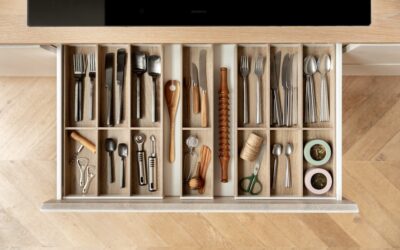
The average base cabinet wastes nearly half its volume to dead air you can’t reach without emptying the whole shelf. That’s the problem kitchen cabinet inserts exist to solve. These add-on organizers, from pull-out shelves to drawer dividers to corner carousels, turn cavernous, hard-to-access boxes into storage you can actually use without digging on your knees. Better still, most retrofit into cabinets you already own for $20 to $150 each, making them one of the highest-value kitchen upgrades short of a full remodel.
Part of our Kitchen Remodeling guide — explore the full guide →
Pull-Out Shelves and Rollout Trays
If you can only add one type of insert, make it a rollout. A pull-out shelf mounts on drawer glides inside a base cabinet, so the entire contents slide out to you instead of you reaching into the back. No more losing a stock pot behind the crockery.
These come as pre-built wood or wire trays, or as standalone glide kits you attach to your own shelving. Quality full-extension glides rated to 75 or 100 pounds are worth the extra few dollars, since a shelf loaded with canned goods gets heavy fast. Measure the interior width carefully and subtract for the glide hardware, usually about an inch on each side.
Corner Cabinet Solutions
Corner cabinets are the black hole of any kitchen, and they demand purpose-built inserts to be usable at all.
- Lazy Susan: A rotating shelf, round or kidney-shaped, that spins everything into reach. The classic fix for a corner base cabinet.
- Half-moon swing-out: Shelves that pivot and pull clear of the cabinet, best for blind corners where a round Susan won’t fit.
- Magic corner: A two-part sliding rack that pulls the hidden back shelves out to the door opening. Pricier but the most efficient use of a blind corner.
Drawer Organizers and Dividers
Deep drawers swallow utensils, foil boxes, and lids into a jumble. Insert organizers restore order and are the cheapest category by far. Bamboo or acrylic cutlery trays keep flatware sorted, while adjustable spring-tension dividers section a drawer for spices or gadgets. Deep pan drawers benefit from peg systems, where movable wooden pegs on a board hold stacks of plates and bowls upright and keep them from sliding. Most drop in with no tools at all.
Vertical and Tray Dividers
Baking sheets, cutting boards, and platters store best on edge, not stacked flat where you must lift the whole pile to grab the bottom one. Vertical tray dividers are simple partitions that create narrow slots for these flat items. Install them in a tall narrow cabinet beside the oven, or in the dead space above a wall oven, and suddenly your cookie sheets have a home. Adjustable versions let you set slot widths to your own collection.
Trash and Recycling Pull-Outs
A pull-out bin insert hides the trash and recycling inside a base cabinet, mounted on a slide-out frame that opens with the door or a dedicated pull. Single, double, and triple-bin models fit standard 15-, 18-, and 24-inch cabinets. Look for a unit with a soft-close glide and a lid-lift feature that opens the top as the frame extends. This one insert declutters the floor and keeps pets out of the garbage, and it’s among the most popular retrofits homeowners make.
Under-Sink and Cleaning Storage
The cabinet under the sink is awkward because of the plumbing, but there are inserts built around it. U-shaped or two-tier under-sink shelves step over the drain trap to double your usable height. A tension rod hung across the cabinet holds spray bottles by their triggers, freeing the floor below. Pull-out caddies on the door interior corral sponges and brushes. Because this cabinet sees moisture, choose coated wire or plastic inserts here rather than raw wood.
Measuring and Installing
Accurate measurement is the whole game with kitchen cabinet inserts. Follow these steps before you buy:
- Open the cabinet door fully and measure the clear opening width, not the exterior, since face-frame cabinets have a lip that narrows the entry.
- Measure the interior depth from the back wall to the inside of the closed door.
- Check the interior height between shelves if you’re stacking a rollout.
- Note whether your cabinet is frameless (European) or has a face frame, as this changes how the hardware mounts.
Most pull-outs bolt to the cabinet floor or side walls with a handful of screws. Frameless cabinets often need small filler blocks so the glides clear the door hinges. Dry-fit the insert before final screwing, and confirm the door still closes with a loaded shelf inside.
Where the Money Is Best Spent
If your budget is limited, prioritize by daily frustration. A base-cabinet rollout and a corner lazy Susan solve the two worst reach problems in most kitchens. Drawer dividers deliver order for a few dollars. A trash pull-out clears the floor. Save the pricier magic-corner and specialty inserts for when you’ve handled the basics and know your habits.
Materials and Build Quality
Inserts come in a range of materials, and the right one depends on where it goes and how hard it works. Solid wood and bamboo look warm and handsome in dry cabinets and drawers, and they machine into precise dividers, but they warp under the sink where moisture lives. Chrome and coated wire baskets are strong, ventilated, and moisture-friendly, making them the go-to for pull-outs and under-sink caddies. Molded plastic and acrylic are the budget choice, easy to wipe clean and fine for drawer trays, though heavy loads can flex thin plastic over time.
When you’re paying for a rollout or a corner mechanism, the hardware matters more than the tray. Look for full-extension, ball-bearing glides with a soft-close feature and a stated weight rating that comfortably exceeds what you’ll load. Cheap partial-extension glides leave the back of the shelf buried, defeating the reason you bought a pull-out in the first place.
The Bottom Line
Kitchen cabinet inserts reclaim the half of your cabinets you can’t currently reach, and most install in an afternoon with a drill and a screwdriver. Start with rollout shelves and a corner solution for the biggest impact, add drawer dividers and a trash pull-out for daily convenience, and always measure the clear interior opening before ordering. Dollar for dollar, few upgrades make a kitchen feel bigger and work harder than a smart set of inserts.