The best kitchen cabinet storage solutions do not add a single cabinet, they just make the cabinets you already have hold more and give it up without a fight. Most kitchens waste an astonishing amount of space to deep, dark shelves where things get lost in the back, blind corners that swallow small appliances, and drawers full of chaos. I have retrofitted hundreds of kitchens with pull-outs and organizers, and homeowners are consistently shocked at how much usable capacity was hiding behind a static shelf. The trick is converting dead vertical and rear space into something you can actually reach.
This guide runs through the storage upgrades that deliver the most real-world capacity, from pull-out shelves and corner fixes to vertical dividers and drawer inserts, with honest notes on cost and which are DIY-friendly.
Pull-Out Shelves: The Biggest Win
If you do one thing, add pull-out shelves to your base cabinets. A standard base cabinet with fixed shelves forces you to kneel down and dig into the dark back corner, so in practice the rear third goes unused. A roll-out shelf on drawer slides brings the whole shelf out to you, so the back is as accessible as the front. It effectively doubles the usable capacity of the cabinet.
These retrofit onto the existing cabinet floor and one or two shelf positions with ball-bearing drawer slides rated for 75 to 100 pounds. You can buy them pre-built in standard widths, or build your own from plywood. For a deep pantry cabinet, stacking three or four pull-outs turns a cave into a wall of reachable storage. Pre-made wood pull-out shelves run $30 to $80 each depending on width and slide quality, and installation is a solid intermediate DIY job requiring a drill, a level, and careful measurement.
Solving the Blind Corner
The blind corner cabinet is the worst-designed space in most kitchens, a deep L-shaped void where a whole quadrant disappears behind the cabinet face. There are three good fixes, in rough order of cost and effectiveness:
- Lazy Susan: a rotating shelf, round or kidney-shaped, that spins the contents out to you. The classic, affordable fix at $30 to $120, though it wastes the corners of the space.
- Half-moon swing-out shelves: hinged shelves that swing the rear contents out through the door opening, better than a Susan at using the full depth.
- Blind corner pull-out systems: engineered wire or wood units, often called magic corners, that pull the front tray out and slide the rear tray forward into reach. The most effective and the most expensive at $150 to $400, but they recover nearly all the dead space.
For a truly deep blind corner that you currently cannot reach at all, the pull-out system is worth the money. For a modest corner, a good Lazy Susan is fine and far cheaper.
Vertical Dividers for Trays and Pans
Baking sheets, cutting boards, muffin tins, and platters are miserable to store flat in a stack, you always want the one on the bottom. Vertical tray dividers turn a cabinet into a set of upright slots so you file those flat items like books and pull any one out without disturbing the rest.
The narrow, awkward cabinet above the refrigerator or beside the oven is the perfect candidate, and so is a dedicated base cabinet for pans. You can buy adjustable divider kits or install fixed plywood dividers yourself. This is one of the cheapest upgrades, $15 to $50 for a divider kit, and one of the most satisfying, because it eliminates the daily annoyance of wrestling a stack of sheet pans.
Drawer Organizers and Deep-Drawer Inserts
Drawers are more efficient than doors because everything comes to you, but an unorganized drawer wastes that advantage. A few inserts fix it:
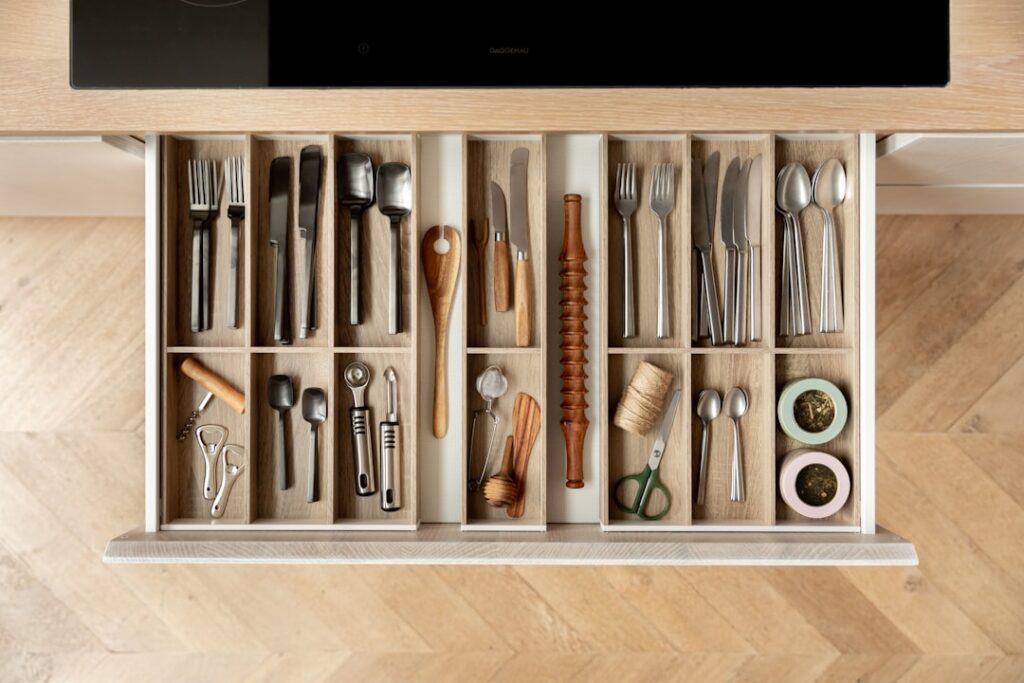
- Adjustable cutlery and utensil trays that expand to fit the drawer width and keep flatware and tools sorted.
- Peg-board drawer systems for deep drawers, with movable pegs that corral stacks of plates and bowls so they do not slide and chip.
- Spice drawer inserts with angled tiers so you read every label at a glance instead of digging through a cabinet.
- Knife blocks that sit in the drawer to free up counter space and protect blades.
If you are renovating, specify a few deep pot-and-pan drawers in your base cabinets instead of doors, deep drawers on full-extension slides are the single most useful storage feature in a modern kitchen. Organizers run $15 to $60 each and install with zero tools.
Door-Mounted and Toe-Kick Storage
The inside of a cabinet door and the space under the cabinets are two overlooked zones. Door-mounted racks turn the back of a sink-base door into storage for sponges, dish soap, and cleaning supplies, or the back of a pantry door into spice and wrap storage. They screw on in minutes and reclaim space that was doing nothing.
Under the base cabinets, the toe-kick area can hide a shallow drawer, roughly 3 inches tall, perfect for flat items like serving platters, place mats, or step stools. Toe-kick drawers are a slick custom touch in a renovation, though they are more involved to add to existing cabinets. Even a simple pull-out trash and recycling unit inside a base cabinet, replacing a freestanding can, is one of the most-used storage upgrades you can make, running $40 to $150 for a two-bin system on slides.
Prioritizing by Cost and Impact
You do not have to do everything at once. If I were advising a homeowner on where the money goes furthest, this is the order:
- Pull-out shelves in the deepest base cabinets, the highest impact per dollar, roughly $30 to $80 each.
- A blind corner fix, because that space is otherwise a total loss, $30 for a Susan up to $400 for a pull-out system.
- A pull-out trash and recycling bin, used dozens of times a day, $40 to $150.
- Drawer organizers and tray dividers, cheap, tool-free, and instantly gratifying, $15 to $60 each.
- Door-mounted racks, free space you are ignoring, $15 to $40.
Most of these are weekend DIY projects with a drill and a tape measure, and none require touching the cabinet boxes structurally. The beauty of good kitchen cabinet storage solutions is that they multiply the capacity of the kitchen you already own, so before you consider adding cabinets or moving to a bigger house, look hard at the dead space behind your existing doors, you probably have far more room than you think.
Measuring and Buying the Right Fit
The most common reason a storage upgrade disappoints is a fit problem, so measure carefully before you buy anything. Cabinet openings are narrower than the nominal cabinet size because of the face frame, so a cabinet labeled 15 inches may have an opening of only 12.5 to 13 inches. For pull-outs and any insert that has to pass through the opening, measure the actual clear opening width, height, and depth, not the outside of the box, and leave clearance for the drawer slides, which eat roughly an inch of total width for the pair.
Pay special attention to face-frame versus frameless cabinets. Frameless, or full-access, European-style cabinets give you the full box width and make retrofitting pull-outs simple. Face-frame cabinets, common in American kitchens, have a lip around the opening that a pull-out has to clear, which often means adding rear-mount or side-mount brackets or a spacer so the slide clears the frame. Many pull-out kits are sold specifically for face-frame cabinets with the hardware to handle that lip, so buy the version that matches your construction.
Weight rating matters too. A shelf full of canned goods or a stack of heavy pots can easily exceed 50 pounds, so choose slides and pull-outs rated for the real load, ball-bearing slides rated 75 to 100 pounds are worth the small premium over lighter builder-grade slides that bind under weight. When in doubt, buy the sturdier hardware; the difference of a few dollars per slide is nothing compared to a pull-out that sags or sticks every time you use it. Measure twice, match the kit to your cabinet type, and rate the hardware for the real load, and your storage upgrades will glide smoothly for years instead of becoming the drawer nobody wants to open.