The average base cabinet is a deep, dark box where the back 12 inches become a graveyard for pans you forgot you owned. Good kitchen cabinet organization systems attack exactly that problem: they bring the back of the cabinet to you, stand items on edge so you can see them, and turn dead corners into usable storage. You don’t have to replace your cabinets to fix this. The best retrofit hardware drops into your existing boxes and can make a cramped kitchen function like one twice its size.
Part of our Kitchen Remodeling guide — explore the full guide →
Pull-Out Shelves: The Biggest Upgrade
If you do only one thing, add roll-out shelves to your deep base cabinets. Instead of getting on your knees and reaching blindly into the back, you pull the whole shelf out into the light. Full-extension ball-bearing slides rated for 75 to 100 pounds handle heavy stockpots and small appliances without sagging.
Retrofit kits run $30 to $80 per shelf for DIY installation, or $150 to $300 per shelf installed by a pro. They’re the single highest-impact change you can make, and they work in nearly any 15-inch or wider base cabinet. Prioritize the cabinets holding pots, pans, and small appliances, where the reach problem is worst.
Drawer Dividers and Inserts
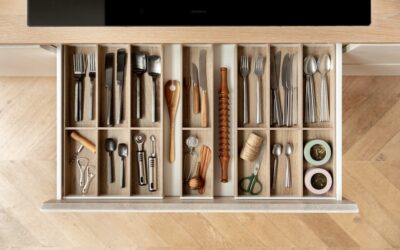
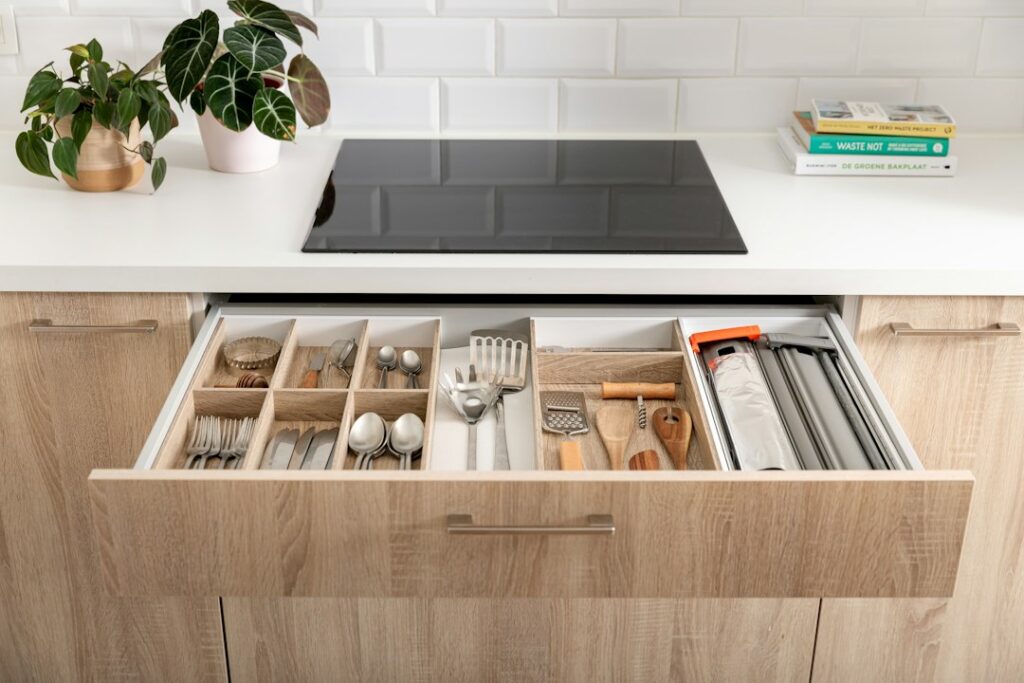
Deep drawers swallow utensils into a jumbled pile. Adjustable dividers and custom inserts carve them into logical zones. A tiered cutlery tray, a peg-board system for stacking plates and bowls, and a knife block insert each turn chaos into a place for everything.
Bamboo expandable dividers cost $15 to $40 and adjust to fit any drawer width. For a more finished look, custom-cut acrylic or wood inserts run more but nest perfectly. The payoff is a drawer where you can find the right tool in one glance instead of digging.
Taming the Corner Cabinet
Blind corner cabinets waste more space than any other unit in the kitchen. Three systems fix them, each suited to a different budget:
- Lazy Susan: A rotating shelf that spins the back contents forward. Cheapest option at $30 to $100, best for bottles and canned goods.
- Half-moon pull-out: Kidney-shaped shelves that swing and slide out of a blind corner, $80 to $200.
- Magic corner (blind corner pull-out): A two-tier system that pulls the entire contents out into the open, the premium fix at $200 to $500.
The magic corner is expensive but transformative; it recovers space you effectively couldn’t use at all before.
Vertical Storage for Trays and Lids
Baking sheets, cutting boards, and pot lids don’t want to lie flat, they want to stand up. A vertical divider rack in a tall cabinet or over the fridge stores them on edge, so you slide out the one you need instead of lifting the whole stack. Tension-rod dividers do this for under $20.
Pot lids are their own headache. A door-mounted lid rack or an in-drawer lid organizer keeps them off your pots and easy to grab. Pairing a pull-out shelf for the pots with a dedicated lid holder is one of the most satisfying small fixes in the kitchen.
Pantry and Upper Cabinet Systems
Uppers reward two-tier shelf inserts that use the tall dead air above your plates and glasses. A simple wire or bamboo shelf riser doubles the storage of any upper for $10 to $25. For the pantry, clear stackable bins and a tiered can organizer let you see inventory at a glance and stop buying duplicates.
Turntables shine in uppers too. A 9- or 12-inch lazy Susan for spices, oils, and condiments brings the back row to the front with a spin, ending the ritual of knocking bottles over to reach the one behind.
Under-Sink Organization
The cabinet under the sink is the hardest to organize because plumbing eats the middle. Use two-tier expandable shelves that step around the drain trap, and hang a tension rod across the front to loop spray bottles by their handles. A slide-out caddy on the floor of the cabinet keeps sponges and dish soap within reach.
Add a slim pull-out trash and recycling system in an adjacent cabinet if you can spare it. Getting the bins off the floor and behind a door is one of the biggest quality-of-life improvements in any kitchen.
Measuring Before You Buy
The most common reason a slick pull-out or organizer gets returned is that it doesn’t fit, and the culprit is almost always the face frame. The cabinet box may be 15 inches wide, but the opening you actually slide hardware through can be a full inch or two narrower because of the frame. Always measure the clear opening, the narrowest point the hardware must pass, not the outside of the cabinet.
Measure three dimensions for every unit: the width of the opening, the interior depth from the back of the face frame to the rear wall, and the clear height. Note whether the cabinet is frameless (European) or face-framed, since some pull-out systems need a mounting bracket or spacer to clear a frame. Write these numbers down before you shop, and cross-check them against each product’s minimum-opening spec so everything drops in the first time.
Planning a Whole-Kitchen Overhaul
If you’re organizing the entire kitchen, work in this order: base cabinets first (biggest reach problem), then corners, then drawers, then uppers and pantry. Measure the interior width, depth, and height of each cabinet before you buy, because cabinet openings are almost always narrower than the box due to face frames.
Budget-wise, a full retrofit of a mid-size kitchen with quality hardware lands somewhere between $800 and $2,500 depending on how much you do yourself. Spread over the years you’ll use it, well-chosen kitchen cabinet organization systems pay for themselves in time saved, food not wasted, and the simple daily relief of a kitchen where everything has a place.