The right kitchen countertop ideas can transform your kitchen from functional to stunning. Countertops are the most visible surface in the room — more eye-level than floors, more touched than walls — and 2026 brings fresh design directions that balance beauty with practicality. From dramatic waterfall edges to bold colored quartz, these trends reflect how homeowners are rethinking their kitchen surfaces.
- 1. Waterfall Edge Quartz
- 2. Marble-Look Veining
- 3. Butcher Block Island Accent
- 4. Concrete Industrial
- 5. Mixed Materials
- 6. Bold Colored Quartz
- 7. Fluted and Textured Edges
- 8. Integrated Sinks
- 9. Backsplash-Matching Counters
- 10. Ultra-Thin Profile Countertops
- Countertop Material Comparison
- Frequently Asked Questions
- What is the most popular kitchen countertop for 2026?
- What countertop is better than granite?
- Are concrete countertops worth it?
- How much do kitchen countertops cost?
- What kitchen countertop is easiest to maintain?
- Can you mix countertop materials in one kitchen?
- What countertop adds the most home value?
Whether you are planning a full kitchen renovation or simply replacing worn countertops, this visual trend guide covers the 10 most impactful kitchen countertop ideas for 2026, with style notes, cost ranges, and practical considerations for each.
1. Waterfall Edge Quartz
The waterfall edge — where the countertop material continues vertically down the side of an island or peninsula to the floor — has moved from high-end kitchens into mainstream design in 2026. This dramatic detail creates a sleek, monolithic look that showcases the countertop material’s pattern and eliminates the visual interruption of exposed cabinet sides.
Quartz is the ideal material for waterfall edges because its consistent patterning can be mitered at the corner to create a seamless 90-degree turn. White quartz with subtle veining is the most popular waterfall choice, but bold veined patterns (Calacatta-inspired, for example) make even more dramatic waterfall statements.
A waterfall edge adds $800 to $2,500 to your island countertop cost, depending on the length and material. The fabrication requires precise miter cutting and experienced installation, so budget for a skilled fabricator. The investment pays off in visual impact — a waterfall island becomes the centerpiece of any kitchen.
2. Marble-Look Veining
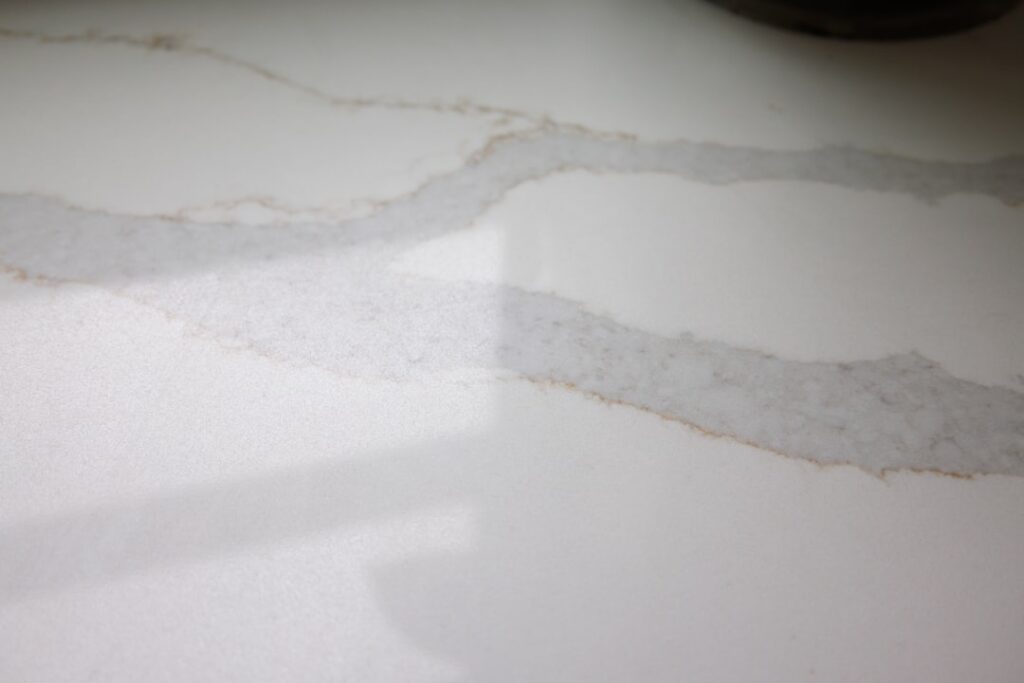
Real marble remains aspirational, but in 2026, quartz manufacturers have perfected marble-look veining to the point where most people cannot distinguish quartz from natural stone without touching it. Products from Caesarstone, Cambria, Silestone, and MSI now feature full-slab veining patterns that flow naturally across the surface rather than repeating.
The most popular marble-look patterns in 2026 are Calacatta (dramatic gray veins on white) and Statuario (softer, more diffused veining). These quartz versions deliver the marble aesthetic with the practical advantages of quartz — no sealing required, stain resistance, and consistent color across slabs.
Cost: $50 to $120 per square foot installed for premium marble-look quartz, compared to $75 to $200 per square foot for actual marble. The quartz version costs less, lasts longer, and requires virtually no maintenance. For most homeowners, marble-look quartz is the smarter investment. See our quartzite countertops guide for another natural stone alternative.
3. Butcher Block Island Accent
Butcher block is making a strong comeback in 2026, but with a modern twist — it is used as an accent material on islands and prep areas rather than as the primary countertop throughout the kitchen. A butcher block countertop on the island paired with quartz or stone on perimeter counters creates warmth, visual contrast, and a functional food-prep surface.
Walnut butcher block is the most popular choice for its rich, dark tone that contrasts beautifully with white or light-colored perimeter countertops. White oak and maple are also strong options. Butcher block requires periodic oiling (food-safe mineral oil, monthly) and is susceptible to water damage near sinks if not properly sealed.
Cost: $40 to $100 per square foot installed for quality butcher block. The material is warmer underhand than stone, absorbs sound (no clinking of glasses and plates), and provides a built-in cutting surface. The maintenance commitment is the trade-off — butcher block demands more care than quartz or granite.
4. Concrete Industrial
Concrete countertops deliver an industrial, handcrafted aesthetic that resonates with loft-style, modern farmhouse, and urban-chic kitchen designs. Each concrete countertop is custom-poured and unique — no two surfaces are identical. The material can be tinted any color, polished to various sheens, and embedded with decorative elements like glass, stone, or metal.
In 2026, the concrete countertop trend leans toward lighter gray tones with smooth, matte finishes rather than the heavy, dark concrete of previous years. Thinner profiles (1.5 inches vs. the traditional 2 to 3 inches) keep the look proportional to modern cabinetry.
Cost: $65 to $150 per square foot installed. Concrete countertops must be sealed to prevent staining, and they can develop hairline cracks over time (which many owners consider part of the character). Weight is a consideration — concrete is heavier than stone, and cabinets must be engineered to support the load.
5. Mixed Materials
One of the strongest kitchen countertop ideas for 2026 is mixing two or more countertop materials in the same kitchen. The most popular combinations include quartz perimeters with butcher block islands, quartzite main counters with stainless steel prep sections, and marble on the baking station with quartz everywhere else.
Mixed materials create visual zones within the kitchen, define different work areas, and allow you to use premium materials strategically — real marble on a 6-square-foot pastry section costs a fraction of marble on all 40 square feet of countertop. This approach also lets you pair the ideal material with each function: waterproof quartz near the sink, food-safe butcher block for prep, heat-resistant granite near the range.
Design tip: choose materials with complementary but not identical tones. A warm walnut butcher block island pairs beautifully with cool white quartz perimeters. Matching the materials too closely defeats the purpose of mixing.
6. Bold Colored Quartz
All-white kitchens are giving way to color in 2026, and countertops are part of that shift. Bold colored quartz — deep navy, forest green, warm terracotta, matte black, and rich burgundy — is appearing in designer kitchens and filtering into mainstream design. These statement surfaces turn the countertop into a focal point rather than a neutral backdrop.
The key to bold colored countertops is balance. Pair a dark, saturated countertop with lighter cabinetry and walls to prevent the kitchen from feeling heavy. Navy quartz with white shaker cabinets is a standout combination. Matte black quartz on a white island with natural wood floating shelves creates a modern, sophisticated aesthetic.
Colored quartz is priced comparably to standard white and gray quartz — $50 to $100 per square foot installed. Availability of bold colors varies by manufacturer; Caesarstone, Silestone, and Cambria offer the widest colored quartz selections.
7. Fluted and Textured Edges
Fluted edges — vertical grooves carved into the countertop edge — are one of the freshest countertop details in 2026. This architectural element adds dimension, tactile interest, and a furniture-like quality that transforms a flat slab into a design feature. Fluted edges are most commonly applied to island fronts and waterfall sides.
Beyond fluting, other textured edge treatments are gaining traction: chiseled or rough-hewn edges for natural stone, leather-finished (honed with texture) granite and quartzite, and ogee edges making a comeback on traditional-style countertops. These details differentiate custom kitchen design from standard builder-grade installations.
Fluted edge fabrication adds $15 to $40 per linear foot to the countertop cost. The detail works on thick countertop profiles (2 inches or more) and is most dramatic on waterfall edges where the vertical surface provides a large canvas for the fluting pattern.
8. Integrated Sinks
Integrated sinks are fabricated from the same material as the countertop, creating a seamless transition from counter surface into the basin. This eliminates the rim, seam, or mounting hardware of traditional drop-in or undermount sinks. The result is a clean, hygienic surface with no crevices for food, mold, or bacteria to accumulate.
Integrated sinks work best with solid surface materials (Corian, quartz composites) and concrete. Natural stone and engineered quartz can also be fabricated with integrated sinks, but the cost is significantly higher due to the complex fabrication required. In 2026, integrated sinks are increasingly specified in modern and minimalist kitchens where seamless surfaces are a design priority.
Cost: $500 to $2,500 per sink, depending on material and basin configuration. This premium is substantial but delivers a design feature that is difficult to achieve any other way. For homeowners building a statement kitchen, integrated sinks are a detail that elevates the entire space.
9. Backsplash-Matching Counters
Extending the countertop material up the wall as a backsplash creates a unified, seamless look that has become one of the dominant kitchen countertop ideas in 2026. Full-height slab backsplashes — where the same quartz, marble, or quartzite extends from the counter to the upper cabinets or range hood — create a dramatic visual flow.
This treatment works especially well with veined materials (marble-look quartz, quartzite, natural marble) because the veining pattern continues uninterrupted from the horizontal counter surface up the vertical backsplash. When the veining is book-matched (mirrored at the seam where horizontal meets vertical), the effect is architecturally stunning.
A full-height slab backsplash adds approximately 30% to 50% to the material cost of your countertop project. The installation requires precise templating and fabrication to ensure the counter-to-backsplash seam is tight and the pattern flows naturally. This is a detail that rewards investing in an experienced fabricator.
10. Ultra-Thin Profile Countertops
Ultra-thin countertops (3/4 inch or thinner, compared to the standard 1.25 inches) are an emerging trend borrowed from European kitchen design. Thin profiles create a sleek, lightweight appearance that makes the countertop look like it is floating rather than sitting heavily on the cabinets.
Porcelain slab countertops (like Dekton and Neolith) are the primary material enabling this trend, as they can be manufactured at just 1/2 inch thick while maintaining structural integrity. Thin quartz is also available from select manufacturers. The visual effect is modern and refined — especially paired with handleless cabinetry and integrated appliances.
Cost: $60 to $130 per square foot installed for thin-profile porcelain or quartz. The material cost may be lower per square foot (less material), but fabrication is more delicate and requires specialized skills, keeping installed costs comparable to standard-thickness premium countertops.
Countertop Material Comparison
| Material | Cost (per sq ft installed) | Maintenance | Heat Resistance | Stain Resistance | Lifespan |
|---|---|---|---|---|---|
| Quartz | $50 – $120 | Very low | Moderate | Excellent | 25+ years |
| Granite | $40 – $100 | Low (annual seal) | Excellent | Good (when sealed) | 25+ years |
| Marble | $75 – $200 | High (regular sealing) | Good | Poor (porous) | 25+ years |
| Quartzite | $60 – $150 | Low (annual seal) | Excellent | Good (when sealed) | 25+ years |
| Butcher block | $40 – $100 | High (monthly oiling) | Poor | Poor | 15 – 25 years |
| Concrete | $65 – $150 | Moderate (periodic sealing) | Good | Moderate (when sealed) | 20+ years |
| Porcelain slab | $60 – $130 | Very low | Excellent | Excellent | 25+ years |
| Solid surface (Corian) | $40 – $80 | Very low | Poor | Good | 15 – 20 years |
For a deeper dive into pricing, see our kitchen countertop cost guide.
Frequently Asked Questions
What is the most popular kitchen countertop for 2026?
Quartz remains the most popular kitchen countertop material in 2026, with marble-look veining patterns leading demand. White quartz with Calacatta-style veining is the single most-specified surface in new kitchens and renovations. Waterfall edge applications on islands are the dominant design trend.
What countertop is better than granite?
Quartz is considered better than granite for most homeowners because it requires no sealing, resists stains without maintenance, and offers more consistent patterning. Quartzite (a natural stone, not to be confused with quartz) is better than granite for heat resistance and has a more refined aesthetic. Both quartz and quartzite command higher prices than granite.
Are concrete countertops worth it?
Concrete countertops are worth it if you value a unique, handcrafted aesthetic and are willing to accept higher maintenance (periodic sealing) and the possibility of hairline cracks. At $65 to $150 per square foot, they are a premium choice. For low-maintenance priorities, quartz delivers a better value.
How much do kitchen countertops cost?
Kitchen countertops cost $40 to $200 per square foot installed, depending on material. For an average kitchen with 40 square feet of countertop, expect $1,600 to $8,000 total. Quartz at $50 to $120 per square foot represents the most popular mid-to-premium range. Budget options like laminate start at $10 to $30 per square foot.
What kitchen countertop is easiest to maintain?
Quartz and porcelain slab countertops are the easiest to maintain. Both require only regular wiping with mild soap and water. Neither needs sealing, polishing, or special cleaning products. Quartz is slightly more susceptible to heat damage than porcelain, so use trivets with both but especially with quartz.
Can you mix countertop materials in one kitchen?
Yes, and it is one of the top kitchen countertop ideas for 2026. Mixing materials (quartz perimeters with a butcher block island, for example) creates visual interest, defines work zones, and lets you use premium materials strategically. Choose complementary — not identical — tones for the best effect.
What countertop adds the most home value?
Quartz and natural stone (granite, quartzite, marble) add the most resale value to a kitchen. Quartz countertops recoup an estimated 60% to 80% of their cost at resale. Laminate and tile countertops add minimal value. In markets where buyers expect stone or quartz, having either is important for competitive pricing.