Butcher block countertops bring natural warmth, rich texture, and a timeless aesthetic to kitchens that stone and synthetic surfaces simply cannot replicate. Made from strips of real hardwood bonded together, butcher block transforms a kitchen from sterile to inviting — and it is one of the few countertop materials that actually improves with age, developing a patina that tells the story of meals prepared and memories made.
Part of our Countertops guide — explore the full guide →
This guide covers everything you need to know about butcher block countertops — the three grain types, best wood species, costs, pros and cons, sealing and maintenance, how butcher block compares to granite, and where it works best in your kitchen.
- What Is Butcher Block?
- Grain Types: Edge, End, and Flat
- Best Wood Species for Butcher Block
- Cost Breakdown
- Pros and Cons
- Sealing and Oiling
- Maintenance Guide
- Butcher Block vs Granite
- Best Uses in the Kitchen
- DIY Installation
- Frequently Asked Questions
- How long do butcher block countertops last?
- Are butcher block countertops sanitary?
- Can butcher block go around a sink?
- Does butcher block increase home value?
- What oil is best for butcher block?
- Can I put hot pans on butcher block?
- Is butcher block better than quartz countertops?
- Is butcher block considered a solid surface countertop?
- Does dark or light butcher block show imperfections more?
- Are acacia and hevea good woods for butcher block?
- What lengths do butcher block countertops come in?
- Can you stain butcher block countertops?
What Is Butcher Block?
Butcher block is a solid wood surface made by laminating strips or blocks of hardwood together under pressure with food-safe adhesive. Originally designed as cutting surfaces for professional butcher shops, butcher block has evolved into a popular countertop choice for residential kitchens, offering the natural beauty of real wood in a durable, functional form.
Unlike a simple wood slab or plank countertop, butcher block’s laminated construction provides superior dimensional stability. The multiple strips of wood counteract each other’s tendency to expand, contract, warp, or cup with humidity changes — a critical advantage in kitchen environments where heat and moisture levels fluctuate constantly.
Butcher block countertops typically range from 1.5 to 3 inches in thickness, with 1.5 inches being the most common for residential kitchens. Thicker options (2.5 to 3 inches) provide a more substantial, furniture-like look and are popular for kitchen islands and standalone prep stations.
Grain Types: Edge, End, and Flat
The three grain orientations of butcher block countertops produce distinctly different appearances, durability levels, and price points.
Edge Grain
Edge grain butcher block is made by standing wood strips on their narrow edge and laminating them together. The result is a surface that shows the long, parallel grain lines of each strip — creating a striped pattern that is clean, linear, and modern. Edge grain is the most popular choice for residential kitchens because it offers an excellent balance of beauty, durability, and affordability.
Edge grain is harder and more durable than flat grain because the wood fibers run vertically rather than horizontally, making the surface more resistant to dents and wear. Knife marks tend to be less visible on edge grain than on flat grain.
End Grain
End grain butcher block is made by arranging small blocks of wood with the end (cross-section) facing up. This creates the distinctive checkerboard pattern associated with traditional butcher blocks. End grain is the most durable orientation because cutting and chopping forces separate the wood fibers rather than severing them — the surface essentially self-heals as fibers spring back together after each cut.
End grain is also the most expensive option, typically costing 50% to 100% more than edge grain. The manufacturing process is more labor-intensive, and the material usage is higher. The checkerboard appearance is dramatic and distinctive but is not to everyone’s taste.
Flat Grain (Face Grain)
Flat grain butcher block is made by laying wood strips flat and laminating them together, showing the wide face of each board. This orientation reveals the most grain character — knots, cathedral patterns, and natural color variations are prominently displayed. Flat grain looks the most like a traditional wood plank or table surface.
The tradeoff is durability. Flat grain is the softest orientation because the wide grain face is more susceptible to dents, scratches, and knife marks. It works well as a countertop surface where cutting boards are used but is not ideal as a direct cutting surface.
| Grain Type | Appearance | Durability | Self-Healing | Cost | Best For |
|---|---|---|---|---|---|
| Edge grain | Parallel stripes | Good | Moderate | $$ | General countertops |
| End grain | Checkerboard | Excellent | Yes | $$$ | Cutting/prep surfaces |
| Flat grain | Wide wood planks | Fair | No | $ | Display, light-use areas |
Best Wood Species for Butcher Block
Hard Maple
Hard maple (sugar maple) is the traditional and most popular wood for butcher block countertops. It has a Janka hardness of 1,450, a tight, closed grain that resists bacteria and moisture penetration, and a light, neutral color that brightens kitchens. Hard maple is FDA-approved for direct food contact, making it the safest choice for cutting surfaces.
Walnut
Walnut is the premium choice for butcher block, prized for its rich, dark chocolate-brown color and dramatic grain patterns. With a Janka hardness of 1,010, walnut is softer than maple and more prone to dents and knife marks — but its beauty is unmatched. Walnut butcher block is best used as a countertop surface (with cutting boards) rather than a direct cutting surface.
White Oak
White oak (Janka 1,360) offers a warm, honey-toned appearance with prominent grain character. Its closed-grain structure resists moisture well, and its hardness is comparable to maple. White oak butcher block has surged in popularity alongside the broader trend of white oak in flooring and cabinetry.
Cherry
Cherry (Janka 950) is the softest common butcher block wood, but it compensates with exceptional beauty. Cherry starts as a warm pinkish-brown and darkens to a rich reddish-brown with age and light exposure — a natural patina that many homeowners find irresistible. Like walnut, cherry is best used with cutting boards to protect its softer surface.
| Wood Species | Janka Hardness | Color | Food-Safe (Unfinished) | Material Cost (per sq ft) |
|---|---|---|---|---|
| Hard maple | 1,450 | Light cream/white | Yes | $30 – $60 |
| Walnut | 1,010 | Dark brown | Yes | $50 – $100 |
| White oak | 1,360 | Honey/golden | Yes | $35 – $70 |
| Cherry | 950 | Pink to reddish-brown | Yes | $40 – $75 |
Cost Breakdown
Butcher block countertops cost $40 to $100 per square foot installed, making them a mid-range countertop option — less expensive than natural stone and quartz but more than laminate.
| Component | Budget (Maple Edge) | Mid-Range (Oak Edge) | Premium (Walnut End) |
|---|---|---|---|
| Material | $30 – $45/sq ft | $40 – $60/sq ft | $65 – $100/sq ft |
| Installation | $10 – $20/sq ft | $10 – $20/sq ft | $15 – $25/sq ft |
| Sealing/finishing | $2 – $5/sq ft | $2 – $5/sq ft | $2 – $5/sq ft |
| Total installed | $42 – $70/sq ft | $52 – $85/sq ft | $82 – $130/sq ft |
For a typical 30-square-foot kitchen countertop area, the total cost ranges from approximately $1,260 for a budget maple installation to $3,900 for a premium walnut end-grain installation. Compare this to white quartz countertops at $50 to $150 per square foot installed or concrete countertops at $65 to $135 per square foot.
Pros and Cons
Pros
- Natural warmth and beauty. No synthetic material replicates the look and feel of real wood. Butcher block adds organic warmth that balances stone, steel, and tile in modern kitchens.
- Repairable. Scratches, stains, and burns can be sanded out and refinished — multiple times over the countertop’s lifetime. This is a significant advantage over stone and quartz, where damage is often permanent.
- Food-safe surface. Certain hardwoods (maple, walnut, cherry, oak) are naturally antibacterial. Studies have shown that bacteria die faster on wood cutting surfaces than on plastic ones.
- Easy to customize. Butcher block can be cut, shaped, sanded, and finished with standard woodworking tools, making custom cutouts for sinks and cooktops straightforward.
- Develops character over time. The patina that develops with use — subtle color changes, minor surface marks, deepened grain — adds character that many homeowners love.
- DIY-friendly installation. Unlike stone countertops that require professional installation, butcher block can be installed by handy homeowners with basic tools.
Cons
- Requires regular maintenance. Butcher block needs oiling every 1 to 3 months to prevent drying, cracking, and moisture damage. This ongoing commitment is the biggest drawback.
- Susceptible to water damage. Prolonged water exposure — especially around sinks — causes warping, staining, and potential mold growth if not properly sealed and maintained.
- Scratches and dents. All wood is softer than stone and quartz. Direct knife use (without a cutting board) leaves visible marks, and dropped heavy objects can dent the surface.
- Can harbor bacteria if improperly maintained. While wood is naturally antimicrobial, deeply scored or poorly sealed surfaces can harbor bacteria in grooves and cracks.
- Heat sensitivity. Hot pans placed directly on butcher block will scorch the surface. Trivets and hot pads are mandatory.
- Not suitable for all areas. Butcher block is not recommended for bathroom vanities or areas with persistent high humidity without extensive sealing.
Sealing and Oiling
How you seal and oil your butcher block countertops determines both their appearance and how well they resist moisture, stains, and bacteria.
Food-Safe Oil Finish (Recommended for Prep Areas)
Mineral oil is the standard food-safe finish for butcher block. It penetrates the wood, creating a moisture barrier from within without forming a surface film. Apply a generous coat of food-grade mineral oil, allow it to soak in for 4 to 6 hours or overnight, then wipe off the excess. Repeat monthly for the first year, then every 2 to 3 months afterward.
For enhanced protection, follow mineral oil with a beeswax and mineral oil blend (like Howard Butcher Block Conditioner). The beeswax fills pores and provides an additional moisture barrier while maintaining food safety.
Polyurethane Finish (Recommended for Non-Prep Areas)
If you do not intend to cut directly on the butcher block, a polyurethane finish provides the most durable, lowest-maintenance protection. Water-based polyurethane creates a clear, hard film that resists water, stains, and heat far better than oil alone. Apply 3 to 4 thin coats with light sanding (220-grit) between coats.
The tradeoff is that polyurethane creates a plastic-like surface film rather than the natural wood feel of an oil finish. It is also not food-safe for direct food contact, so you must always use cutting boards.
Waterlox or Tung Oil (Hybrid Approach)
Tung oil-based finishes like Waterlox offer a middle ground — they penetrate the wood like mineral oil but cure to a harder, more water-resistant film. The result is better protection than mineral oil alone with a more natural look and feel than polyurethane. Tung oil finishes are food-safe once fully cured (typically 30 days).
Maintenance Guide
Daily cleaning: Wipe the surface with a damp (not wet) cloth and mild dish soap. Rinse and dry immediately. Never leave standing water on butcher block.
Stain removal: For most stains, sprinkle coarse salt on the stain and rub with half a lemon. The salt acts as a gentle abrasive, and the lemon juice bleaches the stain naturally. For stubborn stains, sand lightly with 220-grit sandpaper and re-oil.
Sanitizing: Spray the surface with undiluted white vinegar, let it sit for 5 minutes, then wipe clean. For deeper sanitizing, spray with a 3% hydrogen peroxide solution. Do not use bleach on butcher block.
Oiling schedule: Oil monthly for the first year, then every 2 to 3 months. The countertop will tell you when it needs oil — when water no longer beads on the surface and instead soaks in, it is time to oil. The area around the sink will need more frequent oiling than other sections.
Butcher Block vs Granite
| Factor | Butcher Block | Granite |
|---|---|---|
| Cost (installed) | $40 – $100/sq ft | $50 – $200/sq ft |
| Heat resistance | Poor (scorches) | Excellent |
| Scratch resistance | Low (scratches easily) | High (very hard) |
| Stain resistance | Moderate (with sealing) | Good (with sealing) |
| Maintenance | High (monthly oiling) | Low (annual sealing) |
| Repairability | Excellent (sand and refinish) | Difficult (chips are hard to fix) |
| Aesthetic warmth | Very warm and natural | Cool and elegant |
| DIY installation | Yes (moderate skill) | No (professional only) |
| Resale value | Moderate | High |
| Lifespan | 20 – 30+ years | 50+ years |
Butcher block and granite serve different kitchen personalities. Butcher block suits homeowners who enjoy the warmth of natural materials and do not mind the maintenance ritual. Granite suits those who prioritize durability, heat resistance, and minimal upkeep. Many kitchens combine both — granite on perimeter counters and butcher block on the island — for the best of both worlds.
Best Uses in the Kitchen
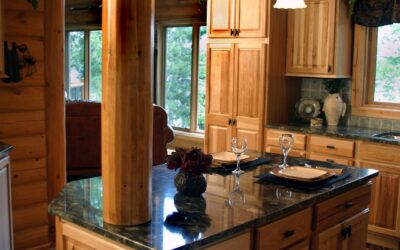
Kitchen islands. Butcher block is most popular as an island countertop. Islands are typically away from the sink (reducing water exposure) and serve as the kitchen’s primary gathering and prep area — where butcher block’s warmth and food-safe surface shine. A butcher block island paired with stone perimeter counters is the most popular combination in 2026 kitchen design.
Dedicated prep stations. A section of butcher block built into a stone countertop layout creates a designated prep and cutting zone that is easier on knives and more comfortable for extended food preparation than stone.
Baking areas. Wood surfaces stay cooler than stone (which absorbs ambient heat), making butcher block ideal for rolling pastry dough. Professional bakers often prefer wood surfaces for this reason.
Bar tops and breakfast nooks. Butcher block’s warm, inviting surface works beautifully for casual dining areas within the kitchen. A raised butcher block bar top adds a furniture-like quality that stone counters do not provide.
For comprehensive guidance on choosing the right flooring to pair with your countertops, visit our kitchen flooring guide.
DIY Installation
Installing butcher block countertops is one of the more accessible DIY countertop projects. The tools and skills required are within reach of moderately experienced homeowners.
- Measure and order. Measure your countertop area and order butcher block with 1 to 2 inches of overhang on all exposed edges. Standard depths are 25 and 30 inches.
- Acclimate the wood. Leave the butcher block in your kitchen for 48 to 72 hours before installation, allowing it to adjust to the room’s temperature and humidity.
- Cut to fit. Use a circular saw with a fine-tooth blade (60+ teeth) for straight cuts. For sink cutouts, drill starter holes in each corner and cut with a jigsaw. Cut from the underside to prevent chipping on the visible surface.
- Sand edges and surface. Sand all cut edges and the top surface with progressively finer grits — 120, 150, and 220. Round over edges slightly for comfort and safety.
- Seal before installation. Apply mineral oil or your chosen finish to all surfaces — top, bottom, edges, and cutout openings. This prevents moisture from entering from any direction.
- Install. Set the butcher block on the cabinet base, check for level, and shim as needed. Secure from underneath using L-brackets screwed into the cabinet frame, with elongated holes that allow wood movement. Never glue butcher block to cabinets — the wood must be able to expand and contract.
- Seal sink and wall joints. Apply a bead of silicone sealant (not caulk) around the sink cutout and the wall backsplash joint to prevent water intrusion.
Frequently Asked Questions
How long do butcher block countertops last?
With proper maintenance, butcher block countertops last 20 to 30 years or longer. The ability to sand and refinish the surface means you can renew the countertop multiple times over its lifetime, effectively extending its usable life indefinitely — as long as the structural thickness is maintained.
Are butcher block countertops sanitary?
Yes. Research from UC Davis found that wood cutting surfaces are actually more sanitary than plastic ones — bacteria penetrate below the wood surface where they cannot multiply and eventually die, while bacteria on scored plastic surfaces remain on the surface and can contaminate food. Regular cleaning with soap and water, combined with periodic sanitizing with vinegar, keeps butcher block countertops hygienically safe.
Can butcher block go around a sink?
Yes, but this is the highest-risk area for water damage. Use an undermount sink (which directs water away from edges), seal the cutout edges thoroughly with multiple coats of mineral oil or polyurethane, apply silicone sealant around the joint, and wipe up standing water promptly. Oil the area around the sink more frequently than the rest of the countertop.
Does butcher block increase home value?
Butcher block adds moderate resale value, particularly in farmhouse, transitional, and eclectic kitchen designs. It is generally valued slightly below granite and quartz in real estate appraisals. The combination of butcher block on the island with stone perimeter counters is viewed favorably by most buyers.
What oil is best for butcher block?
Food-grade mineral oil is the standard recommendation because it is odorless, tasteless, will not go rancid, and is inexpensive. Do not use olive oil, vegetable oil, or coconut oil — these food-based oils eventually turn rancid, creating unpleasant odors and potentially harboring bacteria.
Can I put hot pans on butcher block?
No. Hot pans will scorch butcher block, leaving permanent burn marks that require sanding to remove. Always use trivets or hot pads. This is one area where stone countertops have a clear advantage.
Is butcher block better than quartz countertops?
Neither is better overall, they suit different priorities. Quartz is nonporous, needs no oiling and resists stains and scratches far better, while butcher block costs less in most cases, feels warmer, is easier to install yourself and can be sanded to remove damage. Quartz handles busy sink runs better; butcher block shines on islands and prep zones where its look and repairability matter most.
Is butcher block considered a solid surface countertop?
No, butcher block is solid wood, not a solid surface material. In the countertop trade, solid surface refers to acrylic or polyester products such as Corian that are cast into sheets and joined with nearly invisible seams. Butcher block is laminated hardwood strips, so it behaves like wood: it moves with humidity, needs a finish and can be sanded and refinished.
Does dark or light butcher block show imperfections more?
Dark woods such as walnut show scratches, dust, crumbs and water spots more, because the lighter fibers beneath the surface stand out against the dark color. Light woods such as maple hide fine scratches well but show stains from wine, coffee and oils more easily. Mid-tone species like white oak tend to hide everyday wear best.
Are acacia and hevea good woods for butcher block?
Yes, both are common budget-friendly choices. Acacia is generally hard and dense with bold, varied grain and strong color contrast, so it suits buyers who want a lot of visual character. Hevea, also called rubberwood, is a softer, light-colored hardwood that dents more easily, similar to cherry in hardness. Both need the same oiling or sealing routine as maple.
What lengths do butcher block countertops come in?
Stock butcher block countertops are commonly sold in lengths of about 4, 6, 8, 10 and 12 feet, usually 25 inches deep for standard base cabinets. Island tops and wider slabs are available in deeper sizes, and custom shops make longer pieces. For runs longer than the largest slab, two pieces are joined with a tight seam, ideally away from the sink.
Can you stain butcher block countertops?
Yes, butcher block can be stained to change its color, but it then needs a protective topcoat such as polyurethane or a hardwax oil. Stained and film-sealed tops should be treated as non-prep surfaces, so always use a cutting board. Sand to bare wood first, test the stain on an offcut or the underside, and let each coat cure fully.