
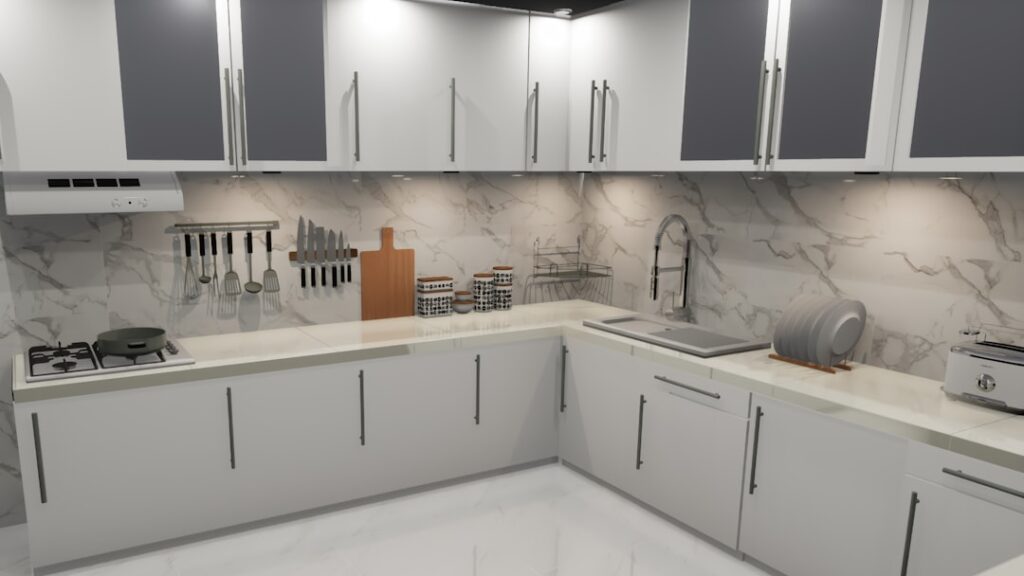
Empty wall space behind a kitchen table or above a coffee station is the easiest decor opportunity in the house, but it is also the one homeowners tend to overstyle. A single oversized print outperforms a wall of tiny mismatched frames every time. Thoughtful kitchen decorations wall design starts with the function of the wall, the existing color palette, and the height at which most people view it from a seated or standing position. The goal is layered visual interest that does not turn into clutter the first time someone leaves a coffee cup nearby.
Part of our Kitchen Remodeling guide — explore the full guide →
- Pick the Wall Before the Decor
- Large-Scale Art as the Anchor
- Open Shelving as Decoration
- Vintage Trays and Cutting Boards
- Signage and Typography
- Functional Decor: Hooks, Racks, and Rails
- Plants That Survive Kitchen Conditions
- Color Palette and Frame Coordination
- Hanging Hardware and Wall Material
- Budget Tiers
Pick the Wall Before the Decor
Three walls in a typical kitchen carry the visual load. The wall behind the breakfast nook, the wall above the coffee bar or beverage station, and the wall that anchors open shelving. A fourth contender is the wall opposite the range — the spot diners and family see when standing at the island. Each wall has a different sight line, which changes what works.
The breakfast nook wall reads from seated eye level (around 48 inches off the floor), so center art at 58 to 62 inches to the artwork’s midline. The coffee bar wall is viewed standing, so center art higher, at 65 to 68 inches. Open shelving styling reads as a whole, so balance the negative space rather than centering individual pieces.
Large-Scale Art as the Anchor
One large piece does more work than five small ones. A 30-by-40-inch framed print, a 36-by-48-inch canvas, or a vintage tray group sized to read as a single block all anchor the wall. Sources worth bookmarking:
- Minted: $90 to $480 for limited-edition prints, customizable framing.
- Juniper Print Shop: $20 to $40 for downloadable files, printed locally for $25 to $80.
- Society6 and Wayfair Custom: $40 to $200 for stretched canvas in big sizes.
- Etsy vintage botanical or food prints: $25 to $150 for original 1950s-1970s pieces, framed.
For most kitchens, food-related themes (still lifes, vintage produce labels, herbal botanicals, classic recipe prints) feel intentional. Skip generic landscape art unless the kitchen opens to a view that justifies it.
Open Shelving as Decoration
Two floating shelves at 24 to 36 inches long, mounted 14 to 16 inches apart, create a mini display zone that doubles as functional storage. Style with three categories of objects: stacked stoneware in a single color (Heath Ceramics, Crate & Barrel, IKEA Dinera), one or two cookbooks standing vertically, and an organic element such as a wooden cutting board or a small terra cotta planter. Leave 30 to 40 percent of each shelf empty for breathing room.
Shelves themselves matter. A 1.75-inch thick solid oak or walnut shelf reads as substantial and pairs with brass or matte black brackets. Avoid the thin 3/4-inch MDF floating shelves that sag within a year under everyday loads.
Vintage Trays and Cutting Boards
Antique brass trays, enamel platters, and hand-carved cutting boards make some of the best kitchen wall decor because they read as functional even when hung. A trio of three different-sized cutting boards from $30 vintage finds at flea markets, or new boards from Boos Block ($60 to $150), creates dimension without the formality of framed art. Hang with French cleats for boards over 5 pounds, or with a single brass screw and a clear safety washer for lighter pieces.
Mix wood tones rather than matching. A walnut board with a maple board and an olivewood board reads richer than three of the same species.
Signage and Typography
Word art has become a tired category, but used sparingly it still works. Skip the “Eat. Drink. Be Merry.” mass-produced signs. Instead, source vintage tin advertising signs from the 1940s and 50s ($25 to $200 from antique malls and Etsy), a custom typographic print of a family-favorite recipe ($30 to $90 from Minted), or a hand-painted wood sign from a local artisan. One sign is plenty. Two starts to read as a country store.
Functional Decor: Hooks, Racks, and Rails
Functional pieces double as decoration. Three high-impact options:
- Wall-mounted pot rail: Schoolhouse Electric, Williams-Sonoma, and Ikea Hultarp sell brass and steel rails at $25 to $140 each. Hang copper pots, brass utensils, and the occasional dried herb bundle.
- Coffee mug rack: A 24-inch wall-mounted mug rail with 8 hooks holds the mug rotation while keeping cabinet space free.
- Magnetic knife strip: A 12- to 18-inch walnut or steel knife strip at $30 to $90 from Wusthof, IKEA, or Williams-Sonoma adds dark contrast against pale walls.
Plants That Survive Kitchen Conditions
Kitchens swing from cool morning to hot cooking temperatures, with a humidity bump every time the dishwasher runs. Plants tough enough to handle it include pothos, philodendron, snake plant, and ZZ plant — all of which tolerate sub-optimal light and irregular watering. A trailing pothos from a wall-mounted brass or terracotta planter ($25 to $90 each) brings green to a wall without taking counter space. Mount the planter at 72 to 84 inches high so the trailing growth fills 18 to 36 inches of vertical wall over a few months.
Real plants beat plastic for any wall over 4 feet wide. The slight movement and texture from a living trail reads as a designed detail.
Color Palette and Frame Coordination
Frame color is the detail that pulls everything together. Three approaches work:
- Monochrome black: Matte black frames against white or cream walls. Modern, graphic, easy.
- Natural wood: White oak or walnut frames warm up a cool-toned kitchen.
- Unlacquered brass: Brass frames pull together brass cabinet hardware and a brass faucet. Patinas over time.
Pick one finish and stick with it across all framed pieces on a single wall. Mixed frame finishes look accidental rather than intentional unless you are a confident stylist.
Hanging Hardware and Wall Material
Different wall types need different anchors. For 1/2-inch drywall, use a Hillman or Toggler self-drilling anchor rated for the load. A 20-pound framed print needs a single 30-pound anchor or two 15-pound anchors. For plaster walls in older homes, drill a 1/8-inch pilot hole first to avoid cracking. Brick and tile backsplashes require Tapcon or masonry anchors plus a hammer drill — never try to drill brick with a standard wood drill bit.
3M Command Strips work for lightweight art under 4 pounds but fail in steamy kitchens within a year as the adhesive softens. Skip them for anything important.
Budget Tiers
- Quick refresh ($60 to $180): One large framed print, three vintage cutting boards, one trailing plant.
- Mid-tier ($300 to $700): Open shelves with curated objects, gallery wall of three coordinated pieces, magnetic knife strip, brass pot rail.
- Designer look ($1,200 to $3,000): Custom-framed limited edition art, custom millwork open shelving, sourced vintage decor, professional installation.
Most homeowners hit the mid-tier setup in a single weekend by combining one big-impact piece, two functional accents, and one organic element.


