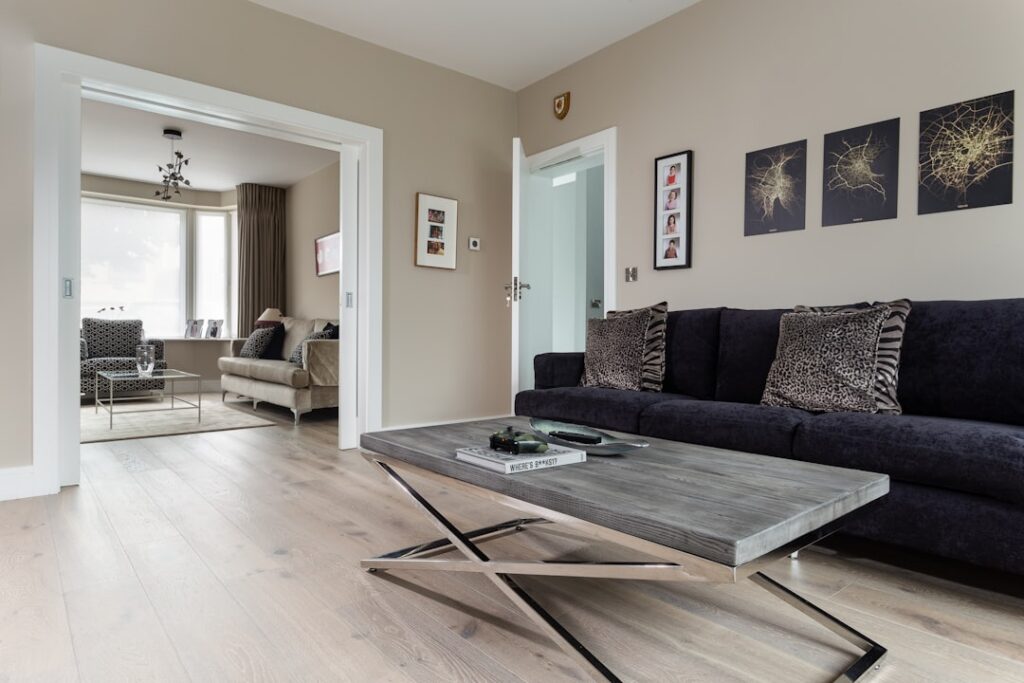
A common search-and-find on home improvement forums goes something like this: “Has anyone installed laminate in their garage?” The replies split between contractors warning against it and homeowners showing photos of two-year-old floors that look pristine. Laminate flooring in garage spaces sits in a gray zone where manufacturer warranties say no, real-world results say sometimes, and the answer depends entirely on how the garage gets used. Understanding the failure modes before installing saves the cost of a do-over.
- Why Manufacturers Don’t Approve It
- When Laminate Actually Works in a Garage
- The Real Garage Flooring Alternatives
- Temperature and Moisture Reality
- Hot Tire Pickup and Chemical Resistance
- If You’re Going to Do It Anyway
- Installation Tips Specific to Garage Use
- Comparing Laminate to Better Alternatives
- The Verdict on Resale Value
Why Manufacturers Don’t Approve It
Standard laminate flooring warranties from Pergo, Mohawk RevWood, Quick-Step, and Shaw exclude installations in spaces with extreme temperature swings, uncontrolled humidity, or direct exposure to automotive fluids. Garages routinely violate all three conditions.
The HDF (high-density fiberboard) core swells when exposed to liquid water, and even minor swelling pops the click joints between planks. Hot tire tracking from a vehicle parked while still warm transfers oils and plasticizers that stain the wear layer. Winter cold below 50 degrees F makes the click systems brittle, leading to cracks at the locking edges when planks are walked on.
When Laminate Actually Works in a Garage
The exception is the converted or man-cave garage: heated, climate-controlled, with no vehicle parking. If you’ve finished out the garage as a home gym, workshop, hobby space, or game room with permanent HVAC service and no automotive use, laminate behaves like any other room.
For these installations, choose products with the highest available wear ratings: AC4 or AC5 laminate from brands like Pergo Outlast+, Mohawk RevWood Plus, or Quick-Step Eligna. Add waterproof construction (Pergo WetProtect or Shaw Repel Plus) for insurance against accidental spills.
The Real Garage Flooring Alternatives
- Epoxy coatings: Two-part epoxy systems from Rust-Oleum EpoxyShield, Behr Premium 1-Part Epoxy, or commercial systems like Sherwin-Williams ArmorSeal. $1.50 to $5 per sq ft DIY, $5 to $12 per sq ft professional.
- Polyaspartic coatings: Faster-curing, more UV-stable alternative to epoxy. $5 to $12 per sq ft installed.
- Interlocking PVC tiles: RaceDeck, SwissTrax, or Greatmats. $3 to $8 per sq ft. No prep, snap together, removable.
- Roll-out rubber or vinyl mats: Costco G-Floor, Park Smart Coin, or RaceMat. $2 to $5 per sq ft. Single-day install over swept concrete.
- Rigid core LVP rated for garage use: Select COREtec Pro and Karndean Korlok products approve garage installation. $3 to $7 per sq ft.
Temperature and Moisture Reality
An unheated attached garage in USDA zone 5 (much of the northern US) sees interior temperatures from 10 degrees F in January to 110 degrees F in August. That 100-degree swing causes 1/16 to 1/8 inch expansion and contraction across a 10-foot run of laminate.
Concrete slabs without proper vapor barriers (anything built before about 1990) typically transmit moisture year-round. ASTM F1869 calcium chloride moisture testing shows 4 to 8 pounds MVER on most older slabs. Standard laminate requires less than 3 pounds MVER and a 6 mil polyethylene vapor barrier, which is barely sufficient for the constant moisture in a slab-on-grade garage.
Hot Tire Pickup and Chemical Resistance
Tires that have been driven on hot pavement reach 150 to 180 degrees F. When that tire parks on laminate, the heat softens the wear layer and the tire compound transfers black marks that don’t come up with normal cleaning. Repeated cycles eventually pull the surface layer off the HDF core.
Motor oil, brake fluid, antifreeze, gasoline, and battery acid all attack the surface finishes of standard laminate. Even brief contact stains the wear layer and seeps into the joints where it reaches the unprotected HDF core. The damage is permanent and not covered by warranty.
If You’re Going to Do It Anyway
For garages that meet the conditioned-space criteria, prepare the substrate carefully. Test moisture with ASTM F1869 calcium chloride or F2170 in-situ probes before any decisions. Install a quality vapor barrier underlayment like Roberts QuietWalk Plus or DMX 1-Step over the concrete.
Maintain interior temperature between 60 and 80 degrees F year-round and relative humidity between 35 and 55 percent. Acclimate the laminate in the install space for a minimum 72 hours before starting. Use 3/8-inch expansion gaps at all walls and any vertical obstructions, with quarter-round or baseboard covering the gap.
Installation Tips Specific to Garage Use
Run planks parallel to the longest wall and stagger end joints by at least 12 inches. Use a tapping block and rubber mallet specifically designed for laminate, not a hammer on the board edges. Click each plank firmly into place before installing the next row.
Where the laminate meets the existing concrete or garage door threshold, install a T-molding or reducer transition. This allows the laminate to expand and contract independently of fixed elements. Never glue or fasten the field of the laminate to the substrate, which defeats the floating installation system.
Comparing Laminate to Better Alternatives
For pure performance and lifespan, epoxy coatings outlast laminate by decades in actual garage conditions. A properly installed two-coat epoxy system from Sherwin-Williams or Rust-Oleum costs $400 to $1,200 for a typical two-car garage and lasts 7 to 15 years before needing recoat. The same garage in laminate runs $2,500 to $5,000 and fails within 2 to 5 years in unconditioned space.
Interlocking PVC tiles from RaceDeck or SwissTrax cost more per sq ft than laminate but install in an afternoon, tolerate temperature swings, resist chemicals, and individual damaged tiles snap out for replacement. The aesthetic looks more “garage” and less “house” than laminate but matches the actual use of the space.
The Verdict on Resale Value
Realtors consistently note that laminate flooring in a garage does not add value to a home and often gets flagged in inspections as a maintenance concern. Buyers expect garages to have concrete (raw, sealed, or coated) or tile flooring. Laminate signals an enthusiast conversion that future owners may need to undo.
If long-term value matters more than aesthetic preference, epoxy coating delivers better return on investment. The exception is fully converted garage-to-living-space projects where the room functions as additional finished square footage.
Laminate flooring in garage spaces works only when the garage isn’t really a garage anymore. For converted, climate-controlled spaces, premium AC4 or AC5 laminate performs well. For working garages with vehicles, temperature swings, and chemical exposure, choose any of the purpose-built alternatives. The right floor matches the actual job the space needs to do.
Prefer to explore on your own?
See how new flooring looks in your actual room in seconds — free, no signup.
Try the free Floor Studio →