
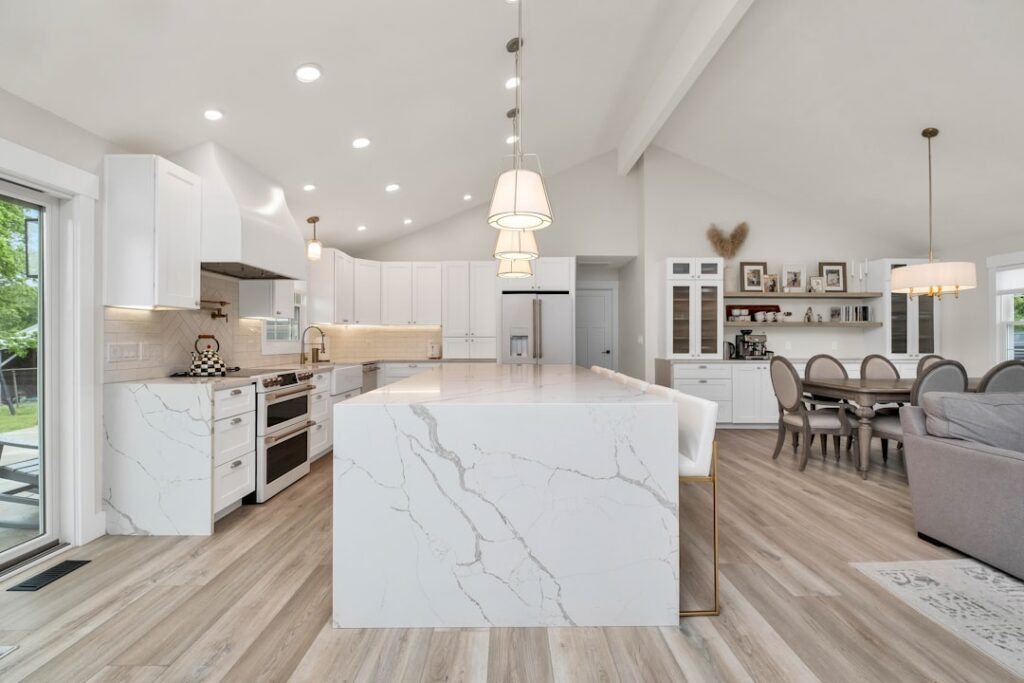
Laminate tile flooring replicates the appearance of ceramic tile, natural stone, and slate using high-definition photographic imaging bonded to a durable HDF (high-density fiberboard) core. Modern laminate tile products have become remarkably realistic, with embossed textures that mimic grout lines, stone veining, and natural surface variation — all while offering the warmth, comfort, and easy installation that laminate is known for.
Part of our Tile & Grout guide — explore the full guide →
This guide covers how realistic today’s laminate tile flooring truly is, the top brands, costs compared to real tile, ideal rooms, and the honest pros and cons you should weigh before buying.
- What Is Laminate Tile Flooring?
- How Realistic Is Laminate Tile Flooring?
- Best Brands for Tile-Look Laminate
- Laminate Tile Flooring Cost
- Laminate Tile vs Real Tile: Complete Comparison
- Pros and Cons of Laminate Tile Flooring
- Best Rooms for Laminate Tile Flooring
- Installation Overview
- Laminate Tile vs LVP Tile: Which Is Better?
- Frequently Asked Questions
What Is Laminate Tile Flooring?
Laminate tile flooring is a type of laminate flooring manufactured to look like ceramic tile, porcelain, natural stone, slate, or travertine. It shares the same four-layer construction as standard laminate — a backing layer for moisture resistance, an HDF core for structural stability, a high-resolution photographic design layer, and a protective wear layer (typically aluminum oxide) for scratch and fade resistance.
The key difference from wood-look laminate is the tile format. Laminate tile products come in square or rectangular tile shapes rather than long planks. Some feature integrated “grout” lines printed and embossed into the design layer, while others use actual grout-colored V-grooves between tiles to enhance the illusion. The most advanced products feature registered embossing technology (EIR), where the surface texture aligns precisely with the printed pattern beneath — so a printed stone crack feels like a crack under your fingertips.
Laminate tile installs using the same click-lock floating floor method as plank laminate. No mortar, no thinset, no grout — the tiles snap together over an underlayment and float freely above the subfloor.
How Realistic Is Laminate Tile Flooring?
The realism of laminate tile flooring has improved dramatically over the past decade, but it still falls short of real tile in certain areas.
Visual realism: 8 out of 10. Premium laminate tile from brands like Quick-Step and Pergo uses high-definition digital printing with multiple unique tile designs per box to minimize pattern repetition. From standing height, the best products are nearly indistinguishable from real stone or tile. The color depth, veining, and tonal variation are impressive.
Texture realism: 7 out of 10. Registered embossing (EIR) creates surface textures that match the printed pattern — a rough slate texture on a slate print, a polished smooth surface on a marble print. The texture is convincing to the touch, though it lacks the cool, dense feel of real stone or ceramic.
Grout line realism: 6 out of 10. This is where laminate tile is most obviously artificial. V-groove edges simulate grout lines, but they do not look or feel like real grout. Some products have improved this with wider, flatter grooves filled with a grout-colored material, but close inspection still reveals the difference.
Temperature and feel: 5 out of 10. Real tile and stone feel cool underfoot due to their thermal conductivity. Laminate feels room temperature or slightly warm because the HDF core insulates. This is actually a benefit for comfort but reduces realism.
Best Brands for Tile-Look Laminate
Not all laminate tile products are equal. These brands consistently produce the most realistic and durable tile-look laminate options.
| Brand | Top Collection | Price (per sq ft) | AC Rating | Key Feature |
|---|---|---|---|---|
| Quick-Step | Exquisa, Impressive Patterns | $3.00 – $5.00 | AC4 | Hydroseal water-resistant joints |
| Pergo | Outlast+ Tile | $2.50 – $4.50 | AC4 | SpillProtect surface technology |
| Armstrong | Alterna (vinyl alternative) | $3.00 – $5.00 | N/A | Groutable for added realism |
| Mannington | Restoration Collection | $3.00 – $4.50 | AC3 – AC4 | Realistic slate and stone looks |
| Faus | Industry Tile | $2.50 – $4.00 | AC5 | Spanish-made, highest AC rating |
Quick-Step leads the laminate tile category with their Exquisa collection, which features large-format tile designs with deep registered embossing and their proprietary Hydroseal technology that creates a water-resistant seal at each joint. The Impressive Patterns collection adds herringbone and chevron tile designs.
Pergo is a strong second choice, offering their Outlast+ line with SpillProtect technology that resists surface moisture for up to 24 hours. Pergo’s stone and tile looks are particularly realistic in their darker color options.
Laminate Tile Flooring Cost
Laminate tile flooring costs significantly less than real tile, which is one of its primary advantages.
| Flooring Type | Material (per sq ft) | Installation (per sq ft) | Total Installed |
|---|---|---|---|
| Laminate tile (budget) | $1.50 – $2.50 | $1.50 – $3.00 | $3.00 – $5.50 |
| Laminate tile (premium) | $3.00 – $5.00 | $1.50 – $3.00 | $4.50 – $8.00 |
| Ceramic tile | $1.00 – $5.00 | $4.00 – $8.00 | $5.00 – $13.00 |
| Porcelain tile | $3.00 – $10.00 | $5.00 – $10.00 | $8.00 – $20.00 |
| Natural stone tile | $5.00 – $20.00 | $6.00 – $12.00 | $11.00 – $32.00 |
For a typical 300-square-foot kitchen, premium laminate tile would cost $1,350 to $2,400 installed, while porcelain tile would cost $2,400 to $6,000 installed. That is a savings of 40% to 60% — a significant difference for homeowners on a budget.
Installation savings are even greater for DIY projects. Laminate tile’s click-lock system requires no special tools, no mortar mixing, and no tile cutting beyond a basic saw. Most homeowners can install 300 square feet in a single weekend.
Laminate Tile vs Real Tile: Complete Comparison
Here is a detailed comparison of laminate tile flooring versus real ceramic or porcelain tile.
| Factor | Laminate Tile | Real Tile (Ceramic/Porcelain) |
|---|---|---|
| Material cost | $1.50 – $5.00 per sq ft | $1.00 – $10.00+ per sq ft |
| Installation cost | $1.50 – $3.00 per sq ft | $4.00 – $10.00 per sq ft |
| DIY difficulty | Easy (click-lock, no wet work) | Moderate to hard (mortar, cutting, grouting) |
| Waterproof | No (water-resistant only) | Yes (fully waterproof) |
| Comfort underfoot | Warm, slight give | Hard, cold |
| Durability | 10 – 20 years | 25 – 50+ years |
| Scratch resistance | Good (AC3 – AC5) | Excellent |
| Resale value | Low to moderate | High |
| Repair | Replace individual tiles (possible) | Replace individual tiles (harder) |
| Underlayment | Required (foam or cork) | Not needed (thinset bond) |
| Radiant heat compatible | Limited (check specs) | Excellent |
Pros and Cons of Laminate Tile Flooring
Pros:
- Warmer and more comfortable — laminate tile feels warmer underfoot than real tile, especially in winter. The HDF core and underlayment provide insulation and slight cushioning.
- Easier installation — click-lock floating installation requires no mortar, grout, thinset, or special tools. A weekend DIY project for most homeowners.
- Lower cost — 40% to 60% less than equivalent porcelain or natural stone, with even greater savings on installation labor.
- Lighter weight — laminate tile weighs far less than ceramic or stone, making it suitable for upper floors where subfloor load capacity is a concern.
- Realistic appearance — premium brands achieve near-photorealistic stone and tile looks from normal viewing distances.
Cons:
- Not waterproof — the HDF core will swell and delaminate if soaked with standing water. Water-resistant treatments help but do not make laminate tile fully waterproof.
- Less durable long-term — laminate tile lasts 10 to 20 years versus 25 to 50+ years for real tile. It cannot be refinished.
- Hollow sound — floating laminate tile can sound hollow underfoot compared to mortar-set tile. Quality underlayment reduces this but does not eliminate it.
- Lower resale value — real estate agents and appraisers generally value real tile higher than laminate tile alternatives.
- Cannot get wet — unsuitable for full bathrooms with showers, wet rooms, or outdoor applications where standing water is likely.
Best Rooms for Laminate Tile Flooring
Laminate tile flooring works best in dry to moderately dry areas where you want the look of tile without the cost, coldness, or installation complexity.
Kitchens — laminate tile is popular in kitchens because it provides the stone or tile look homeowners want while being warmer and more comfortable for standing and cooking. Use water-resistant varieties (Quick-Step Hydroseal or Pergo Outlast+) and wipe up spills promptly.
Dining rooms and living rooms — these rooms see minimal moisture exposure, making them ideal for laminate tile. The stone look adds elegance without the coldness of real tile.
Entryways and foyers — tile-look laminate in a slate or travertine pattern creates a strong first impression. Choose AC4 or AC5 rated products for high-traffic entryways.
Basements (with caution) — only if the basement is dry and climate-controlled. Laminate tile is not suitable for basements with any moisture issues. For damp basements, luxury vinyl plank is a safer choice.
Avoid in full bathrooms — the humidity, splashing, and potential for standing water make bathrooms risky for laminate tile. Half bathrooms (powder rooms) with minimal water exposure are borderline acceptable.
Installation Overview
Installing laminate tile flooring follows the same basic process as plank laminate with a few tile-specific considerations.
Subfloor preparation: The subfloor must be clean, dry, flat (within 3/16″ per 10 feet), and structurally sound. Concrete subfloors require a 6-mil polyethylene vapor barrier. Plywood subfloors do not need a vapor barrier but may need leveling compound for low spots.
Underlayment: Install a foam or cork underlayment (2mm to 3mm thick) for sound absorption and minor leveling. Some laminate tile products include an attached underlayment pad — do not double up if yours already has one.
Layout: Dry-fit the first two rows without clicking them together to plan your layout. Stagger tile joints by at least 6 inches between rows. For square tiles, offset rows by half a tile width for a running bond pattern.
Expansion gaps: Leave a 1/4″ to 3/8″ gap around all walls, pipes, and fixed objects. Laminate expands and contracts with temperature and humidity changes. Cover gaps with baseboards or quarter-round trim.
Cutting: Use a miter saw, circular saw, or jigsaw with a fine-tooth blade. For curved cuts around door frames or pipes, a jigsaw is essential. Measure twice and cut once — laminate tile cannot be reattached once cut.
Laminate Tile vs LVP Tile: Which Is Better?
If you want a tile look without using real tile, you have two main options: laminate tile and luxury vinyl plank/tile. Here is how they compare.
| Factor | Laminate Tile | LVP/LVT Tile |
|---|---|---|
| Waterproof | No | Yes |
| Realistic texture | Good (EIR technology) | Good to excellent |
| Scratch resistance | Better (harder surface) | Good (depends on wear layer) |
| Dent resistance | Better (rigid HDF core) | Can dent under heavy furniture |
| Comfort | Good | Better (softer, quieter) |
| Cost | Similar ($2 – $5 per sq ft) | Similar ($2 – $6 per sq ft) |
| Best rooms | Dry rooms only | Any room including bathrooms |
For most homeowners in 2026, LVP/LVT tile has become the preferred alternative to real tile because it is fully waterproof. Laminate tile still wins on scratch resistance and rigidity, but the waterproof advantage of vinyl tile is decisive for kitchens, bathrooms, and basements.
Frequently Asked Questions
Is laminate tile flooring waterproof?
No. Laminate tile flooring is water-resistant but not waterproof. The HDF core will swell and delaminate if exposed to standing water for extended periods. Premium products with sealed joints (like Quick-Step Hydroseal) resist spills for up to 24 hours, but they are not suitable for wet areas like full bathrooms or outdoor applications.
Can laminate tile be used in a bathroom?
Only in half bathrooms (powder rooms) where moisture exposure is minimal. Full bathrooms with showers or bathtubs generate too much humidity and splash water for laminate tile. Use porcelain tile or waterproof luxury vinyl tile in full bathrooms instead.
How long does laminate tile flooring last?
Laminate tile flooring lasts 10 to 20 years depending on the AC rating, traffic levels, and how well it is maintained. AC4-rated products in moderate-traffic areas can reach the 20-year mark. Real tile lasts 25 to 50+ years by comparison.
Does laminate tile look fake?
Premium laminate tile from brands like Quick-Step and Pergo looks remarkably realistic from standing height. Budget products with low-resolution printing and no embossing can look obviously fake. The main giveaway is the grout lines — laminate tile’s V-groove joints do not perfectly mimic real grout. Spending more on a premium product makes a significant difference in realism.
Can you grout laminate tile?
Standard laminate tile cannot be grouted because it is a floating floor that must be free to expand and contract. A few specialty products (like Armstrong Alterna) are designed to be grouted, but these are technically vinyl rather than true laminate. If real grout lines are important to you, consider real tile or groutable vinyl tile instead.
Is laminate tile flooring cheaper than real tile?
Yes. Laminate tile costs $3 to $8 per square foot installed, while porcelain tile costs $8 to $20 per square foot installed. The savings come from both lower material costs and significantly lower installation labor costs, since laminate tile requires no mortar, thinset, or grouting.
Prefer to explore on your own?
See how new flooring looks in your actual room in seconds — free, no signup.
Try the free Floor Studio →

