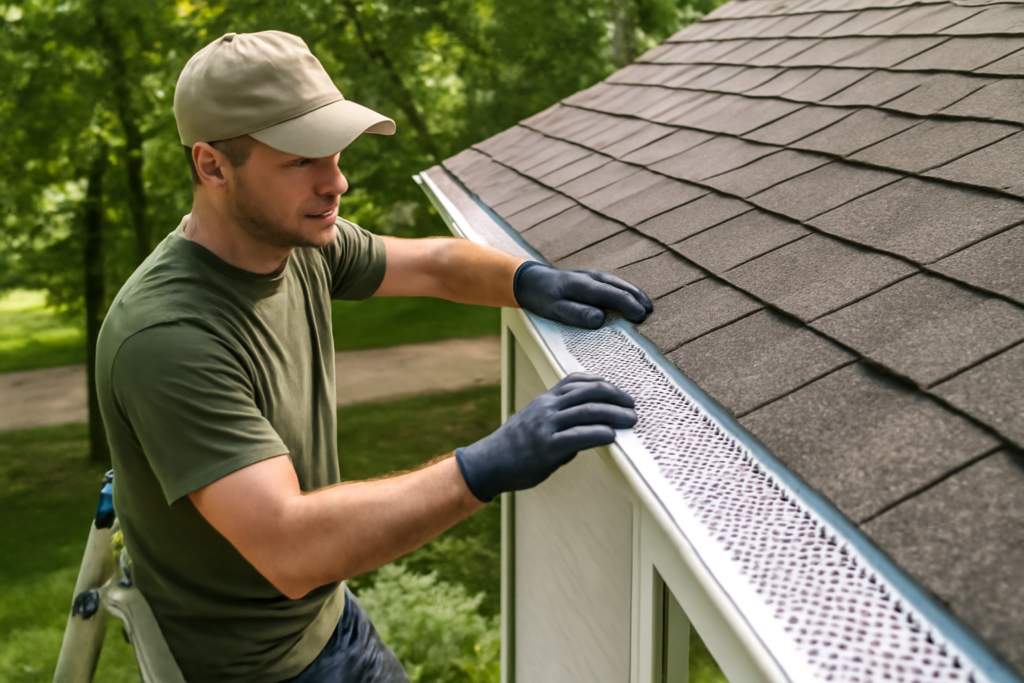
LeafFilter gutter guards are the most heavily advertised leaf-protection system in the country, and that marketing muscle is exactly why homeowners ask me whether they’re worth the premium price. The short answer: the product itself is genuinely good, but you pay top dollar for it. This guide breaks down how the system actually works, what it costs, where it shines, and where you might do just as well with a cheaper option.
How the System Works
LeafFilter is a micromesh guard — a fine surgical-grade stainless steel mesh, 275 microns, mounted on a rigid uPVC frame. The mesh sits over your existing gutter and screws into the front lip. Water passes through the tiny openings while leaves, pine needles, shingle grit, and even roof sand ride over the top and blow off. That micron rating is the key spec: it’s fine enough to block the pine needles and seed pods that defeat cheaper screen and reverse-curve guards. The frame pitches the mesh forward so debris sheds instead of piling up.
What LeafFilter Costs
This is where people flinch. LeafFilter runs roughly $17 to $43 per linear foot installed, with most jobs landing around $20 to $30 per foot. On an average single-story home with 200 feet of gutter, that’s $4,000 to $6,000. A two-story home with more complex rooflines can push past $8,000. For comparison, big-box micromesh guards you install yourself run $2 to $4 per foot in materials. You are paying a large premium for professional installation, the brand, and the warranty — not for a fundamentally different mesh.
One negotiating note from the field: LeafFilter’s in-home sales reps almost always open high and have room to come down. The quoted price is rarely the final price if you don’t sign on the first visit.
The Warranty
LeafFilter’s headline feature is a lifetime transferable “no clog” warranty. If the gutters clog while the guards are installed, they’ll come clean them out at no charge, and the warranty transfers to the next homeowner if you sell — a real resale talking point. Read the fine print, though: the warranty covers clogging, not every possible water issue, and it requires professional installation by LeafFilter to stay valid. You can’t buy the panels and self-install without voiding it.
What Drives the Price on Your Home
The per-foot number swings based on factors the ad never mentions. Gutter footage is the obvious one, but roof height matters as much — a two- or three-story home means more setup, safety equipment, and labor time, pushing you toward the top of the $17 to $43 range. Complex rooflines with lots of valleys, dormers, and corners add cut time and waste. If your existing gutters need repair, realignment, or resealing before the guards go on, that’s folded into the quote too. Gutter size plays in as well; oversized 6-inch commercial-style gutters cost more to cover than standard 5-inch K-style. When you compare quotes, make sure each one covers the same scope so you’re not comparing a bare guard install against one that includes gutter reconditioning.
Installation and What to Expect
A professional crew does most homes in a single day. Before the mesh goes on, they clean and realign your existing gutters and reseal end caps and miters as needed — that prep is part of the value, since guards over sagging, leaking gutters just trap problems. The panels cut to length and screw down along the front. There’s no roof-shingle intrusion; LeafFilter mounts to the gutter itself, which matters because some competitor systems slide under your first row of shingles and can affect a roofing warranty. Ask the rep to confirm they’re not lifting shingles.
Does It Handle Heavy Rain?
This is the fair knock on any very fine mesh, and it’s worth understanding before you buy. Because 275-micron openings are small, water has to slow down and soak through rather than pour in. In an ordinary rain that’s a non-issue, but in a torrential downpour a fully saturated mesh can let some water sheet over the leading edge before it filters through, so you may see a little overshoot at the roofline during the heaviest cloudbursts. In practice the forward pitch of the panel and a clean mesh minimize it, and it’s a minor trade for keeping every needle and seed out of the gutter year-round. If you live somewhere with frequent intense storms, ask the rep specifically how the pitch is set on your roof to shed heavy flow.
Where LeafFilter Shines
- Pine needles and fine debris. The 275-micron mesh handles what screen guards can’t. If you’re under pines or oaks, this is the category of guard you want.
- You’re done climbing ladders. For older homeowners or two-story homes where cleaning is genuinely dangerous, paying for a professional install and a hands-off warranty is money well spent.
- Resale. The transferable warranty is a documented selling point most guards can’t match.
Where It Falls Short
- Price. You can get 90% of the performance from a self-installed micromesh guard at a fraction of the cost if you’re comfortable on a ladder.
- Not truly maintenance-free. No guard is. Fine grit and pollen can build a film on any micromesh over years, and in heavy downpours a very fine mesh can cause some water to sheet over the front edge before it soaks through. A light rinse every year or two keeps flow up.
- High-pressure sales. The in-home pitch is aggressive, with “today only” pricing. Get it in writing and don’t be rushed.
LeafFilter vs. the Alternatives
Against reverse-curve guards like Gutter Helmet, LeafFilter’s micromesh generally does better with fine debris and can’t shoot water past the gutter in heavy rain the way surface-tension designs sometimes do. Against cheap plastic screen guards from the hardware store, there’s no contest on debris blocking — but those screens cost a tenth as much and work fine under maple leaves without pine needles. Against DIY micromesh brands, the mesh quality is comparable; you’re mainly buying installation and warranty. If your gutters are in good shape and you’ll climb a ladder once a year, a $600 DIY micromesh job does most of what a $5,000 LeafFilter job does.
Maintenance Over the Long Haul
Any company selling “never clean your gutters again” is overpromising, and LeafFilter is no exception. The mesh itself won’t clog with leaves, but two things still happen over years of service. First, a thin film of pollen, roof grit, and organic residue can build on the surface of the mesh, slowly reducing how fast water passes through. A gentle rinse with a garden hose — never a pressure washer, which can dent the frame or push debris into the mesh — restores flow. Second, debris that sheds off the mesh still lands somewhere; in valleys and against dormers, leaf piles can accumulate on top of the guards and need a brush-off once or twice a year. That’s a far cry from scooping wet muck out of open gutters, but it isn’t zero. Plan on a quick visual check each fall.
Questions to Ask the Rep
Before you sign anything, get clear answers to a short list. Confirm the mesh is stainless steel and ask for the micron rating in writing. Ask whether installation touches your shingles at all, since roof-warranty conflicts are avoidable. Get the exact warranty terms on paper, including what “no clog” covers and what voids it. Ask what gutter prep is included — cleaning, realignment, resealing — and whether any of it costs extra. Finally, ask for the price to stay valid for at least a week so you can gather competing bids without the pressure of a same-day discount. A reputable installer won’t balk at any of that.
Is It Worth It?
LeafFilter gutter guards earn their reputation on product quality and a strong warranty, and for the right buyer — heavy fine debris, a tall or steep roof, no interest in ladder work, and value placed on a transferable guarantee — the premium is defensible. If you’re budget-focused and handy, a self-installed micromesh guard gets you comparable protection for far less. Either way, get at least two competing quotes, insist the price and warranty terms are in writing, and never sign under first-visit pressure. The guards are a good product; just make sure you’re paying a fair number for them.