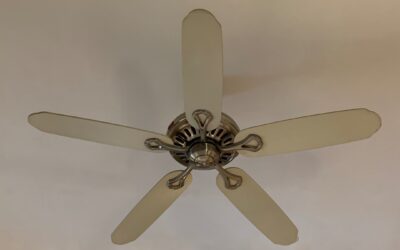
Walk the fan aisle today and the bulb socket is disappearing: most new fixtures ship with a sealed LED panel built into the housing instead of screw-in lamps. An integrated LED ceiling fan buys you slimmer profiles, higher efficiency, and dimming smoothness no bulb kit matches — and it introduces one question older fans never raised: what happens when the light dies and there’s no bulb to change? That trade sits at the center of every buying decision in this category, so let’s give it the honest treatment along with the specs that actually matter.
- Integrated vs. Bulb-Based: What Actually Changed
- Reading the Light Specs: Lumens and Kelvin
- Dimming: Where Integrated LEDs Earn Their Keep
- The Replaceability Question, Answered Honestly
- Sizing and Placement Still Rule
- What They Cost and Who Makes Good Ones
- The Energy Math, Run Honestly
- Smart Features Worth Paying For
- Installation Differences From a Standard Fan
- Buy It or Skip It
Integrated vs. Bulb-Based: What Actually Changed
A traditional fan lights the room through a ceiling fan light kit holding two to four replaceable bulbs under glass shades. Integrated fans replace all of that with a factory-sealed LED array and driver, usually behind a frosted acrylic lens. The gains are real: flush low-profile housings (critical under 8-foot ceilings), even edge-to-edge light with no bulb shadows, 15 to 30 watts doing the work of 150+ incandescent watts, and rated lifespans of 25,000 to 50,000 hours. The loss is serviceability — the light engine is a component of the fan, not a consumable inside it.
Reading the Light Specs: Lumens and Kelvin
Ignore watts; buy lumens. Integrated fans typically deliver 800 to 2,200 lumens, and the right number depends on the room and whether the fan is the primary light source. Rough targets: 800 to 1,100 lumens supplements other lighting in a bedroom; 1,500 or more is the floor when the fan is the room’s main fixture; great rooms want 2,000-plus or additional lighting. Color temperature matters just as much — 2700K–3000K reads warm and residential, 4000K reads office-neutral, 5000K reads garage. The best current fixtures offer CCT-selectable panels (a 3000K/4000K/5000K switch on the remote or under the canopy), which future-proofs the choice and is worth prioritizing when two models are otherwise equal.
Dimming: Where Integrated LEDs Earn Their Keep
Factory-matched driver and diode is why integrated fans dim better than any bulb retrofit — smooth 10-to-100-percent ramps with no flicker, controlled from the fan’s own remote rather than a wall dimmer. That last detail is a rule, not a preference: the LED driver expects full-time power and does its own dimming, so a standard wall dimmer on the supply line causes flicker, buzz, and premature driver failure. Wire the fan to constant power (or a plain toggle) and dim via the included remote, the brand’s wall control, or the app on smart models. Fans with DC motors typically pair the best dimming with six-plus speeds and 70 percent lower motor draw, which is why DC-plus-LED has become the premium combo.
The Replaceability Question, Answered Honestly
Sealed light engines are rated for 25,000 to 50,000 hours — 15 to 30 years at typical use — but electronics fail on a curve, and the driver usually dies before the diodes. So ask three things before buying. First, warranty split: motors often carry lifetime coverage while the LED and electronics get 1 to 3 years (Hunter and Minka-Aire, for instance, cover electronics much shorter than motors). Second, parts availability: better brands sell replacement light engines and drivers for $30 to $80, turning a failure into a four-screw swap — check the brand’s parts store for your model before checkout. Third, worst case: on bargain fans with no parts channel, a dead panel means a dead light permanently, which is a strong argument for spending $50 more on a brand with a real parts catalog, or simply choosing a bulb-based fan where longevity trumps sleekness.
Sizing and Placement Still Rule
LED or not, fan physics is unchanged: 44-inch spans for rooms under 144 square feet, 52 inches for 144 to 225, 60-plus for larger rooms, with blades 8 to 9 feet off the floor for ideal airflow and never below 7. Integrated LED fans dominate the hugger and low-profile segment because deleting the bulb housing saves 4 to 6 inches of drop — the honest reason to buy one under an 8-foot ceiling. On sloped or high ceilings, use the matching downrod and note that light spread widens usefully with mounting height. Damp-rated integrated models handle covered porches; look for the UL damp listing rather than assuming.
What They Cost and Who Makes Good Ones
Entry integrated models run $80 to $150 from house brands, and this is the tier where the no-parts worst case lives. The $150–$350 mid-band — Hunter’s Dempsey line, Minka-Aire’s Light Wave, various Fanimation and Craftmade models — adds CCT selection, DC motors on many SKUs, and actual replacement-part support. Above $350 you’re into designer housings and smart integration (Modern Forms, Big Ass Fans’ Haiku family) where the LED arrays are excellent and the app control is native. Across every tier, the spec sheet tells you more than the brand: lumens, CCT options, dimming range, warranty split, and a searchable parts store are the five lines worth reading.
The Energy Math, Run Honestly
Efficiency claims deserve numbers. A conventional AC-motor fan draws 60 to 75 watts on high; DC motors do the same work at 20 to 30. On the light side, an 18-watt integrated panel replaces the 240 watts a four-bulb incandescent kit once burned, or the 36 watts of its LED-bulb retrofit. Run fan and light 8 hours a day through a six-month season at the national average near $0.16 per kWh and a DC-motor integrated fan costs roughly $18 to $25 a year against $45 to $60 for the old AC-plus-incandescent setup. The bigger money is indirect: a fan’s wind-chill effect lets most households raise the thermostat 2 to 4°F in summer, worth 4 to 8 percent on cooling bills — but only in occupied rooms, since fans cool people, not air. An LED ceiling fan spinning in an empty room is pure spend.
Smart Features Worth Paying For
Smart control has moved from gimmick to genuinely useful on integrated fans, with a clear hierarchy. Worth it: native app scheduling (fan on before you get home), breeze modes that vary speed to mimic natural air, walk-away timers, and Alexa, Google, or HomeKit voice control on fans you’d otherwise fumble a remote for. Sometimes worth it: adaptive modes pairing a temperature sensor to speed, which work well in bedrooms. Rarely worth it: proprietary hubs on budget fans — an $89 fan demanding its own bridge and abandoned app is a downgrade from a pull chain. The durable pattern is buying fans that speak an open standard (HomeKit, Matter as it spreads) or pairing an ordinary fan with a Bond bridge or Caséta control, so the smart layer outlives any one manufacturer’s app enthusiasm. As ever, confirm the receiver is a listed replacement part; smart or dumb, that little module remains the most likely component to die first.
Installation Differences From a Standard Fan
Hanging an integrated fan follows the standard playbook — fan-rated box, matched downrod, balanced blades — with two wrinkles worth knowing in advance. First, canopy space: the remote receiver that runs the LED driver and motor lives in the canopy on most models, and older shallow ceiling boxes leave it a tight fold; take your time seating wires so nothing pinches, because a pinched receiver antenna is the classic source of flaky remote range. Second, wiring intent: since the fan expects constant power with control at the remote, cap the ceiling’s blue light-hot lead (if present) per the manual and feed the unit from the always-hot or a plain switch — wiring both switched legs the old way confuses some receivers. The good news runs the other direction: integrated fans are typically 2 to 5 pounds lighter than bulb-kit equivalents, and low-profile models skip the downrod assembly entirely, making them one of the easier one-person fan installs.
Buy It or Skip It
Choose an LED ceiling fan when you want a low-profile fixture, the cleanest dimming available, or a modern housing no bulb kit can match — and buy it from a brand that sells the light engine as a spare part. Stick with a bulb-based fan when 30-year serviceability with $5 parts matters more than slimness, or when the fan sits somewhere replacing the whole fixture would be a genuine project. Both are good fans; only one can be fixed with off-the-shelf ceiling fan light bulbs, and knowing which trade you’re making is the whole game.